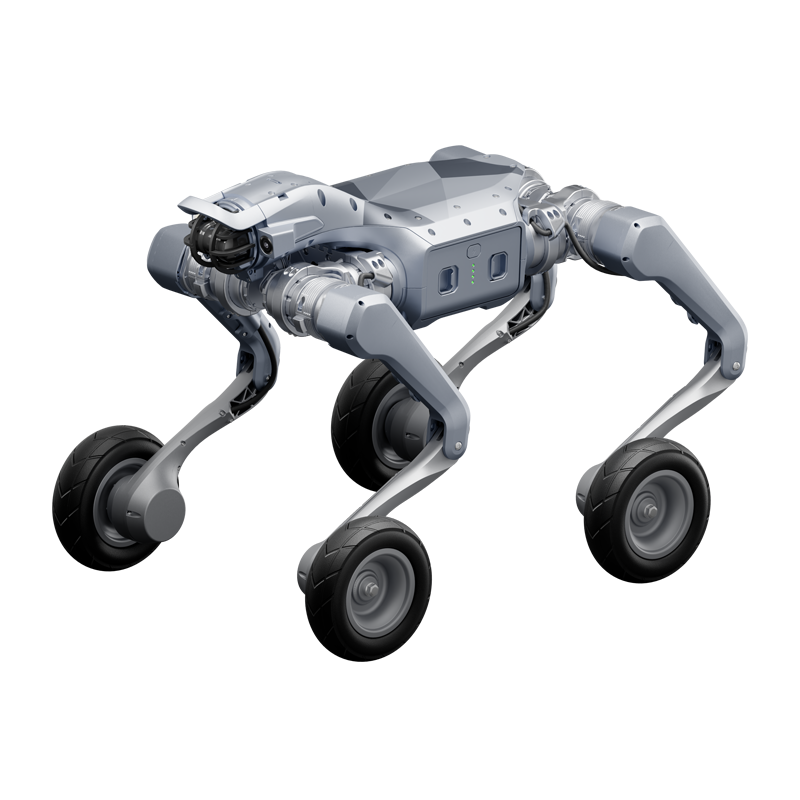
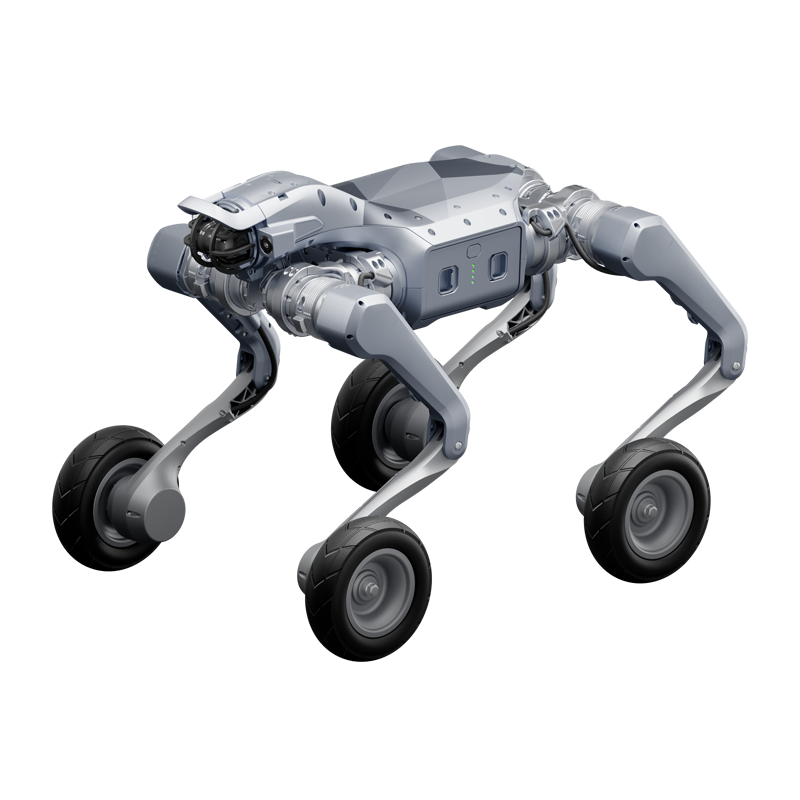
Unitree has announced the AS2-W (Super Athlete) — a hybrid wheeled-legged robot that combines high-speed movement on flat surfaces with exceptional traversability on rugged terrain.

What Happened
Unitree released the AS2-W model, weighing approximately 25 kg, capable of reaching speeds up to 6 m/s (peaking at 30 km/h) and overcoming obstacles up to 80 cm high. The robot has a range of over 30 km when unloaded, can carry a payload of up to 16 kg, and is equipped with industrial sensors, including LiDAR and HD cameras. For computation, expansion modules are provided that support up to 150 TOPS (e.g., NVIDIA Orin NX).
Context
The development of a hybrid wheeled-legged base aims to solve a classic robotics problem: the compromise between efficient road movement and the ability to traverse complex off-road terrain. The integration of high-performance chips makes the platform ready for on-board Embodied AI processing.
Why It Matters for the Industry
The release of the AS2-W provides developers with a powerful hardware layer for testing control algorithms and visual perception in real-world field conditions. This accelerates the transition from laboratory prototypes to commercial solutions in sectors such as autonomous delivery, industrial monitoring, and infrastructure inspection.
Why It Matters for Users
For practical applications, this means the emergence of mobile devices capable of independently performing tasks in mountains, on stairs, and off-road for several hours, becoming useful tools for logistics and monitoring hard-to-reach objects.
What Is Not Yet Known / Limitations
There are varying assessments of the product's readiness: from being perceived as a universal platform to skepticism regarding reliability during long-term operation in real-world conditions, as well as questions regarding safety and integration for the enterprise sector.
Sources
Author
Look at AI, Editorial Team