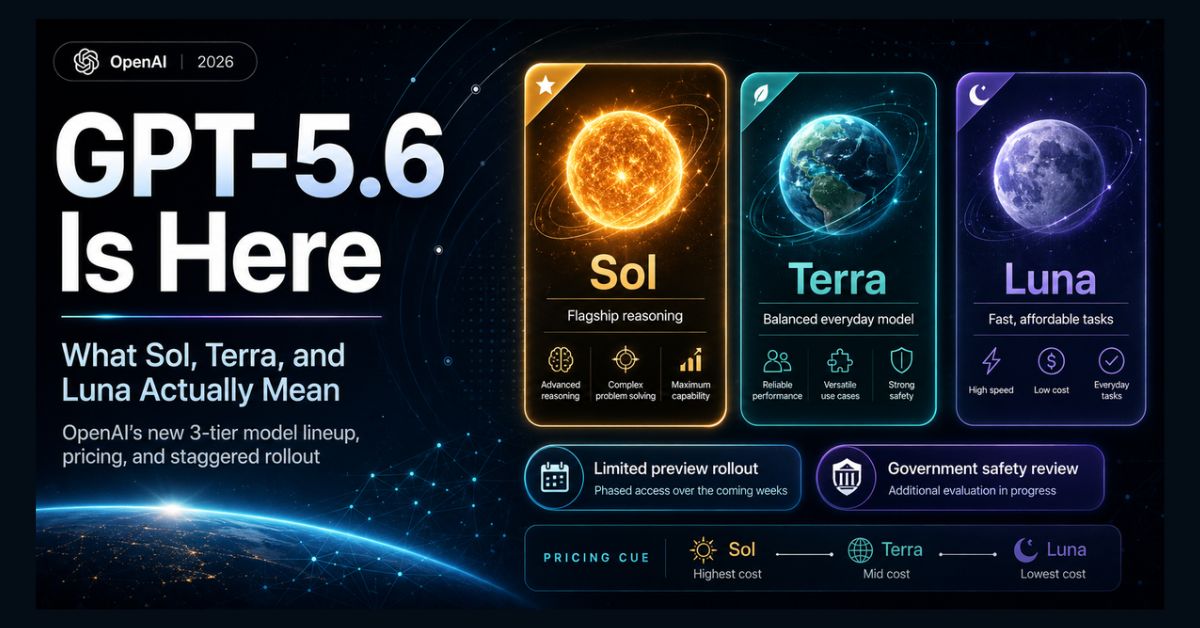
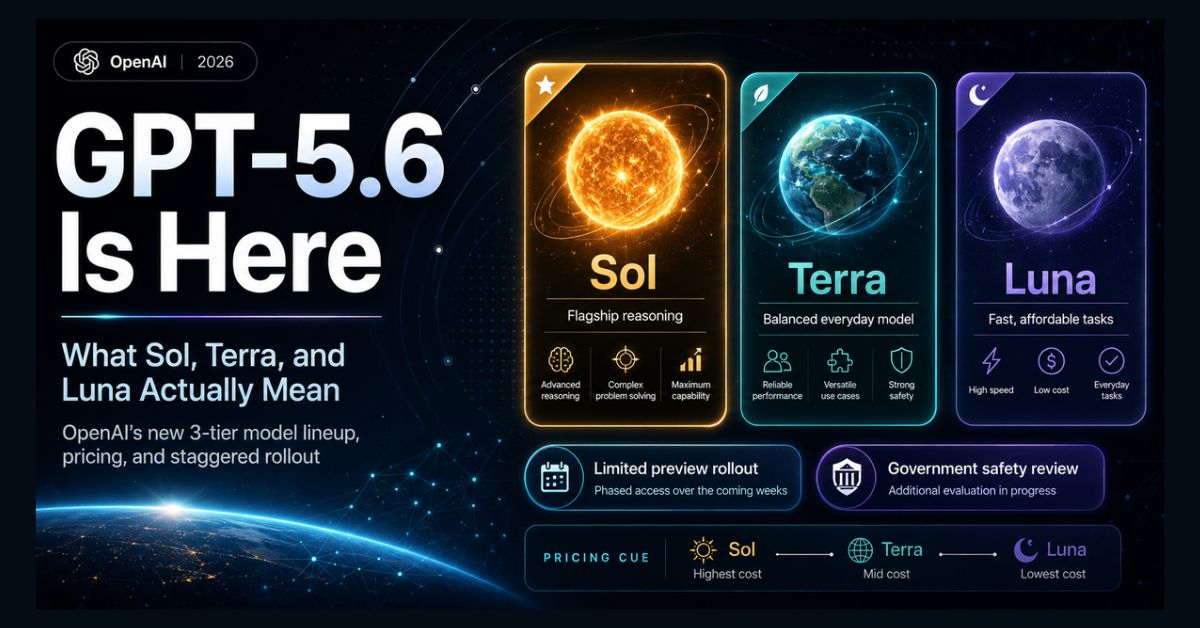
OpenAI has shifted its model release strategy, introducing the GPT-5.6 lineup instead of a single universal flagship. The new family includes the high-performance Sol for complex reasoning, the balanced Terra, and the high-speed Luna, marking a transition toward a specialized AI agent architecture.

What Happened
OpenAI released the GPT-5.6 model family, consisting of three tiers: the flagship Sol, the balanced Terra, and the high-speed Luna. The Sol model is focused on complex agentic tasks and coding, though users have noted a significant slowdown in performance compared to Terra. Meanwhile, Terra demonstrates performance levels comparable to GPT-5.5 while offering twice the lower cost.
Context
The new architecture implements deep reasoning mechanisms (Max Reasoning) in the Sol model and optimized prompt caching. Instead of a "one flagship for all" approach, OpenAI is implementing segmentation, allowing for a more precise alignment of task computational complexity with costs.
Why It Matters for the Industry
For the industry, this signifies a radical change in the economics of AI applications. The shift to a segmented lineup stimulates the development of multi-tier agentic systems, where different tasks are delegated to models with the optimal balance of price, speed, and intelligence. This creates new standards for agentic systems through the implementation of Max Reasoning mechanisms and routing optimization.
Why It Matters for Users
Users and developers should reconsider their pipeline architectures: when top-tier models slow down, it is worth switching to lighter versions like Terra, which maintain high quality with significantly higher speed and lower cost. In the future, this will enable the use of the Router Agent pattern for dynamic task distribution between Sol, Terra, and Luna.
What Is Not Yet Known / Limitations
It remains to be verified whether Max Reasoning represents a qualitative leap in reasoning architecture or simply an increase in computational expenditure.
Sources
Author
Look at AI, Editorial Staff