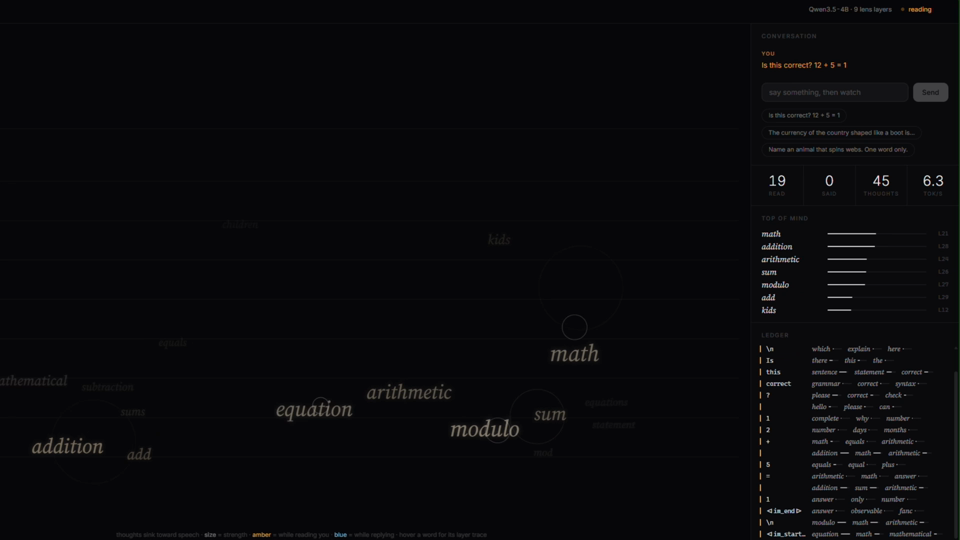
The open-source project Subtext has been introduced, allowing for the observation of language model reasoning processes through the visualization of their internal states before the text response is generated.

What Happened
Developers have released Subtext, a tool that utilizes the Jacobian lens method to display how concepts and words are formed within the neural network's hidden layers. The system operates continuously during a dialogue, allowing for the tracking of the model's intermediate "thoughts" at various architectural levels before they are converted into tokens.
Context
The project is based on the Jacobian lens method developed by specialists at Anthropic. This approach belongs to the field of mechanistic interpretability, which aims to make neural network operations less like a "black box," allowing researchers to understand the internal logic of models.
Why It Matters for the Industry
For the industry, this project opens new possibilities in the fields of AI Observability and Trust. It demonstrates the practical application of interpretability methods for monitoring planning and reasoning processes, which is critical for debugging complex agents and creating systems capable of more predictable behavior.
Why It Matters for Users
Users and developers gain the ability to see the "behind the scenes" of AI operations. This helps in better understanding how a model maintains context and forms judgments, simplifying the prompt debugging process and helping to understand the causes of hallucinations.
What Is Not Yet Known / Limitations
At the current stage, Subtext is a research demo project. Machine learning specialists and enterprise AI architects indicate that the tool is not yet ready for full-scale exploitation in production environments.
Sources
Author
Look at AI, Editorial Staff