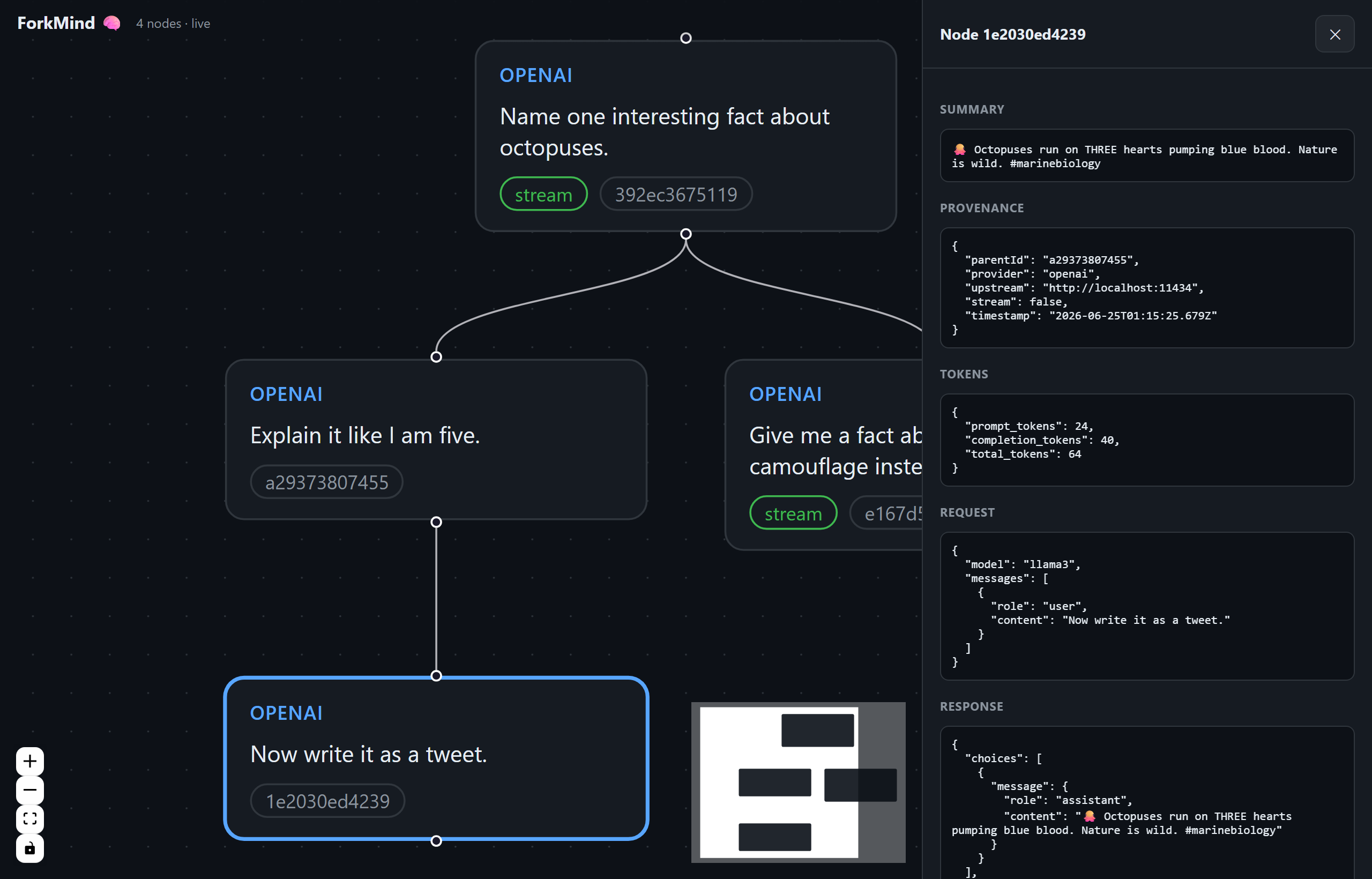
ForkMind has been introduced, bringing engineering discipline to working with Large Language Model context by using branching and state management mechanisms similar to Git.

What Happened
ForkMind has been released—a local tool for managing LLM state. It allows users to visualize dialogues as a Directed Acyclic Graph (DAG), create branches for testing different prompts or model parameters, and perform regression testing on responses. The project supports any OpenAI-compatible APIs, including Ollama and Groq, and provides an MCP server for integration with AI agents.
Context
Developing complex agentic systems and tool-calling chains requires precise control over context and versions of system instructions. Traditional logging does not provide the ability to effectively "roll back" or perform isolated testing of changes, which makes debugging multi-step reasoning difficult.
Why It Matters for the Industry
ForkMind addresses a critical problem in debugging agentic workflows by allowing a transition from simple logging to managed state graphs. In the long term, this could contribute to the standardization of context management approaches and the implementation of context versioning tools into CI/CD pipelines for automated testing of LLM responses.
Why It Matters for Users
AI agent developers and LLM enthusiasts gain the ability to test hypotheses in isolation (e.g., changing system prompts) without losing the current context. The tool accelerates the debugging cycle and allows for automated quality checks of responses when updating models or instructions.
What Is Not Yet Known / Limitations
The tool's architecture is oriented toward local-first use, which may limit its application in the enterprise sector, where more advanced support for teamwork is required.
Sources
Author
Look at AI, Editorial Team