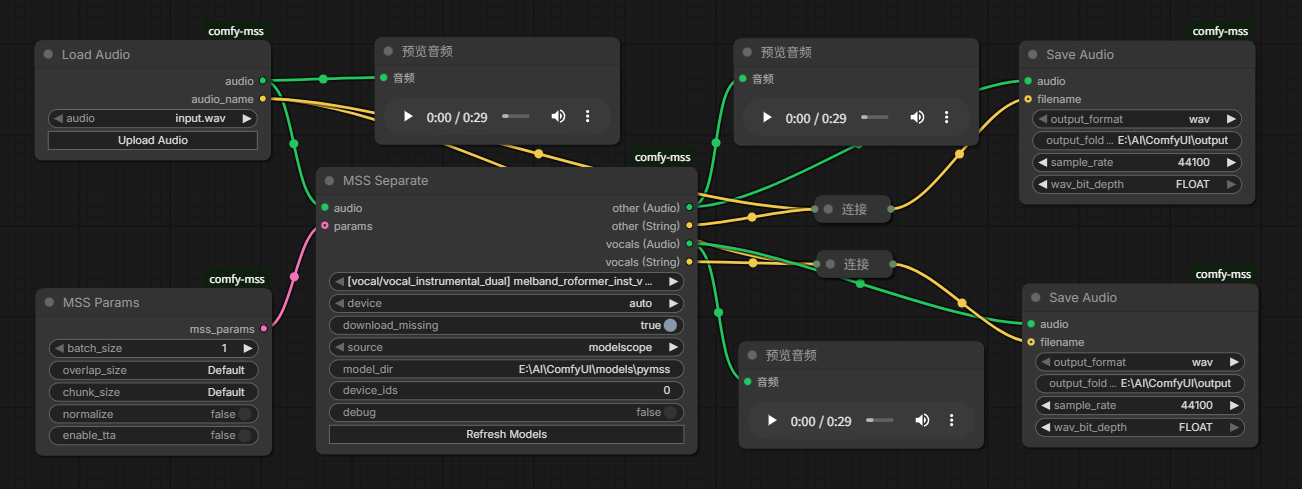
A new package, Comfy-MSS, has been released, allowing the use of the pymss library's capabilities to separate music tracks into individual stems directly within ComfyUI workflows.

What Happened
Developers have introduced Comfy-MSS—a set of custom nodes for ComfyUI that integrates the pymss library (version 2.0.14). The tool allows users to load audio, manage model parameters, ensemble results, and save files in wav, flac, and mp3 formats. The package supports models such as BS-Roformer, HTDemucs, and UVR, and provides hardware acceleration via CUDA for NVIDIA systems and MLX for Apple Silicon chips.
Context
Traditionally, implementing source separation (stem separation) tasks required using separate scripts or specialized software. Comfy-MSS moves these complex processes into the format of automated nodes within the ComfyUI graph interface, allowing high-performance audio processing to be embedded into general multimodal neural network pipelines.
Why It Matters for the Industry
The integration of such tools expands the possibilities of generative art by allowing seamless audio separation to be embedded into multimodal projects. This promotes the standardization of audio processing within the ComfyUI ecosystem and simplifies the prototyping of complex AI systems that require sound manipulation within a single computation graph.
Why It Matters for Users
Users gain the ability to automate routine audio production tasks, such as vocal extraction or track cleaning, without leaving the ComfyUI environment. The use of modern algorithms, including RTFx-based models, ensures high processing speeds—reaching hundreds of times faster than real-time—which significantly accelerates iterations when creating audio-visual content.
What Is Not Yet Known / Limitations
Questions remain regarding data security and intellectual property risk management when using automated tools in corporate environments.
Sources
Author
Look at AI, Editorial Team