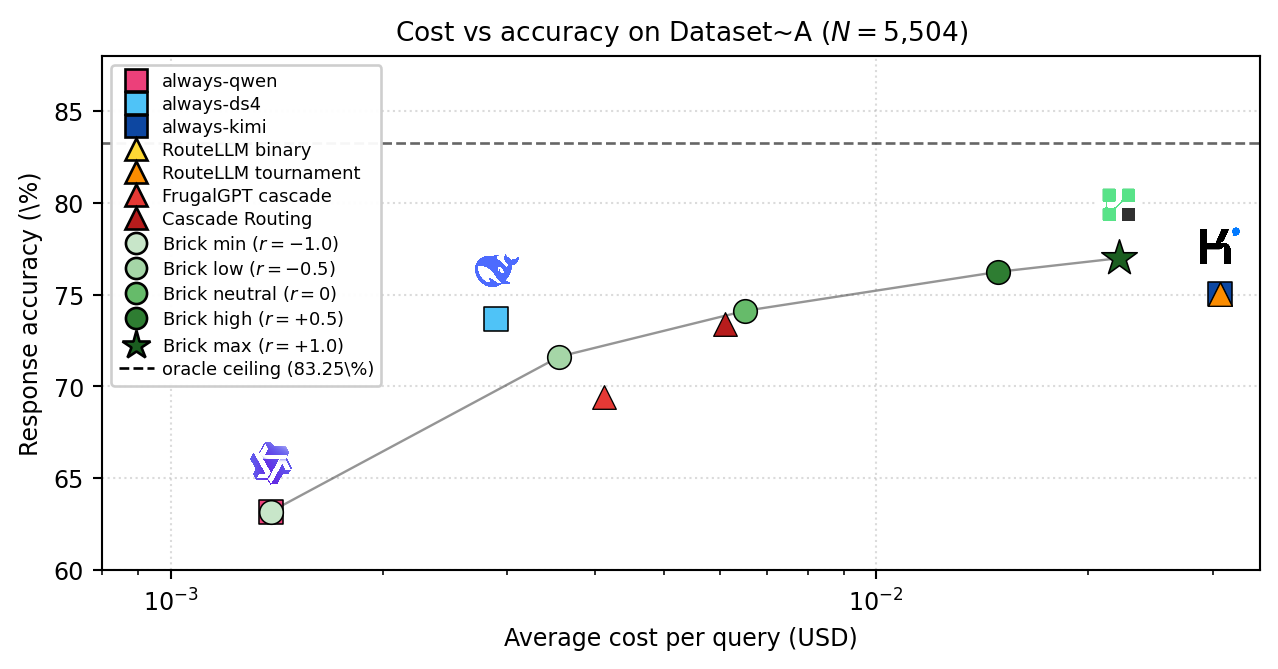
Brick has been released—an intelligent tool for managing Mixture-of-Models (MoM) LLM pools, which allows for a significant reduction in costs when using neural networks, such as Claude Code, by automatically selecting the optimal model based on the complexity of each query.


What Happened
Developers have introduced Brick, a smart routing system that analyzes query capabilities and directs them to the most appropriate model—ranging from lightweight open-source solutions to powerful proprietary systems. A key feature is the use of spatial embeddings to determine query complexity in a single pass, avoiding costly and slow cascading checks.
Context
In modern AI agentic systems, using a single most powerful model for all tasks leads to excessive expenditures. The Mixture-of-Models (MoM) approach involves using a pool of heterogeneous models, where an intelligent router acts as the link, optimizing the balance between cost and response quality.
Why It Matters for the Industry
Moving toward a Mixture-of-Models architecture via such routers allows the industry to optimize the price/quality ratio, approaching the accuracy of top-tier models at significantly lower operational costs. This paves the way for creating scalable AI agents and standardizing multi-level inference in production environments.
Why It Matters for Users
Users and developers can radically reduce the operational costs of AI tools and agentic workflows. The tool allows the computational power of top neural networks to be used only where truly necessary, automatically switching to cheaper models for simple tasks.
What Is Not Yet Known / Limitations
There is a risk of violating privacy policies when automatically redirecting data to less secure open-source models, which requires attention to data security issues.
Sources
Author
Look at AI, Editorial Staff