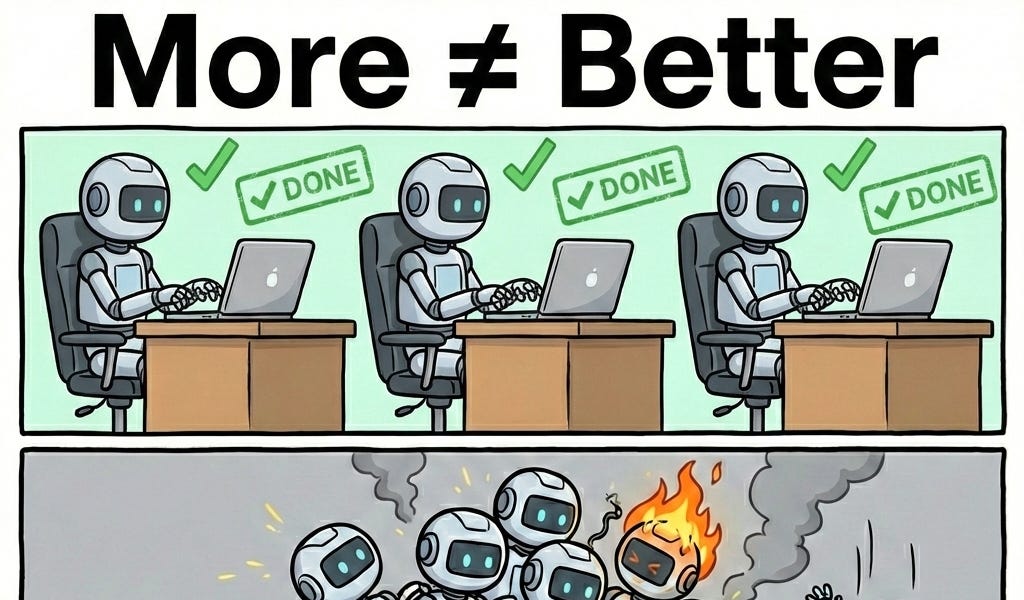
Scaling multi-agent systems faces a "coordination trap," where increasing the number of participants slows down system performance due to communication overhead. To overcome this barrier, experts suggest shifting complexity from the agents themselves to a centralized management level.
What Happened
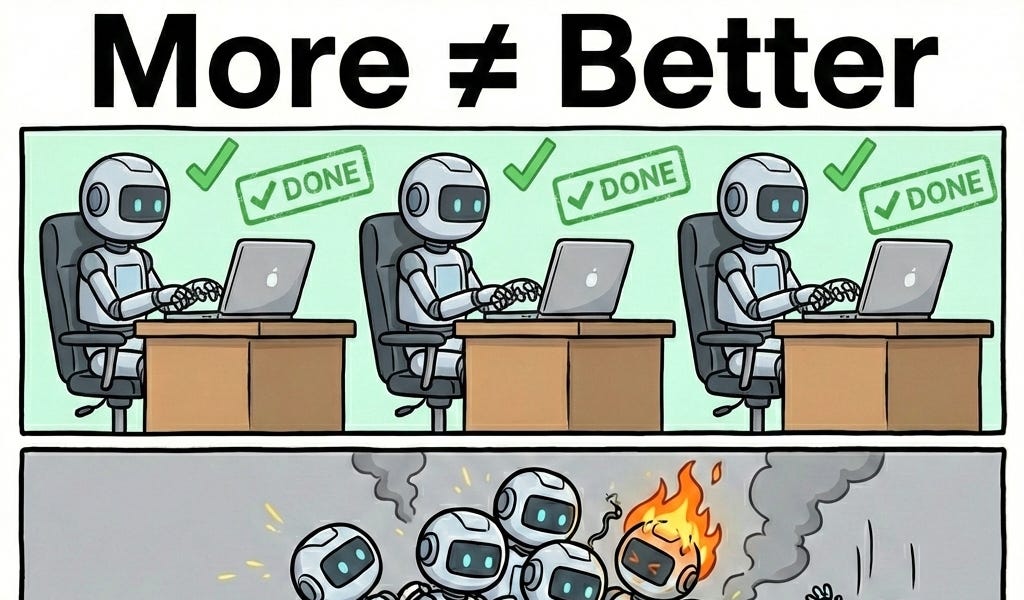
Researchers have identified an architectural problem where adding new agents to systems with distributed intelligence leads to an exponential increase in context transfer and communication costs. Instead of creating autonomous and universal agents, they propose an architecture featuring "smart orchestration" paired with specialized, or "dumb," executors.
Context
The traditional approach often attempts to mimic human team interaction by creating agents with broad general context. However, in complex systems, this leads to performance degradation. Modern research points to the necessity of transitioning toward rigid hierarchical structures and isolated contexts to ensure stability.
Why It Matters for the Industry
For the industry, this signifies a paradigm shift in AI framework development: the focus is shifting from increasing the capabilities of individual LLM agents to the reliability of task transfer mechanisms, queue management, and the optimization of interaction protocols. In the long term, a standardization of orchestrator-worker patterns is expected, where management complexity is decoupled from execution computational complexity.
Why It Matters for Users
Developers and AI product designers are advised to avoid overly complex models with "shared context" when building their own systems. More reliable and predictable solutions are built upon simple, highly specialized tools managed by a rigid, centralized controller.
Sources
Author
Look at AI, Editorial Team