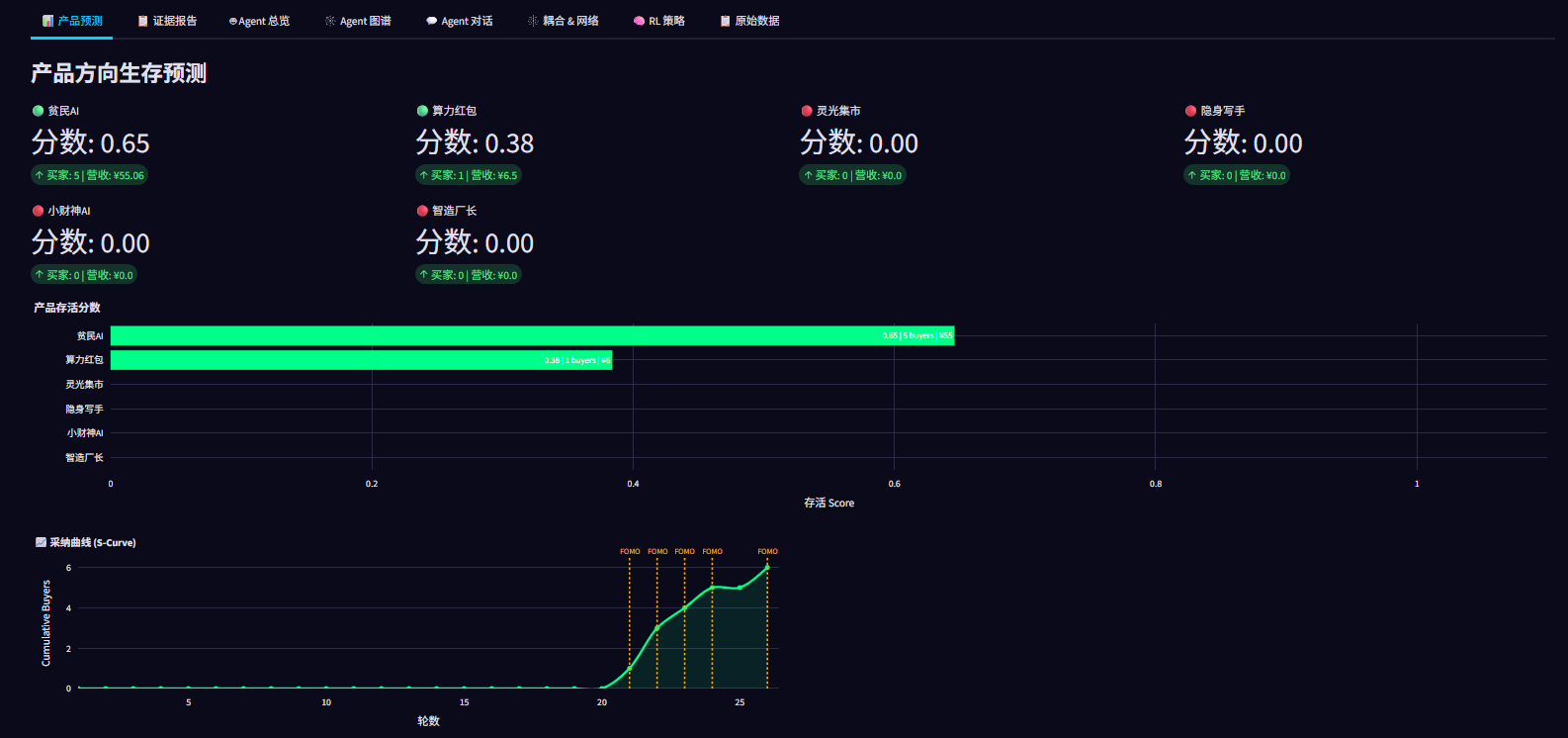
Developers have introduced MarketFish — a multi-agent modeling engine that allows testing a product on more than 128 AI consumers before an actual market release. The system simulates 30 rounds of purchasing, taking into account the individual budgets, emotional states, and social connections of the agents, providing a deep validation of market hypotheses in a digital environment.


What Happened
The open-source project MarketFish has been presented, designed to create "synthetic markets." The engine supports 11 LLM providers, including DeepSeek, OpenAI, and Anthropic, allowing for variations in the cognitive abilities of the simulated agents. The system is capable of modeling dynamic preference changes and social influence through a series of consecutive trading cycles.
Context
The project is based on fundamental academic research, such as *Generative Agents* and *TwinMarket*. It represents a shift from traditional testing methods to the use of Multi-Agent Simulation to imitate consumer behavior using modern large language models.
Why It Matters for the Industry
The emergence of pre-validation tools in synthetic markets reduces the risks of failed launches and allows companies to test pricing strategies on digital twins of consumers. In the long term, this could lead to the integration of complex simulations into CI/CD pipelines for the automated validation of business model resilience.
Why It Matters for Users
Developers and startups gain the ability to conduct cheap and fast validations of Value Propositions and GTM (Go-To-Market) strategies in a controlled environment. This allows them to move beyond guessing whether an idea is in demand by running simulations where AI agents with diverse behavioral patterns—ranging from rational to emotional—attempt to purchase the product.
What Is Not Yet Known / Limitations
There are concerns regarding practical production applicability due to high inference costs and significant latency when scaling simulations (processing 128+ agents over 30 rounds).
Sources
Author
Look at AI, Editorial Team