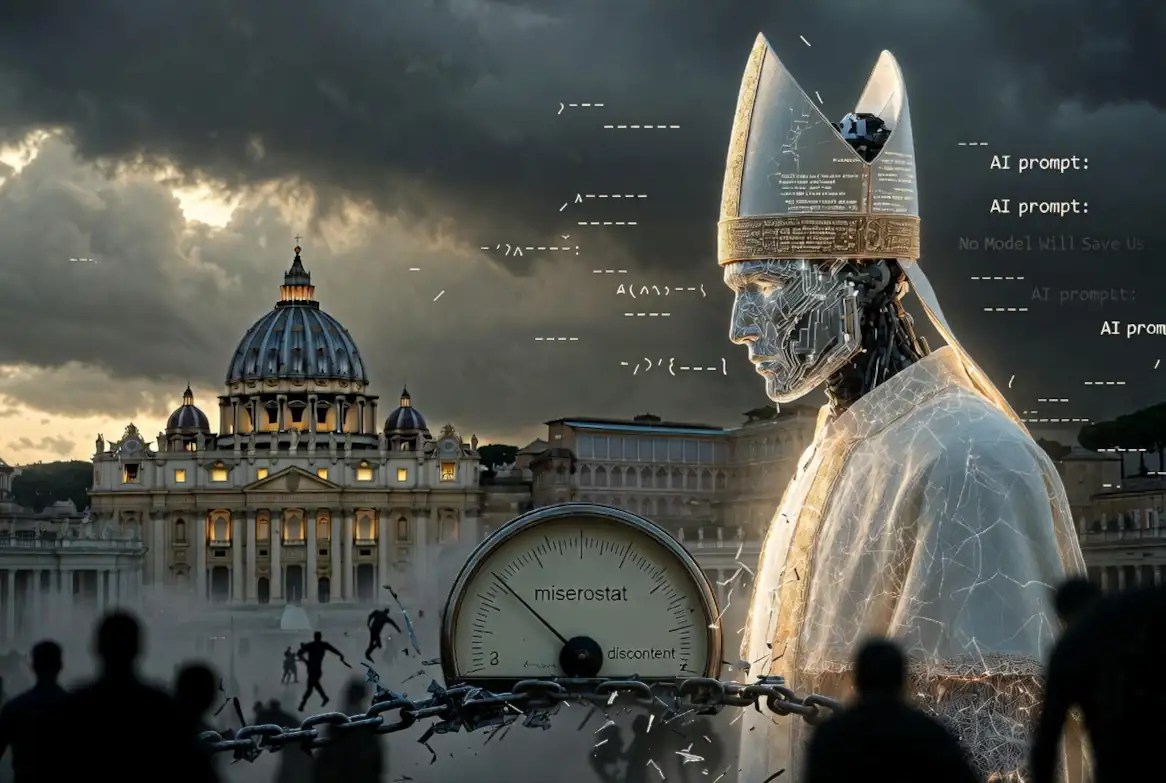
In his new work, William Briggs analyzes the risks of artificial intelligence through the lens of Pope Leo XIV's encyclical "Magnifica Humanitas." The author argues that the key threat stems not from the technical imperfections of architectures, but from the moral state and value systems of their creators.

What Happened
William Briggs published an article exploring the concept of the "doctrine of unintended consequences" and the psychological phenomenon of "miserostat." The central thesis of the work is that technological progress does not solve fundamental human problems but merely transforms them; meanwhile, modern developers (so-called "woke coders") embed their subjective values into neural networks, simulating intelligence without the capacity for moral growth.
Context
At the heart of the discussion lies the encyclical "Magnifica Humanitas," dedicated to the risks of AI, and the concept of the miserostat—a mechanism through which progress fails to bring human satisfaction, instead only changing the nature of human dissatisfaction. This complements the understanding that AI is merely a simulation of intelligence, devoid of genuine ethical depth.
Why It Matters for the Industry
For the AI industry, this implies a necessary paradigm shift: from the pursuit of pure performance and SOTA metrics to deep ethical design. Companies will face growing demand for AI Alignment tools, frameworks for measuring hidden ideological biases in training data, and interpretability mechanisms that allow for the control of embedded values at the workflow level.
Why It Matters for Users
For users, this serves as a reminder that the technological refinement of models is not a universal solution to safety and ethics problems. In the future, this could lead to the emergence of new user interfaces that allow for the explicit configuration of ethical filters and worldview parameters for AI agents interacting with humans.
What Is Not Yet Known / Limitations
There are differing assessments of risks: ranging from purely technical aspects to the complexity of managing ethical parameters in already finished products.
Sources
Author
Look at AI, Editorial Staff