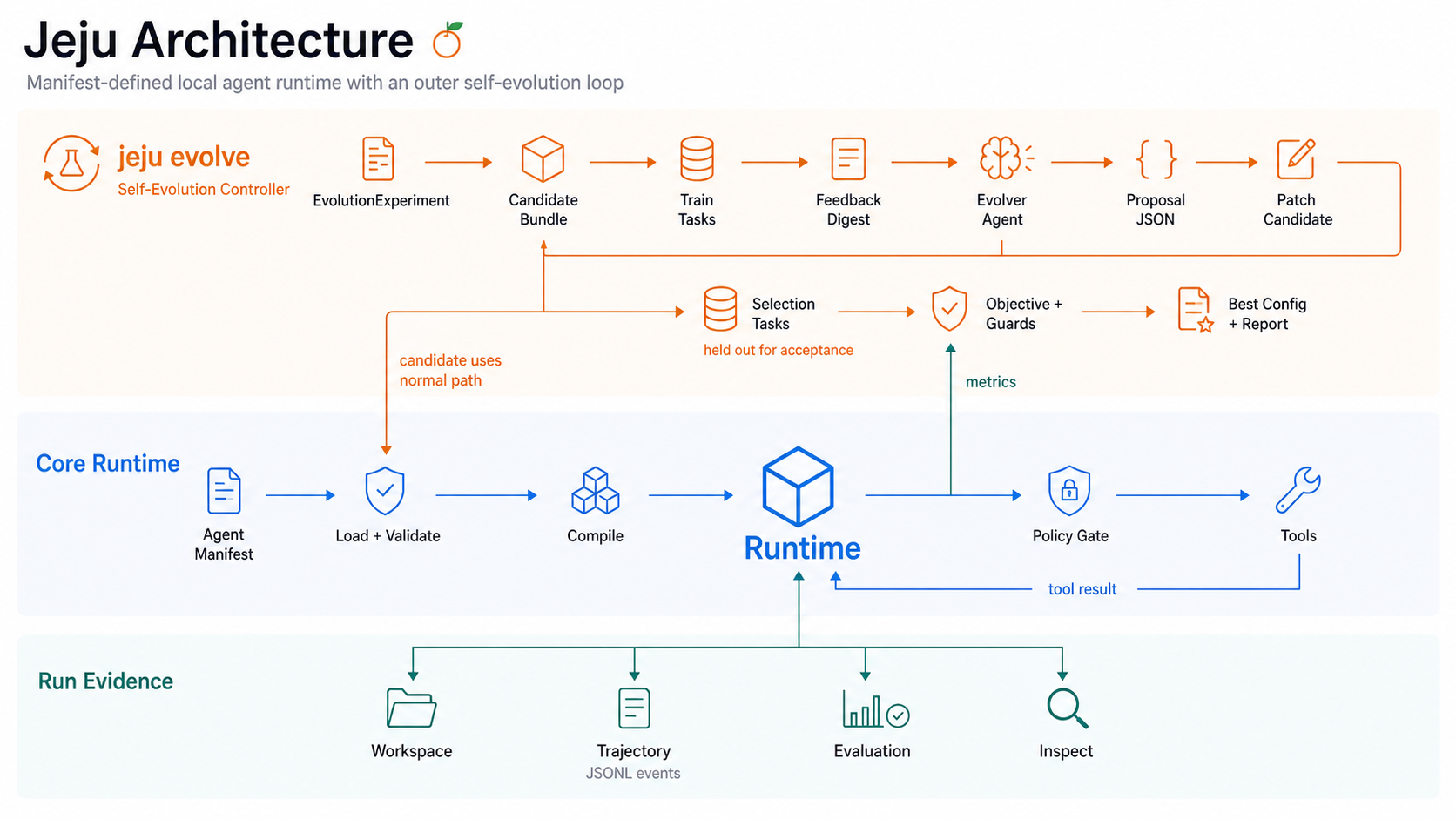
Jeju, an experimental local-first runtime (harness) for developing AI agents, has been introduced. It allows moving away from the "black box" concept in favor of transparent and declarative control over model behavior.
What Happened
Developers have released Jeju, a tool focused on a local-first approach. It allows describing agent behavior through configuration manifests in YAML format, setting strict execution boundaries (workspace, tools, permissions), and inspecting every step in detail via `trajectory.jsonl`. The system also integrates a `jeju evolve` mechanism to automatically improve configurations based on test results and evaluation.
Context
Traditional AI agent development often faces the problem of process opacity, where the model's decision-making logic remains hidden. Jeju offers a transition from imperative complex coding to the declarative description of workflows, which simplifies management and makes agent behavior reproducible.
Why It Matters for the Industry
For the industry, Jeju could be an important step toward standardizing the development of agentic systems. It proposes a shift from opaque models to a controlled architecture, which is critical for integrating AI into real industrial workflows and ensuring safety in enterprise environments.
Why It Matters for Users
For agent developers, Jeju provides a convenient environment for rapid prototyping and debugging. Instead of writing custom code, users can use declarative manifests, gain full control over the model's actions, and visualize the execution trajectory to find errors in reasoning chains.
What Is Not Yet Known / Limitations
At this stage, the project is experimental and falls more into the R&D category than ready-to-use production solutions. Experts in the field indicate the need for additional verification of the tool before its implementation in mission-critical systems.
Sources
Author
Look at AI, Editorial Team