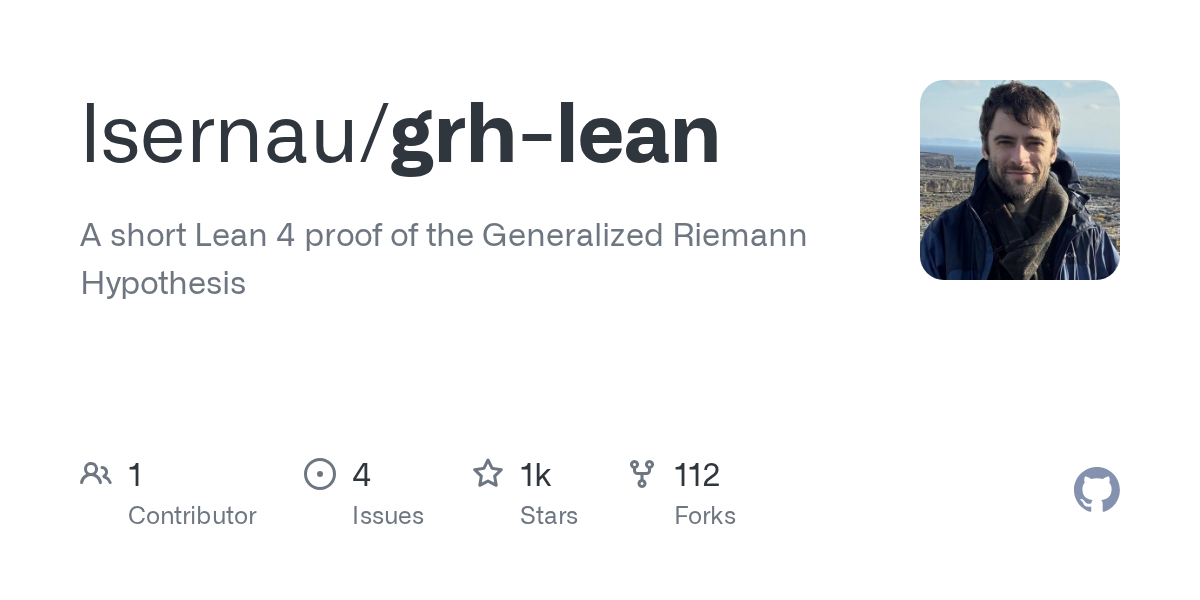
Anthropic researcher Luke Sernau published a compact version of the formalized proof of the Riemann Hypothesis and the Generalized Riemann Hypothesis for Dirichlet L-functions in Lean 4. The grh-compact edition is about 76,000 lines compared to approximately 17.37 million lines in Levent Alpöge's original proof, representing a reduction of about 228 times. The code passed six independent machine checks, but no mathematician has read it yet, and there is no peer-reviewed article.


What happened
Luke Sernau from Anthropic uploaded the compact edition grh-compact of the formalized proof of the Riemann Hypothesis and the Generalized Riemann Hypothesis for Dirichlet L-functions to the repository github.com/lsernau/grh-lean. It is about 76,000 lines, whereas Levent Alpöge's original proof was approximately 17.37 million lines, resulting in a reduction of about 228 times (99.56%). The code is built on Mathlib, uses only the axioms propext, Classical.choice, and Quot.sound, and passed six independent machine checks: Lean default/paranoid kernel, nanoda, lean4lean, con-leche, and con-ron. The license is Apache 2.0.
Context
Alpöge's original proof was created using the Claude model and received official confirmation of correctness from Lean FRO and the Mathlib Initiative on November 21, 2026. Prior to this, a formalized proof of the Riemann Hypothesis existed only in a volume of about 17.37 million lines, making it practically unreadable for humans: no mathematician could realistically go through such code. This is why compacting it to 76,000 lines is a fundamental shift: this volume is now realistic for audit by a team of mathematicians. However, the Clay Mathematics Institute still considers the Riemann Hypothesis unsolved, as the status does not change without human audit and peer-reviewed publication.
Why this matters for the industry
The compact edition makes the formalized proof of the Riemann Hypothesis practically auditable for the first time: 76,000 lines versus 17.37 million is a real shift in how large formal proofs can be checked and read. For the industry, this validates a new pipeline: LLM generation of formal code, independent machine checks, and compaction, after which the result becomes auditable. If the proof is confirmed, the Generalized Riemann Hypothesis for Dirichlet L-functions will make the effective form of Dirichlet's theorem on primes in arithmetic progressions unconditional, along with a more precise Polya–Vinogradov estimate and a Chowla estimate for the first prime in a progression. The pattern of "AI generates a formal artifact, a deterministic kernel verifies it, and the result is compacted to be readable" may become a standard workflow for tasks requiring machine guarantees rather than probabilistic ones: code verification, formal specifications, and cryptography.
Why this matters for users
Any reader can open the repository github.com/lsernau/grh-lean, read the README and GUIDE.md, see how the proof is structured, and try to build it. Building requires Lean v4.35.0 and Mathlib; the process takes 1–2 hours on 12 cores with 24 GB of RAM. It is important to understand: this is machine-verified code that has not yet been read by mathematicians, and the Clay Mathematics Institute still considers the Riemann Hypothesis unsolved. There are no direct user products (APIs, services) here — the practical value right now is that the result is open, reproducible, and checks can be run independently.
What is still unknown / limitations
No mathematician has read the code yet, and there is no peer-reviewed article: "machine-verified" is not the same as "mathematically accepted." Machine checks confirm correctness relative to the axioms used but do not replace expert audit. The Clay Mathematics Institute still considers the Riemann Hypothesis unsolved. Active human audit is expected in the coming months: 76,000 lines is a realistic volume for a team of mathematicians, and only after its completion and possible publication in a peer-reviewed journal will the result cease to be a claim and become an established result.
Sources
- GitHub - lsernau/grh-lean: A short Lean 4 proof of the Generalized Riemann Hypothesis
- TechTimes: Riemann Hypothesis Proof Claim Shrinks to 76,000 Lines of Code; No Mathematician Has Read It
- Wikipedia: Alpöge's proof of the Riemann hypothesis
Author
Look at AI, editorial team