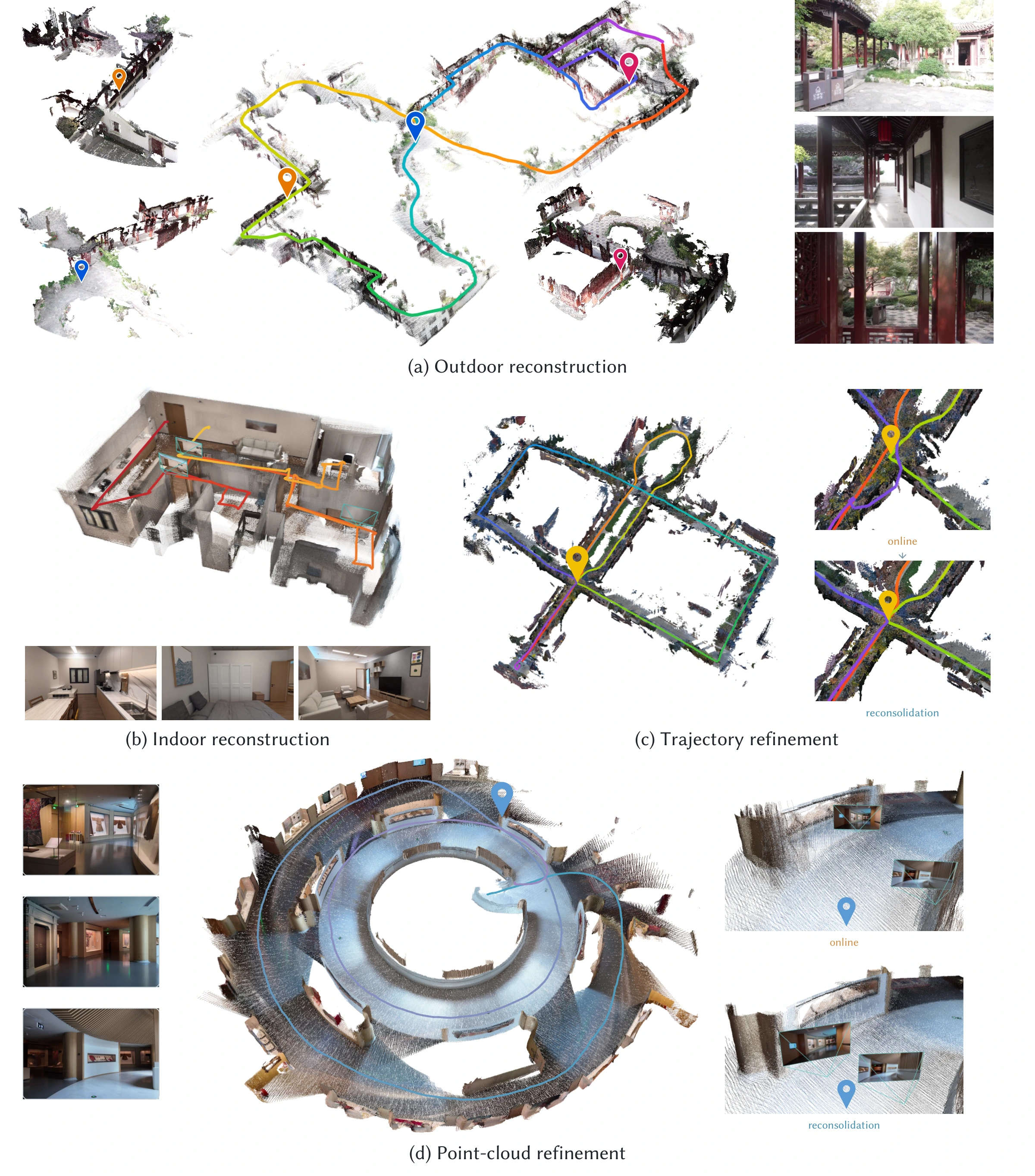
Robbyant, the robotics division of Ant Group, has released LingBot-Map 2.0, a streaming 3D reconstruction model that predicts camera poses, intrinsics, depth, and confidence in real-time from standard RGB video. It rebuilds accumulated spatial memory during motion. Open code, weights, and a technical report are already available, and on long routes in Rome, the average trajectory error after memory reconsolidation dropped from 17.01 m to 4.72 m.


What happened
Robbyant published LingBot-Map 2.0 along with the code, base streaming checkpoint weights, and a technical report. The model operates in real-time on standard RGB video, predicting camera poses, intrinsics, depth, and confidence at each stage. The key mechanism is Geometric Context Reconsolidation: the model reviews accumulated context without external optimizers, pose graphs, or loop closure, writing updated memory back into the KV-cache. The architecture consists of 24 layers: the bottom 12 are frozen and reuse computations from keyframes, while during reconsolidation, only the top 12 layers are recalculated in a single forward pass. On the VBR benchmark with routes in Rome up to 5.2 km long and approximately 18,800 frames, the average camera trajectory deviation (ATE) dropped from 17.01 m in streaming mode to 4.72 m after memory reconsolidation, a 72% reduction. For comparison, LingBot-Map 1.0 showed 31.12 m, and ABot-Recon showed 29.89 m. On Oxford Spires, the error decreased by 36%—from 6.17 m to 3.92 m—whereas LingBot-Map 1.0 and ABot-Recon recorded 8.25 m and 7.38 m, respectively. The release includes a CLI infer.py, an interactive 3D viewer demo.py based on Viser, and a Python API GCRStream for frame-by-frame integration.
Context
Classic Simultaneous Localization and Mapping (SLAM) systems typically consist of several separate stages: loop closure, pose graph optimization, and post-processing. In streaming 3D reconstruction systems without such correction, drift accumulates, and on long routes, the map gradually "drifts." LingBot-Map 2.0 moves the correction of accumulated drift inside the learnable model: both streaming and memory reconsolidation become end-to-end learnable. The published base streaming checkpoint uses DINOv3 ViT-L/16, 24 layers, an input resolution of 512×288, and runs in BF16 on CUDA GPUs with PyTorch 2.8+ and FlashInfer. The CC BY-NC 4.0 license permits use for research purposes but not for commercial use. The arXiv version of the paper has not yet been released, so full method details are currently available only in the technical report.
Why this matters for the industry
For the industry, reliable spatial memory is a fundamental building block for autonomous robot navigation over large areas. LingBot-Map 2.0 eliminates the classic SLAM pipeline and makes memory reconsolidation part of the model itself, simplifying integration into robotic systems and reducing computational costs for correcting accumulated errors. Open code, weights, and the Python API GCRStream provide a reproducible baseline system that can be used as a reference point when comparing against classic SLAM pipelines. If the approach is confirmed on independent datasets, in-model memory reconsolidation could become the norm for streaming 3D systems, displacing separate SLAM pipeline stages from production pipelines. For startups, this is a signal that "spatial memory" is ceasing to be a closed competency, although commercial use is currently limited by the license.
Why this matters for users
The model can be downloaded and run locally: a CLI infer.py, an interactive 3D viewer demo.py based on Viser, and the Python API GCRStream for frame-by-frame integration are available. Requirements include a BF16 CUDA GPU, PyTorch 2.8+, and FlashInfer. On long routes spanning kilometers, the model maintains trajectory error at approximately 4.7 m after memory reconsolidation, compared to approximately 17 m without it, which is clearly visible in the demo video. For researchers and prototype developers, this is a ready-made module: it can be immediately tested on custom videos, ATE can be verified on proprietary data, and it can be compared with current SLAM pipelines.
What is currently unknown / limitations
There is no data on latency, throughput, or noise robustness, nor benchmarks on real robotic scenarios. Commercial use is limited by the CC BY-NC 4.0 license, and there is currently no API, pricing, or SLA for production use. Results on long routes were obtained on the VBR and Oxford Spires benchmarks, and their confirmation on independent datasets is still pending.
Sources
- LingBot-Map 2.0: Reconsolidatable Streaming 3D Reconstruction — Robbyant (project page)
- Robbyant/lingbot-map-v2 — GitHub (code, technical report PDF, benchmarks)
- robbyant/lingbot-map-v2-base-streaming — Hugging Face (model weights)
Author
Look at AI, editorial team