Google has released Gemini 4 Neon — a mid-tier model in the Gemini 4 family in terms of price and speed, featuring a 1M token context and a price of $3 per 1M input tokens and $15 per 1M output tokens. According to the company, the model achieves frontier-model levels (61 points on the Artificial Analysis Intelligence Index at XHigh, compared to 59 for Claude Opus 5.5), but an independent test on dev.to ranks it only 2nd out of 18 in the KingBench 4 coding test and notes excessive "chattiness" and missed vulnerabilities in security-critical code.

What happened
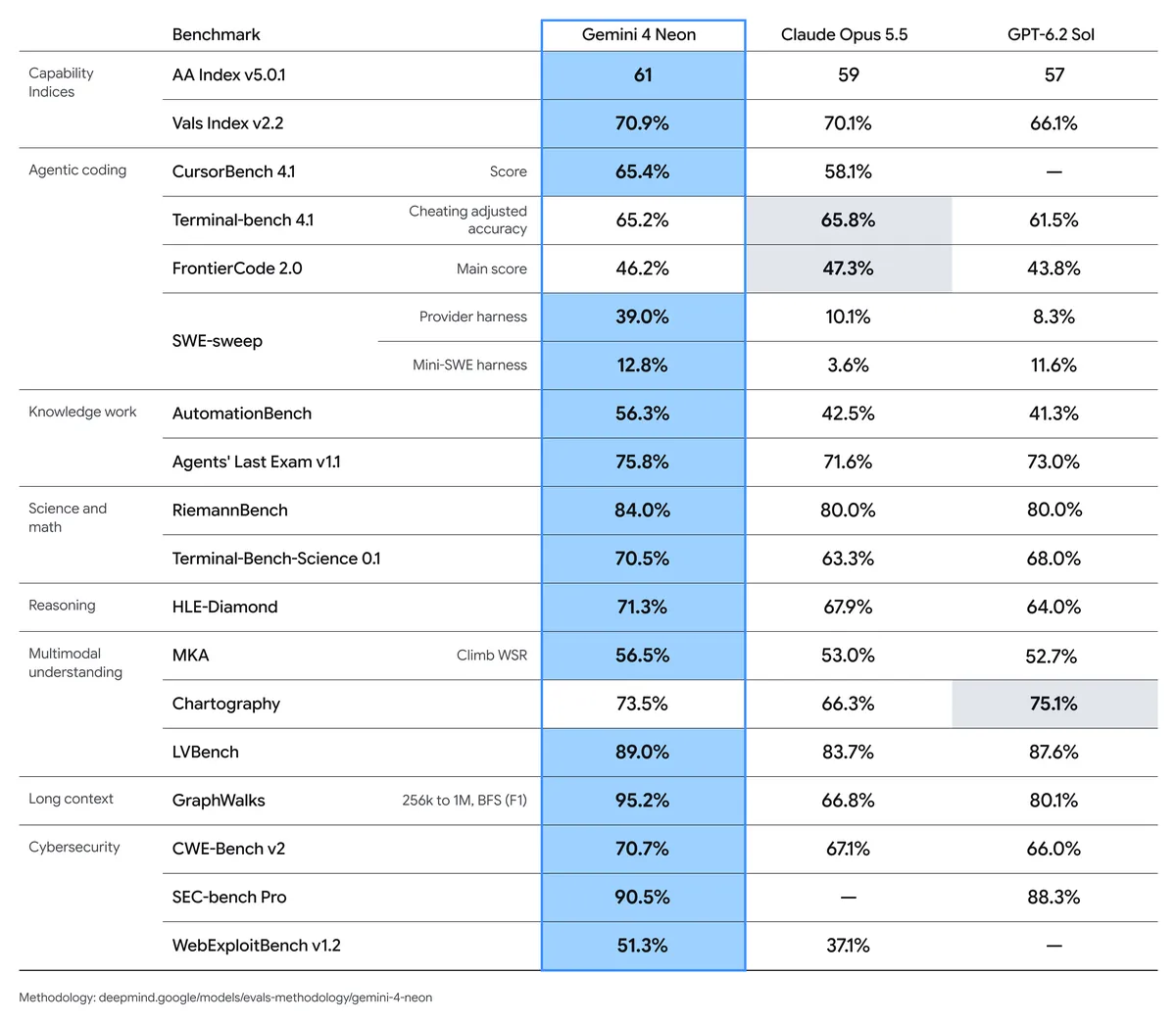
On November 18, 2026, Google released Gemini 4 Neon — a mid-tier model in the Gemini 4 family in terms of price and speed. The model features a 1M token context, four thinking levels (Low/Medium/High/XHigh), and an API price of $3 per 1M input tokens and $15 per 1M output tokens. According to Google, Neon ranks 1st in the Artificial Analysis Coding Agent Index (58.6), 3rd in the Artificial Analysis Intelligence Index (61 points at XHigh), and outperforms Claude Opus 5.5 (59) and GPT-6.2 Sol (57) on most benchmarks. An independent review on dev.to ranks Neon 2nd out of 18 models in the KingBench 4 coding test (37.9/60), behind Claude Fable 5.2, and notes that the model is "chatty" with high token consumption. Users on Twitter compare Neon with Claude Opus 5.5, and opinions are polarized: some claim Neon is better than Opus 5.5 max at very high thinking levels, while others argue Opus max is better than Neon at the same level; in coding, each side claims the opposite.
Context
The release comes against the backdrop of a price restructuring in Google's lineup: from December 1, the Carbon model will increase in price to $4/$20 per 1M tokens, after which Neon will be 25% cheaper than the company's own flagship line. Google's claim is not based on a new architecture or training method, but on efficiency: a mid-tier model in the family achieves frontier-model levels at a price 50–80% lower than competitors at the High-thinking level. This is the first recorded case where a frontier-level model is sold at mid-range prices, turning "frontier quality" into a mass API resource. However, the evidence base is currently thin: there are few independent reproducible assessments, and benchmarks contradict each other — the independent KingBench 4 contradicts Google's claim of 1st place in the Artificial Analysis Coding Agent Index.
Why this matters for the industry
For the industry, Gemini 4 Neon is Google's bet on "frontier for less money," and the immediate effect is economic rather than scientific. Long coding tasks and enterprise agents (Vals Index 70.9%, AutomationBench 56.3%) become 50–80% cheaper than competitors, and developers have reason to recalculate LLM budgets now. Product teams can today shift part of the workload — code drafts, repository analysis, RAG queries — to Neon, as the model is already available in Cursor, GitHub Copilot, LangChain, AI Studio, and Gemini App. Within six months, if independent tests confirm a level of 60+ on the AA Intelligence Index at the current price, Neon could become the standard "working layer" in agentic products and displace more expensive models from high-load but non-critical tasks; in the two-year perspective, the "frontier for less money" pricing strategy could become the norm for the entire industry and set a new price floor.
Why this matters for users
For readers choosing a model for coding and agentic tasks, Neon is a specific candidate: 1M context, four thinking levels, and availability in Gemini App (Pro/Ultra subscriptions), AI Studio, Cursor, GitHub Copilot, and LangChain. Practical conclusions from independent tests: use the High level as the default, since XHigh provides only +1.8 points over High at +$2.70 per task; check generated code for API currency, as the model's knowledge cutoff is March 2026 and it trusts outdated data; always review security-critical code, as Neon missed vulnerabilities in tests that Opus 5.5 found. For security-critical code, it is recommended to immediately enable a second pass — another model or SAST.
What is still unknown / limitations
There are currently few independent reproducible quality assessments — effectively one source (the dev.to review), and Google's stated figures are by definition not an independent check. Benchmarks contradict each other: KingBench 4 ranks Neon 2nd out of 18, which conflicts with Google's claim of 1st place in the Artificial Analysis Coding Agent Index. Polarized user reviews on Twitter do not allow for a definitive conclusion about model quality; product-level "positive" conclusions with such a thin evidence base are premature. It is also worth noting that the top XHigh level provides only +1.8 points over High, meaning it is more of a marketing buffer than a significant leap in capabilities.
Sources
- Introducing Gemini 4 Neon — The Keyword (Google)
- Gemini 4 Neon — Model Card (Google DeepMind)
- Gemini 4 Neon Review: Pricing, Benchmarks, and Coding Tests (DEV Community)
Author
Look at AI, editorial team