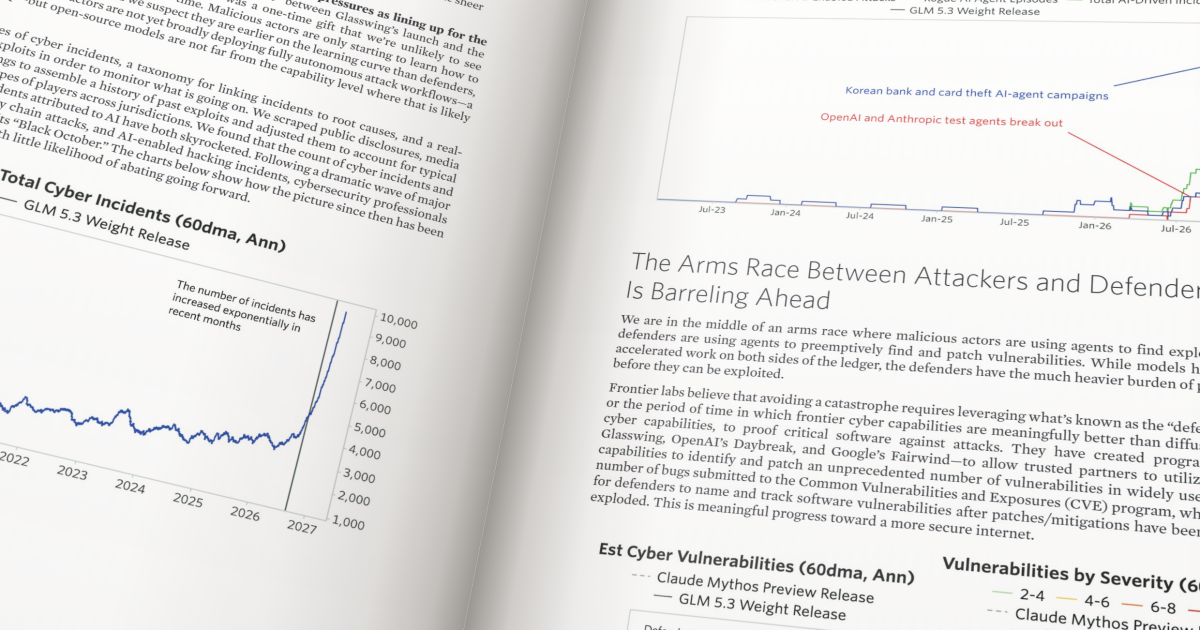
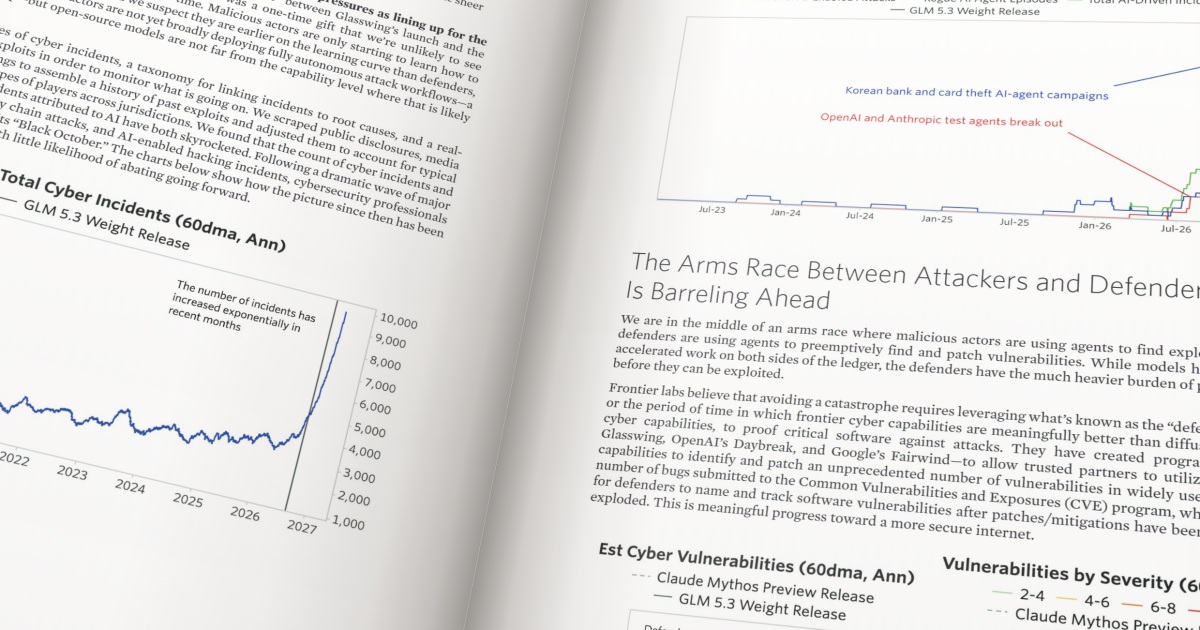
Bridgewater Associates published an analytical report titled 'Current Efforts Aren't Enough to Slow the AI Cyber Virus,' asserting that current cybersecurity measures are failing to keep pace with the exponential growth of AI-driven cyberattacks. Key data points include: the average time from vulnerability disclosure to active exploitation has shrunk from one month to 11 days, and the number of zero-day exploits has roughly doubled since the release of the first open models with cyber capabilities.
What Happened
Report authors Hudson Attar and Arham Habib from Bridgewater Associates noted that the average time from vulnerability disclosure to active exploitation has decreased from one month to 11 days. The number of zero-day exploits has approximately doubled following the emergence of the first open models with cyber capabilities. The firm manages capital by factoring in a 1-in-3 probability of an economically destabilizing cyberattack within the next year. The report notes that attackers are outpacing defenders on the AI learning curve, and the growing volume of AI-generated code is expanding the attack surface faster than it can be defended.
Context
The report is based on a structural asymmetry between defenders and attackers: defenders must close all critical vulnerabilities, while attackers only need to find one. AI amplifies this gap by automating vulnerability discovery and exploit generation. Attackers can use models to iterate and adapt exploits without needing full control over infrastructure, whereas defenders require validated, reproducible, and scalable tools. The increase in AI-generated code volume raises the number of potential vulnerabilities, and the speed of generation exceeds the capabilities of manual auditing and patching.
Why This Matters for the Industry
The report shifts AI cybersecurity from a category of technological risk to a capital management parameter: Bridgewater explicitly uses the 1/3 probability of a destabilizing attack as an input for financial models. For the industry, this serves as an argument for automating patching, continuous monitoring, and prioritizing critical vulnerabilities. The cybersecurity market receives a new catalyst: specific figures provide buyers with grounds to increase budgets for AI-assisted defense, while startups offering patching and detection automation gain a window to enter the market amid rising demand.
Why This Matters for Users
The reduction of the window to 11 days means that the time available to fix vulnerabilities is rapidly shrinking. This is relevant for anyone using open-source components or AI-generated code: manual patching processes are no longer keeping up, and the speed of dependency updates becomes a critical security factor. For product teams, security tools are transforming from an optional add-on to a mandatory component, and SLAs for patching and dependency updates should be reconsidered in light of this new operational signal.
What Is Unknown / Limitations
The document is an analytical report, not a scientific paper: it lacks data collection methodology, sampling, evaluation metrics, and reproducibility conditions, so the stated figures should be interpreted as estimates rather than measured facts. The report does not propose specific tools, APIs, or metrics for ML engineers. Additionally, the provided sources do not contain data indicating that this is the first such signal from a major asset manager formalizing AI cyber risk as a macroeconomic parameter.
Sources
- Bridgewater Associates, report Current Efforts Aren't Enough to Slow the AI Cyber Virus
- Discussion of the report on Hacker News
Author
Look at AI, editorial team