
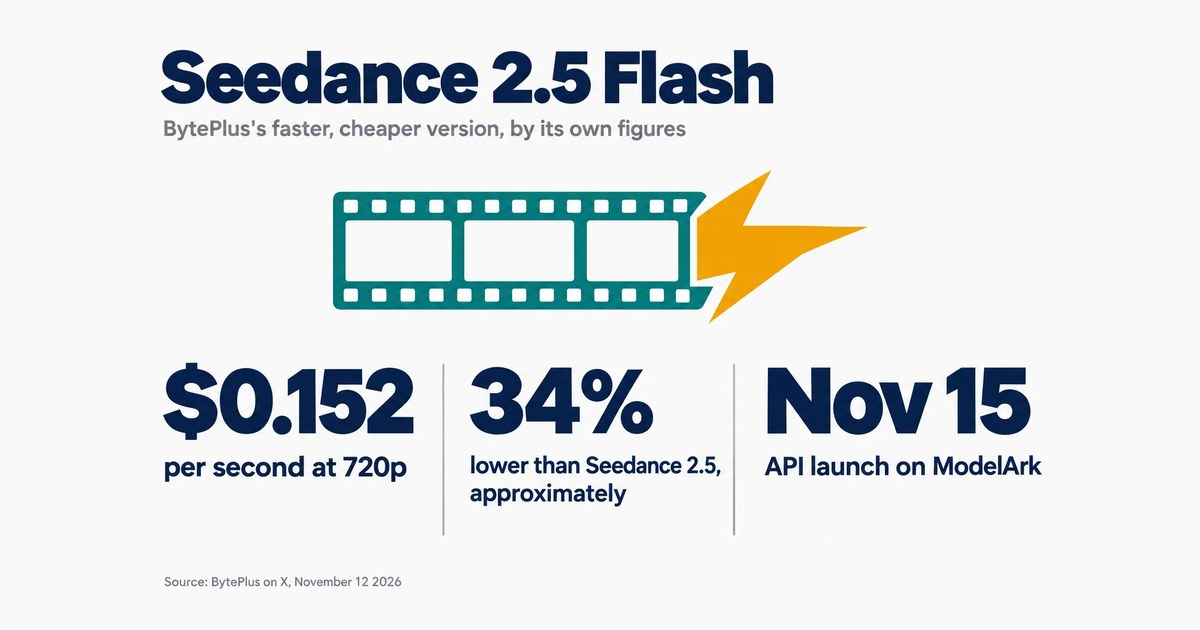
BytePlus, ByteDance's international cloud division, announced Dreamina Seedance 2.5 Flash on November 12, 2026. This is an accelerated and cost-reduced version of the Seedance 2.5 video generator, created by the Doubao team. According to the company, generation is nearly twice as fast, and a second of 720p video costs $0.152, which is approximately 34% cheaper than the flagship version. The model is already available in the Dreamina interface, and a separate API on the BytePlus ModelArk platform will open on November 15, 2026.

What happened
The new model is priced within ModelArk at $7.0 per million tokens for 480p and 720p resolutions, compared to $10.70 for the flagship Seedance 2.5. Converted to duration, a 5-second clip at 720p costs $0.76, while a 30-second clip costs $4.56. Generation works from both text and images, but only up to 720p: 1080p and 4K modes are not supported and remain exclusive to the flagship. As of November 12, the model is available in Dreamina, specifically in the AI Video, AI Canvas, and AI Agent tools. A separate API on the BytePlus ModelArk platform will open on November 15, 2026, with calls executed under the identifier dreamina-seedance-2-5-flash-261115.
Context
Seedance is a family of video generators developed by the Doubao team within ByteDance and brought to the international market through the BytePlus cloud platform, while reaching a broader audience via Dreamina, CapCut's AI ecosystem. The 'Flash' suffix refers to a scheme long established in language models: alongside an expensive flagship, there exists a cheaper and faster version that handles rough work—such as idea iteration, trial runs, and checking composition and camera movement. ByteDance is transferring this pattern entirely to video generation, formalizing it as a separate tariff with public pricing, rather than just a technical option in the flagship's settings. However, the quality of Flash is claimed to be close to the flagship, although the company has not published confirming metrics.
Why this matters for the industry
For the industry, this is primarily a price shift: the Flash tariff matches the price of Seedance 2.0, the previous generation model, meaning the price level has dropped another step, and the cost of iteration in video generation has fallen to the level of yesterday's flagship market. This increases pressure on competitors like Kling and Runway, who will now have to respond with their own cheap and fast tiers. The scheme of 'a cheap, fast model for idea iteration plus an expensive flagship for final rendering' is packaged as a ready-made tariff product with public prices, so batch pre-generation of frame variants may become standard production practice. This allows startups and agencies to calculate the unit economics of video features in advance and build a two-tier pipeline into their products from day one.
Why this matters for users
The model can already be selected in Dreamina, CapCut's AI platform: 'Omni reference' and 'First and last frames' modes are available, along with 480P and 720P resolutions and synchronous audio. From November 15, the same tasks will be solvable via the ModelArk API, making it possible to calculate budgets in advance for video planning based on the per-second price at 720p. A practical scenario looks like this: cheaply check camera movement, composition, and scene delivery in Flash, then regenerate successful prompts in the flagship Seedance 2.5 to get a final 1080p render, which Flash does not provide.
What is currently unknown / limitations
The claim of being 'nearly twice as fast' is not accompanied by published benchmarks: there is no baseline, measurement conditions, or independent verification yet. The assertion that 'quality is closer to the flagship' is also not confirmed by metrics or evaluation methodology. There is no technical report describing the acceleration method—it is unknown whether distillation, caching, architectural changes, or inference trajectory optimization are involved, so the potential cost of speed, such as artifacts, degradation of motion dynamics, or audio desynchronization in fast modes, has not yet been assessed. Until independent benchmarks appear, conclusions that cheap video generation has finally ceased to be a promise should be treated with caution.
Sources
- BytePlus on X: Introducing Dreamina Seedance 2.5 Flash (official announcement)
- Seedance 2.5 Flash: Test Video Ideas Fast and Spend Less — Dreamina (official product page)
- Seedance 2.5 Flash: Price, Speed Claim and API Date — CellCog
Author
Look at AI, editorial team