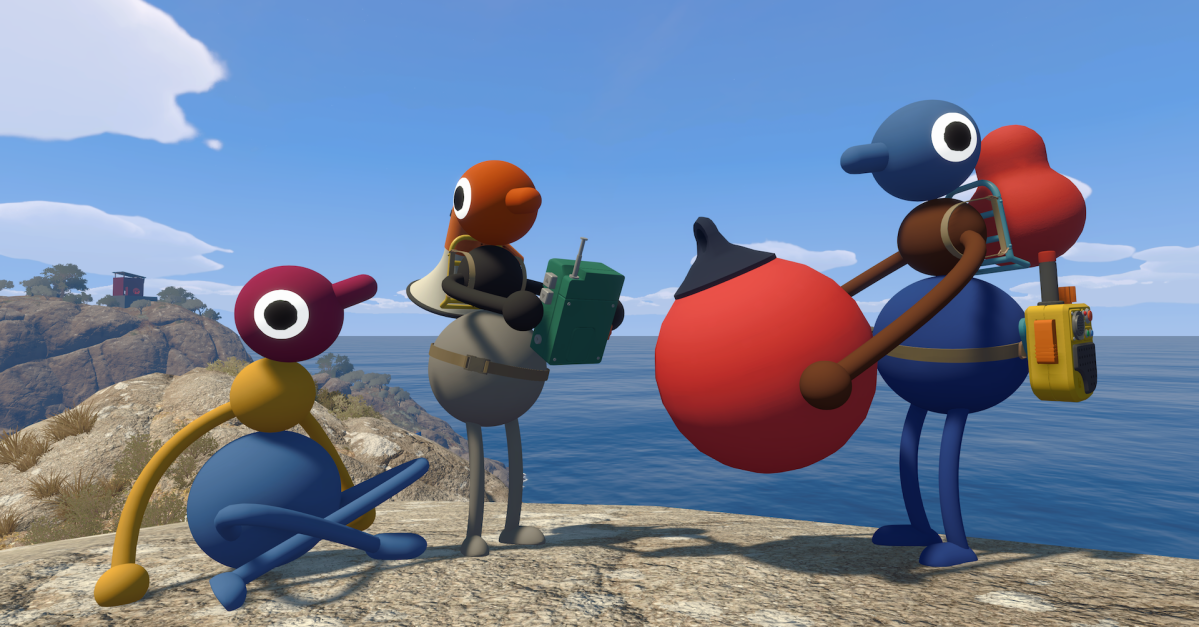
Part of the Independent Games Festival (IGF) jury published a statement that they will not vote for games using generative AI "in any form." The trigger was the cooperative adventure project Big Walk by the studio House House, known for Untitled Goose Game: the developers disclosed that they used an LLM minimally at the final stage of development to debug technical bugs. The case showed that there is no unified understanding of the acceptable boundary of AI application in the indie segment—the dispute flared up over purely instrumental use that did not touch the game's content.

What happened
The developers of Big Walk disclosed when submitting the game to the Independent Games Festival that they used an LLM "sparingly," meaning minimally, at the final stage of development to debug technical bugs. By House House's own estimate, the share of code related to this is "significantly less than 0.1%" of the codebase, and AI was not used for graphics, narrative, or other creative tasks. In response, a group of festival jury members issued a statement refusing to vote for games with generative AI; among those who signed it are Sam Barlow, the author of Telling Lies and Immortality, and Lena Raine, the composer of Celeste. The discussion split the indie community, and the project itself became a test case for how strictly the community is ready to judge any mention of AI in a competitive development.
Context
Behind the conflict lies a gap in disclosure rules. IGF requires developers to declare the use of AI when submitting an application, whereas Steam does not request disclosure of AI application in code or chatbots, so the same project is disclosed differently to different platforms. At the same time, the use of LLMs for debugging during development has long been normalized in engineering practice: it is a dev-process tool that does not end up in the final build and does not create new points of failure or inference costs for the release. The difficulty is that the criterion of "in any form" is technically not operationalized: compilers, static analyzers, LLM assistants in IDEs, and generative AI for content creation form a single continuum, and without thresholds by purpose and degree of use, the jury evaluates the developer's declaration, not a measurable artifact. Big Walk turned out to be a borderline case that called into question binary categories like "AI-free."
Why this matters for the industry
For the industry, the effect is purely procedural: the case did not bring new models, benchmarks, or methods, but studios are already reviewing disclosure wording, and festivals are reviewing definitions of "generative AI." The practical takeaway for teams: it is necessary to document where and how an LLM was used, starting from prompts, diffs, and reviews, from the very beginning of development, because such a report cannot be compiled retroactively. At the same time, the disclosure of AI use is turning from a formal label into a factor of distribution and reputation: now, instrumental use of less than a tenth of a percent of the codebase can influence the competitive fate of a project. A likely, though not yet realized, consequence is the evolution of award program rules from binary prohibitions to categories of use and graduated declarations, as well as growing demand for tools that log LLM calls in the dev process and generate machine-readable reports on AI application.
Why this matters for users
For readers choosing games, the practical takeaway is: the "AI-free" status today is a self-report by the developer, not a verifiable characteristic; there is no independent audit of AI contribution to code, so one has to rely on studio statements and jury member signatures. The case also shows how professional pressure works in this environment: even transparent and minimal use of an LLM turned into a public dispute, and some signatories of the statement, according to The Verge, feared "professional consequences" due to their signature. For indie enthusiasts, what happened is a benchmark: the acceptability of generative AI in festival programs is currently being actively reviewed, and one should observe not only the game content but also how studios declare the development process.
What is still unknown / limitations
The estimate of "significantly less than 0.1%" is a self-report without an auditable methodology: it is not specified exactly what was measured—lines, commits, or diffs—so neither side of the dispute can confirm or refute the figure in a reproducible way. Logging LLM calls would solve the disclosure problem, but not the measurement problem: an API call log is not equivalent to code provenance due to autocomplete and prompt-to-diff tools. It is also unknown how many jury members signed the statement and how the IGF organizing committee will officially react to it, and expectations that award programs will move to categories of use and graduated declarations remain interpretations, not established facts.
Sources
Author
Look at AI, editorial team