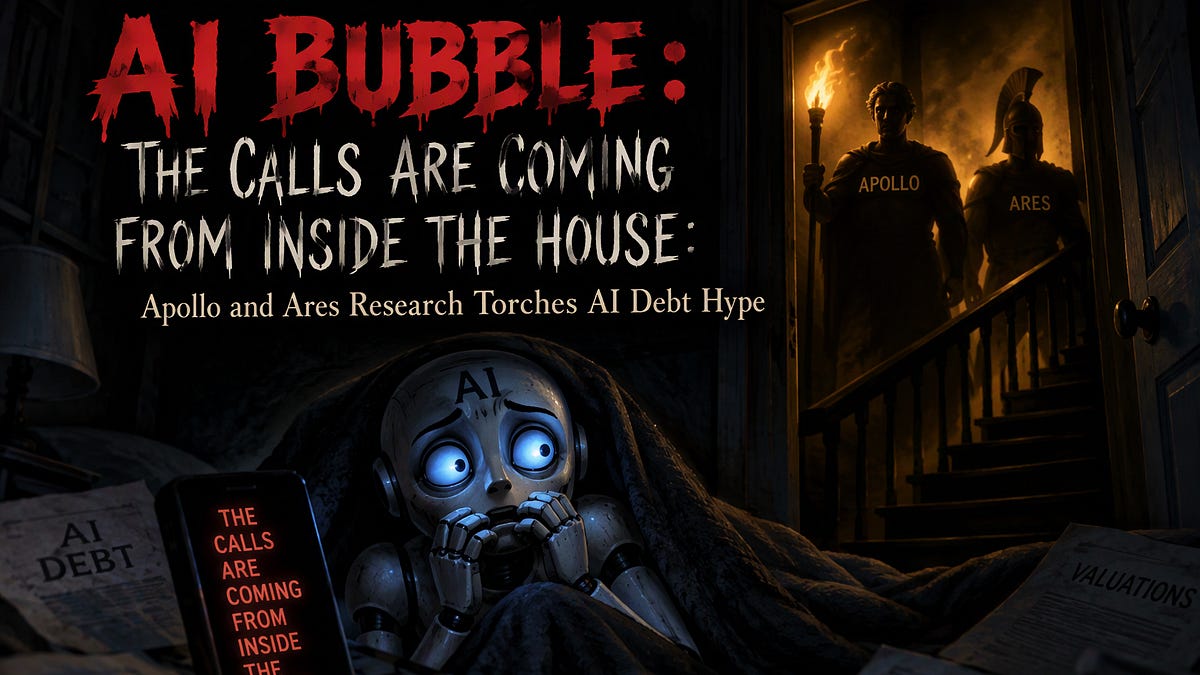
Former Wall Street analyst Rod Dubitsky published a Substack analysis on November 9, 2026, examining two studies by major asset managers, Apollo and Ares Management, which from different angles cast doubt on the narrative of the sustainability of the investment boom surrounding AI. Apollo’s Chief Economist, Torsten Slok, argues that AI has not yet delivered a financial effect to corporate America beyond the technology sector. Ares describes how venture-style risk in data center financing is being sold to insurance companies under the guise of investment-grade debt. The rarity of the moment lies in the fact that the skepticism comes not from external critics, but from market insiders who themselves profit from this debt.

What Happened
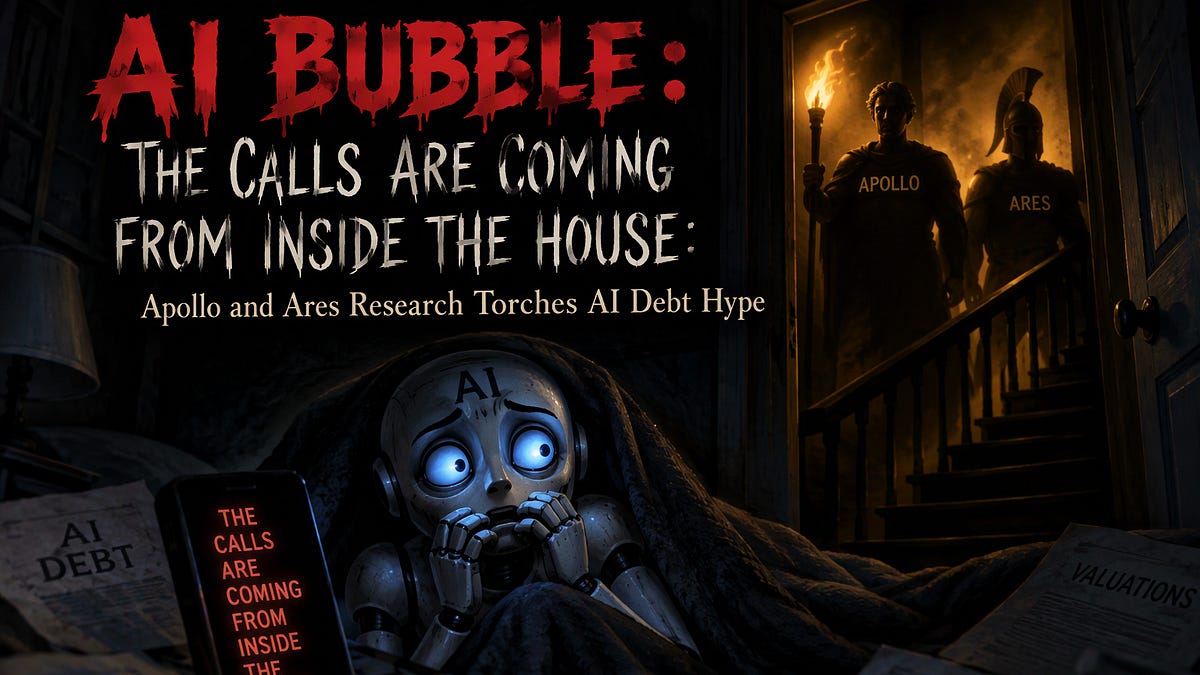
On November 9, 2026, Rod Dubitsky’s piece titled "AI Bubble: The Calls Are Coming from Inside the House" was published on Substack, where he analyzes fresh publications from two financial institutions. In an issue of The Daily Spark, Apollo’s Chief Economist Torsten Slok presents data showing that for the S&P 493 (the S&P 500 excluding the "Mag 7"), revenue per employee and margins remain flat, while for the "Mag 7" they continue to grow. In his observation, companies outside the tech sector are already booking token expenses as cost centers rather than growth drivers. In the fall issue of the In The Gaps newsletter, Ares Management describes how more than 100 deals for financing digital data centers in the last 12 months are concentrated in eight names—Meta, Oracle, Microsoft, Amazon, Google, Nvidia, OpenAI, and Anthropic—which account for approximately $573 billion in debt. It is also noted that property insurance for such assets often covers only about 3% of their value: for the Meta/BlackRock complex in El Paso, coverage is $450 million against a valuation of $14 billion. Dubitsky’s material is financial rather than technical: it contains no data on APIs, inference prices, or latency.
Context
The unusual aspect of the moment is the origin of the criticism: the skeptical assessment of AI debt is published by Apollo and Ares, i.e., major market insiders who themselves organize and place such capital, rather than external "bears"; Dubitsky is more of an aggregator than a primary source here. Ares describes a structure in which data center financing is set up as a venture bet with an expected return of 50x-100x and a "bet the farm" philosophy; guarantees in such deals are weak, and contracts contain "outs" allowing participants to exit obligations. At the same time, such structurally risky assets are sold to insurance companies at investment-grade spreads of only 50-100 basis points, and guarantees work only on paper, which the materials call "guarantees in name only." The concentration of financing in a narrow circle of issuers creates correlation: problems with one counterparty easily spread stress throughout the chain, and ultimately the risk is borne by insurers and annuity holders, i.e., people far outside the tech industry. This is why the authors consider the divergence between capital expenditures on infrastructure and revenue outside the tech sector to be a key indicator, rather than an abstract "hyperbole."
Why This Matters for the Industry
For the industry, the signal lies in a shift in demand mode: while token expenses fall into corporate budget cost centers, the "AI-powered" argument in pitches loses weight, and negotiations increasingly feature demands to show savings or revenue growth. Startups should not assume automatic growth in client AI budgets in their plans and should build measurable inference unit economics in advance: the cost of solving a specific task, cache hits, the share of cheap models, and expense observability. The likely scenario if the gap between infrastructure investment and non-tech sector revenue persists is stricter underwriting of AI debt and a review of spreads, which may narrow the window for cheap financing; competition will shift toward solutions with transparent unit economics, and demand will grow for the AI cost management and ROI analytics category. If the signal reaches budget committees, labs and corporate teams will prioritize cheap inference: smaller models, routing, distillation, mandatory evals, and expense reporting. The long-term risk is that stress, correlated through a narrow circle of counterparties, could limit compute availability and the pace of scaling experiments for the entire ML ecosystem.
Why This Matters for Users
For the reader, the analysis provides a set of verifiable indicators instead of abstract debates about a "bubble." The first and most personal point: the real bearer of risk is insurers and annuity holders, so end payers in the event of stress could be ordinary clients of insurance and pension products, far from the tech industry. The second point—what to watch next: the divergence between CapEx and revenue outside the tech sector, the actual share of insurance coverage for data centers, and whether stated guarantees work under stress conditions. The third point—practical hygiene in choosing services: a skeptical filter should be applied to "AI-powered" formulations in marketing, asking for the price of solving a specific task rather than evaluating a product by the loudness of the model name. If the signal of weak ROI reaches the mass market, the next cycle will see AI products selected by price per task and proven utility, and marketing with empty promises will lose its audience.
What Is Still Unknown / Limitations
Revenue per employee and margins are lagging and aggregate proxies, by which it is not possible to reliably distinguish "AI is not working" from "the effect has not yet accumulated": technology diffusion usually takes years, and there is no decomposition by industries and periods in available materials, so the conclusion about a complete absence of effect outside the tech sector remains questionable. The publication currently records a signal of prices and expectations, not a realized crisis: debt market reactions, spread revaluations, and underwriter decisions are not described in the sources, and scenarios of tightened financing and compute price reviews are interpretations, not facts. Finally, a conflict of interest is visible in the publication: Apollo, publishing skeptical analytics, itself records approximately $80 billion in obligations in AI debt in 2026, including $40 billion for SpaceX data centers, $5.4 billion under the SpaceX/xAI line, and $35 billion for the Anthropic/Broadcom project.
Sources
- AI Bubble: Apollo & Ares Research Expose Structural Flaws in AI Debt (Rod Dubitsky, Substack)
- No Signs of AI Payoff Outside the Tech Sector — The Daily Spark (Torsten Slok, Apollo)
- Ares Management — In The Gaps Newsletter, Fall 2026 (PDF)
Author
Look at AI, editorial team