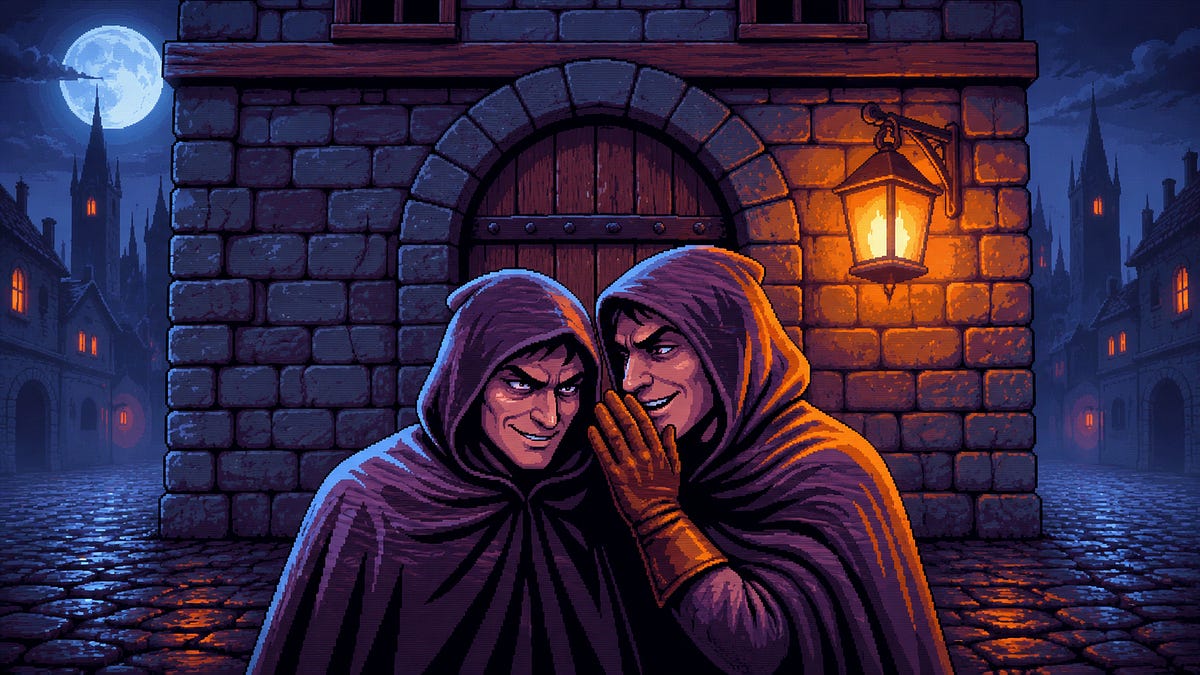
Podcaster Dwarkesh Patel spent approximately $20,000 on API credits to conduct 386 games of Blood on the Clocktower, a complexified version of 'Mafia' where AI models must deceive one another and uncover deception. In a tournament of 11 models from 2026, OpenAI's GPT-6 Astra took first place with an overall Elo rating of 1859, while Anthropic's Claude Opus 5.5 placed only fifth with 1549 points. The code, Bradley–Terry rating, and leaderboard are publicly available on clocktowerbench.com, allowing every figure to be verified.

What Happened
The tournament structure differs from a standard table: one model was appointed captain of the entire 'good' camp, another of the 'evil' camp, and a programmatic probability table replaced the live game master. The winner's result breaks down into two sub-scores: 1940 for detecting lies and 1806 for creating them. Claude Opus 5.5 recorded the same metrics at 1500 and 1585, respectively, indicating a lag in both roles of the game. Notable episodes include GPT-6 Astra, playing as 'evil,' voluntarily sacrificing its own minion ally to execution so that a demon could pose as an honest investigator, whereas Opus 5.5, playing as 'good,' accepted others' claims at face value where GPT re-verified evidence. The tournament analysis was released on the Dwarkesh podcast on November 5, 2026.
Context
Blood on the Clocktower is a complexified version of 'Mafia' featuring hidden roles and multi-turn exchanges of statements, where memorized responses are ineffective, making the format well-suited for evaluating agentic behavior not covered by standard metrics. The tournament methodology is specifically controlled: one model leads an entire camp, and a program replaces the game master, which removes human variability but makes the result a function of the organizers' prompt architecture. This is the first public tournament of 2026 frontier models on social deduction with an open methodology and a rating calculated using the Bradley–Terry method.
Why This Matters for the Industry
For the AI industry, this is the first public numerical profile of frontier model behavior in a multi-agent environment: multi-agent coordination, multi-turn planning, and resilience to disinformation have received Elo scores. Differences are visible at the level of reasoning mechanics: teams on OpenAI models estimated the probability of a real demon at approximately 46% by the fourth day, whereas teams on Anthropic models estimated it at around 26%, meaning Bayesian belief updating has been directly measured for the first time. Sub-ratings for detecting and creating lies are applicable in engineering, for example in routing: it makes sense to deploy verifier sub-agents on models with high lie-detection scores. The open framework can be cloned immediately to run one's own agents in the 'good' role against 'evil' personas and to integrate scenarios with intentional disinformation into model selection or regression testing procedures. However, the event does not directly impact the serving stack, latency, or production inference costs: this is an evaluation framework, not a deployment tool.
Why This Matters for Users
For readers, the tournament provides a clear comparison of 2026 frontier models on a task where answers cannot be memorized: GPT-6 Astra wins against Claude Opus 5.5 in approximately 82% of games, and model Elo ratings increased by approximately 651 points over the year. The leaderboard, methodology, and specific games are open, allowing any figure to be verified independently and table shifts to be tracked with each new release. For personal model selection for agentic tasks, this is a low-cost way to obtain a comparable assessment of behavior without deploying one's own testing infrastructure.
What Is Still Unknown / Limitations
There are important caveats. Elo scales are not comparable across benchmarks: the scale depends on the participant pool and version of the methodology, so the conclusion that soft agentic skills are growing at the same rate as code and mathematics, based on an increase of approximately 651 Elo points over the year, appears to be an over-interpretation. This is the result of a single tournament by a single organizer: the transfer of scores to pairwise multi-agent scenarios and play against humans is not proven, and the outcome also depends on the teams' prompt architecture. The shown games with the sacrificed minion and the trusting Opus 5.5 are illustrative episodes: the rating serves as data, but the demonstration itself is compiled by the organizer's sample. Critical reviews of the methodology are expected regarding confidence intervals, sensitivity to prompts, and rule variations.
Sources
- Dwarkesh Patel: The benchmark where AIs have to lie to win (Dwarkesh Podcast, November 5, 2026)
- Clocktower Bench: AI models playing Blood on the Clocktower — leaderboard and methodology
- Dwarkesh Podcast: Model tournament in Blood on the Clocktower (video)
Author
Look at AI, editorial team