The independent organization METR (Model Evaluation and Threat Research) published an assessment of AI development acceleration at Anthropic, conducted from August 12 to October 29, 2026, with a high level of access to the company's internal data. The key finding: by October 2026, Anthropic is likely improving model capabilities on well-defined tasks roughly twice as fast as during the period from March 2024 to October 2025, with METR attributing about 80% of this acceleration to the active use of AI in the laboratory's own research work. The report did not identify convincing bottlenecks capable of stopping this process.
What happened
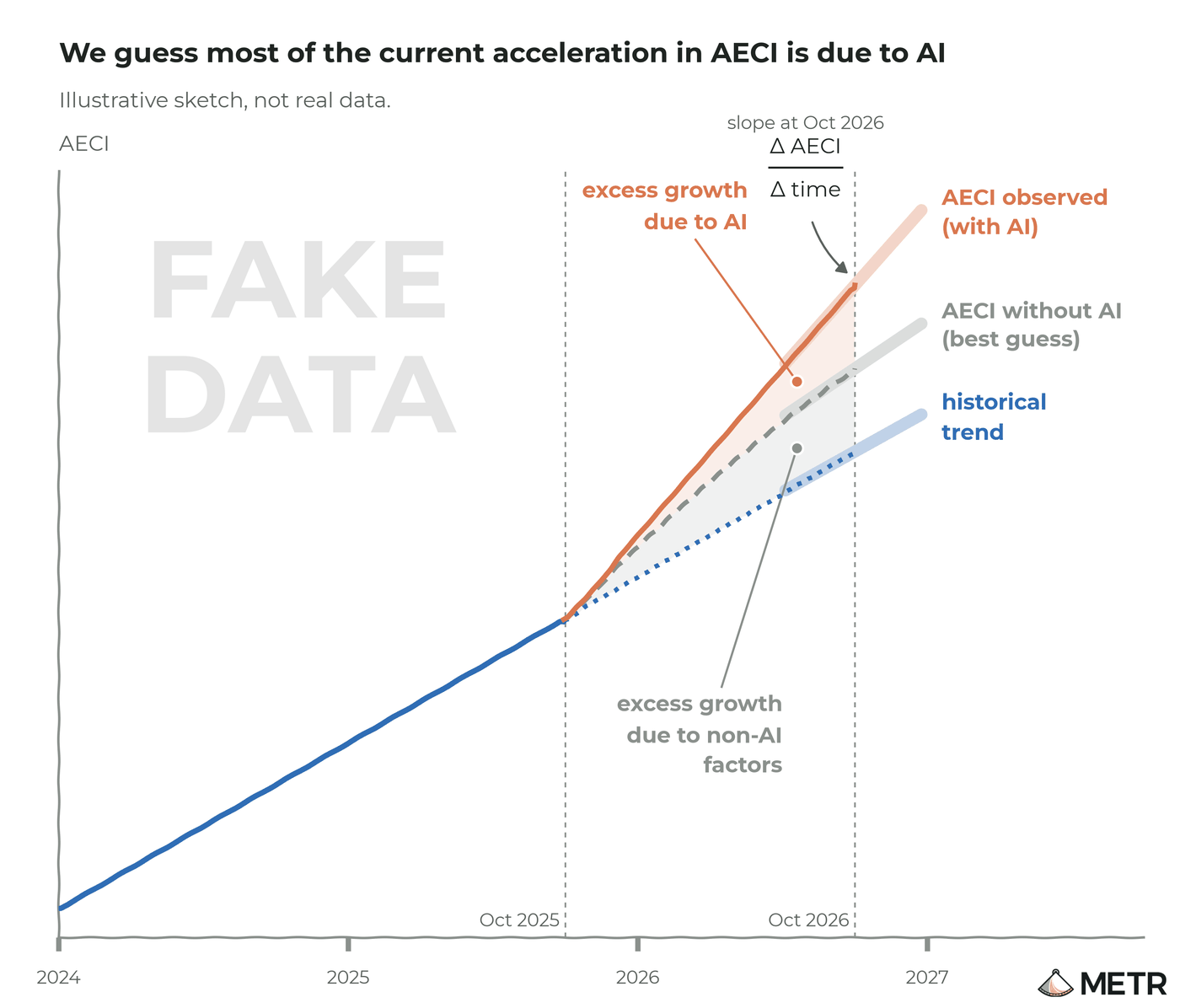
The report was published on the METR blog on November 5, 2026, and describes work conducted from August 12 to October 29, 2026: the team received high-level access to Anthropic's internal data and relied on triangulation—the internal AECI (Anthropic Epoch Capabilities Index), interviews, and employee self-reports on work speed. The headline estimate is roughly 2x acceleration in model capability improvement, with a full uncertainty range of 1.3x–3x. According to the AECI index, the growth rate increased from approximately 15 to approximately 29 points per year, meaning a coefficient of 1.9x with a 95% confidence interval of 1.5–2.8x, which aligns with the headline but allows for a more modest effect. The most striking number is employee self-reports of acceleration up to approximately 12x on the latest internal model, Model 4, compared to approximately 1.2x in early 2025. Alongside this, METR explicitly states that it failed to identify convincing bottlenecks—in compute, data, or algorithms.
Context
The debate over whether AI tools accelerate the creation of more powerful AI predates this measurement: until now, it relied on reasoning, predictions, and indirect demonstrations, because internal data from frontier model developers had not previously been seen by external teams. METR is an independent organization for model and threat evaluation (Model Evaluation and Threat Research), and its work became the first independent high-access measurement of this type at one of the leading laboratories. A fundamental methodological detail: the primary measurement was performed on well-defined tasks, precisely where AI assistants are strongest, and extrapolating the results to open and poorly defined research problems does not follow from this data. The internal model Model 4, mentioned in the self-reports, is not a public product: available materials contain no data on its API, price, or latency. The report's methodological framework—deep interviews, telemetry, verified self-reports, and capability growth rate indices like AECI—is itself part of the result: it sets a standard for how to measure AI's contribution to research productivity instead of abstract predictions.
Why this matters for the industry
For the industry, the report provides the first external benchmark on the topic of acceleration: laboratories and product teams now have a measurable reference point, in the form of a double rate of model improvement with 80% attribution to AI, which can be relied upon in planning and debates about timelines. Simultaneously, the report strengthens the negotiating position of laboratories, which can now argue for increasing their pace; the consequence for everyone else is that features around frontier models become obsolete faster, and teams should re-check their roadmaps, removing features that the next model will likely absorb in the next two releases. If bottlenecks truly do not emerge, a denser schedule of capability updates should be expected: eval suites are rebuilt more frequently, RAG indexes and fine-tunes are updated, and capacity plans and budgets are revised for each new model. In a scenario of sustained compound acceleration, where AI tools accelerate the creation of more powerful models, which in turn enhance the tools themselves, the advantage around a fixed model version quickly becomes obsolete, and defensibility shifts to data, integrations, observability, and independent internal quality measurements.
Why this matters for users
Immediately, nothing changes for the products and tools readers use every day: this is a report, not a launch, it does not open new APIs or models, and Model 4 remains an internal Anthropic development. The practical value for the reader lies elsewhere: the full report is open on metr.org, and in one place it shows how an independent organization measures AI acceleration through a capability growth index, interviews, and verified self-reports. This is a clear example of the difference between a controlled measurement and a loud number like 12x, which an employee reports about their own speed, and an honest demonstration that subjective self-reports are biased upward and require verification. Finally, if METR's conclusions are correct, stronger models will appear more frequently than before, and the independent assessment sets a benchmark for timeline expectations, which is useful to check alongside the laboratories' own announcements.
What is still unknown / limitations
The headline of approximately 2x relies on the internal AECI index and partially on employee self-reports; the lower bound of 1.5x according to AECI allows for a significantly more modest effect. Self-reports on speed are subjective, inherently biased upward, and are not equivalent to controlled measurements, meaning the maximum figures from them cannot be considered fact. The measurement was performed only on well-defined tasks, so extrapolation to the laboratory's entire R&D does not follow from this data. There is no external replication of the conclusions in available materials: triangulation largely relies on Anthropic's own data. It is also unknown whether bottlenecks will remain unfilled further: the compound acceleration scenario remains a hypothesis, and its economic side, including the growing cost of each subsequent model, is beyond the scope of this assessment.
Sources
- Independent Assessment of AI R&D Acceleration at Anthropic in October 2026 — METR
- METR: Independent Assessment of AI R&D Acceleration at Anthropic in October 2026 — AI Alignment Forum
- Independent Assessment of AI R&D Acceleration at Anthropic in October 2026 — METR Substack
Author
Look at AI, editorial team