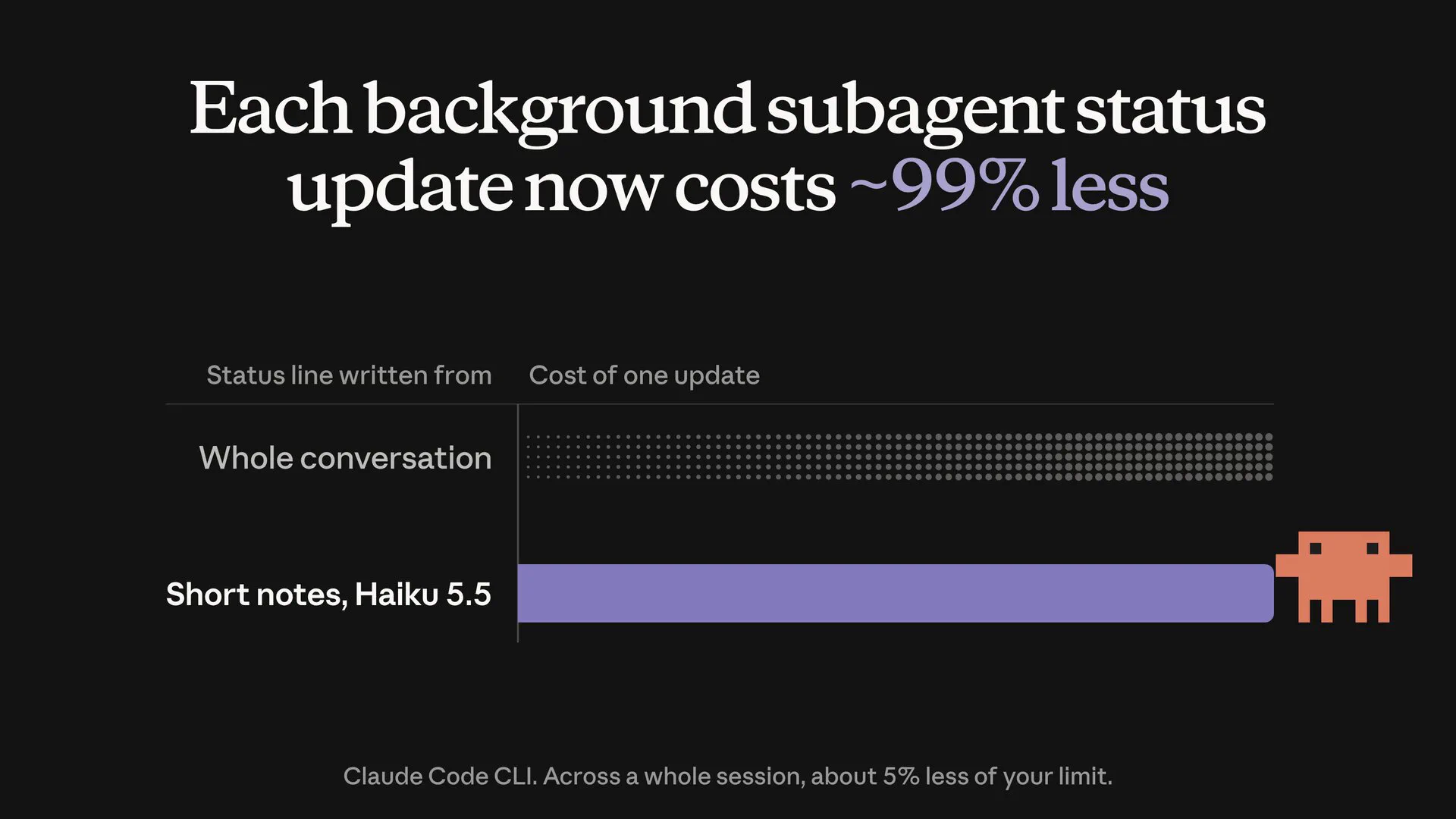
Anthropic has confirmed and resolved token overconsumption in Claude Code: long sessions were losing their limit not on useful work, but on administrative operations. Background subagents, engaged in code review and testing, constantly updated the status line, and the base model re-read the entire conversation history for each such line. Now, the status is generated by the low-cost Haiku 5.5 model based on short notes, without reading the full context, so updating Claude Code returns several percent of the limit to command-line users for free. This case is illustrative as a clear example of how routine agent calls are made cheaper by routing to a compact model directly within a finished product.


What happened
Background subagents in Claude Code, performing code review or running tests, updated the status line every 30 seconds, and with each update, the base model re-read the entire conversation history. According to technical reports from users, these administrative calls consumed up to 16 percent of the token budget in a session, and after complaints, Anthropic publicly confirmed the issue and then released a fix. Now, the less resource-intensive Haiku 5.5 model generates the status line: it relies on short notes and does not read the full context, so the cost of an individual status update, according to the company's estimate, has decreased by approximately 99 percent. The change was included in the Claude Code v2.1.316 release and later and works only in the CLI.
Context
The reason for such losses lies in the economics of long-running agents: long sessions are filled with administrative traffic—statuses, progress summaries, notifications—which formally does not relate to useful work but consumes the same tokens. The price of each administrative operation is determined by the volume of context re-read, so routine where an expensive model duplicates reading the entire conversation history turns into a hidden and rapidly growing expense item: the longer the session, the more expensive each such call becomes. Notably, users themselves reported the issue, and the vendor officially acknowledged the described mechanism of overconsumption instead of leaving it unaddressed—such acknowledgments are rare in the industry and increase trust in the official analysis. The fix itself relates not to the models, but to orchestration: a routine subtask with reduced context can be delegated to a compact model, keeping the flagship model for the work for which the agent was launched.
Why this matters for the industry
For the industry, the value of the case lies not so much in the bug fix itself, but in the transferable pattern: agent administrative operations—status lines, logging, intermediate summaries—should be moved out of the base model's context and delegated to a cheap model based on compressed notes. The incident showed that in agent products, a significant share of tokens goes not to useful work, and the platform can plug such a hole itself with a single patch, as Anthropic did. Teams building multi-agent pipelines and long-running scenarios should check their own cycles for hidden re-reading of the full context: similar patterns of administrative calls are often found in custom orchestrators. A likely, though not guaranteed, consequence is the consolidation of two-tier routing in agent SDKs and frameworks, where the distribution of subtasks by criticality and cost will become a standard part of the runtime.
Why this matters for users
The practical part concerns those who run Claude Code in the terminal. It is enough to update to version v2.1.316 or later, for example with the command npm update -g @anthropic-ai/claude-code—the way of working does not change. In sessions with background subagents, this returns approximately 5 percent of the limit for free, which corresponds to roughly 6 percent additional requests with the previous limit. The effect manifests only where background subagents are actually used: without them, the savings are close to zero. The desktop application has not yet received the optimization and continues to consume tokens according to the old scheme, so its users should wait for the corresponding update. However, savings on a single administrative call are not equal to savings for the entire session: administrative traffic constitutes only part of the total consumption, so expectations should be calibrated to the session level.
What is currently unknown / limitations
The stated savings (approximately 99 percent per status update and about 5 percent of the limit in a session) are estimates by Anthropic itself; there is no public measurement methodology for these figures, and no independent measurement has been conducted. The impact of the fix on status update latency and the quality of the generated status lines, which are now written by Haiku 5.5, has also not been disclosed. The savings apply only to the CLI; the desktop application still behaves as before. The forecast about the consolidation of two-tier routing in SDKs and frameworks is an interpretation, not a fact from sources, so transferring the pattern to own pipelines requires independent measurement, not copying vendor figures.
Sources
- Claude Code Update: Reduced Usage for Background Subagents — @ClaudeDevs (official Claude AI Developer Updates account)
- Claude Code background subagents now cost about 99% less per status update — daily.dev
- Anthropic just fixed a major token wasting bug in Claude Code — Coding Beauty
Author
Look at AI, editorial team