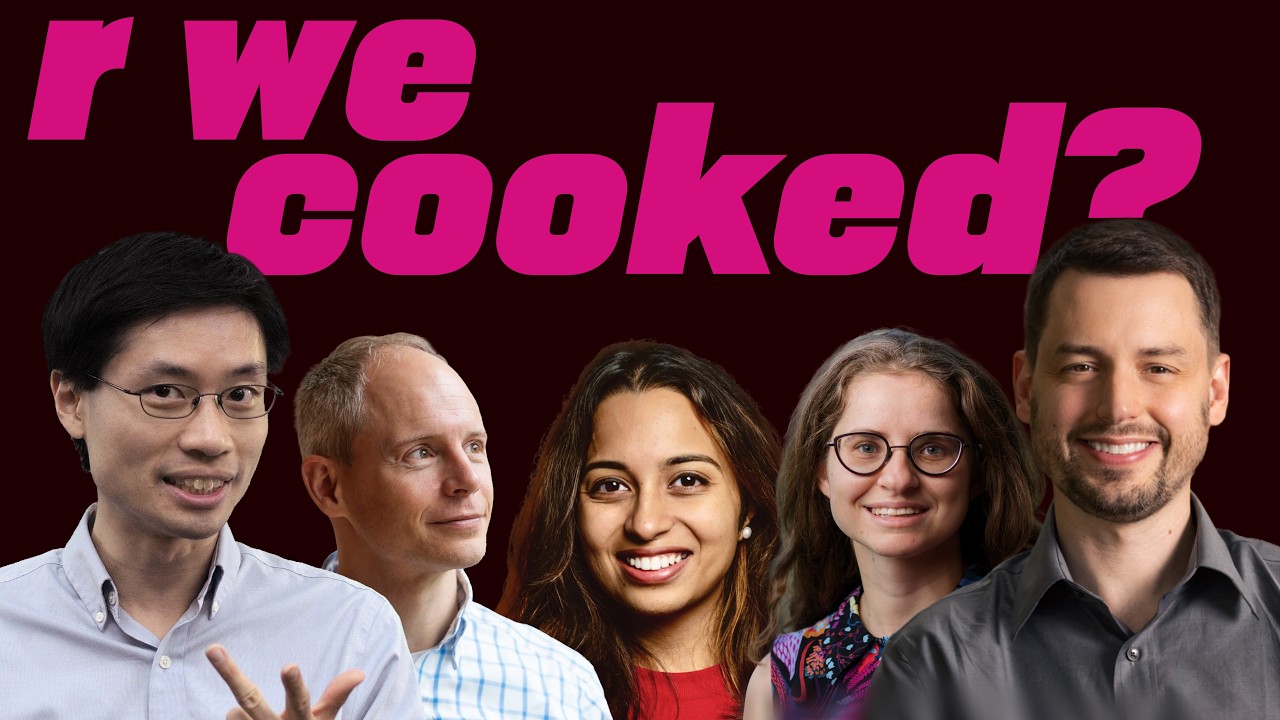
The Student Carnegie AI Safety Initiative (CASI) at Carnegie Mellon University published a recording of the 'Are We Cooked?' discussion on November 3, 2026, lasting 1 hour and 7 minutes: five CMU professors answer the question of what students should do when AI writes code and solves open mathematical problems. The main message from the participants: programming remains a fundamental skill, but hiring and academic evaluation criteria are shifting from the number of publications to trust, real-world problems, and relationships. The weight of the conversation is underscored by the participation of Zico Kolter, Director of the ML Department at CMU and Chair of OpenAI's Safety Committee.


What Happened
The panel was held as an open YouTube recording and had accumulated approximately 24.4k views by the time of the news publication. Five CMU professors participated in the discussion: mathematician Po-Shen Loh, former coach of the US Olympic Math Team; Zico Kolter, co-founder of Gray Swan; Daphne Ippolito from the Language Technologies Institute; Aditi Raghunathan; and Vincent Conitzer, head of FOCAL and the new CoRe Safe AI center. Lawrence Feng moderated the conversation. Four cross-cutting themes were discussed: whether to learn programming today, in what areas humans still surpass AI, whether AI alignment is possible when humans themselves disagree on goals, and how the shift from 'paper counts' to 'trust and relationships' will change hiring and academic careers. The professors also discussed what a student should study if choosing a major now.
Context
The impetus for the panel was growing student anxiety: generative models already write code and tackle open problems, calling into question the meaning of traditional career preparation in technology. CASI is a student AI safety initiative at Carnegie Mellon University, and inviting practicing professors became a way for the organization to bring their positions beyond the classroom. The significance of the positions is explained by the status of the speakers: these are active heads of ML structures and research centers, and one participant simultaneously leads OpenAI's safety committee. The declared shift in academic evaluation from the number of publications to trust and relationships fits into a broader debate about how formal metrics distort the choice of truly important problems.
Why This Matters for the Industry
For the AI industry, the panel is not a market event but a reputationally costly signal: writing code and counting publications are becoming cheaper as commodities, while trust, relationships, and the ability to drive real-world problems are becoming scarce. Teams have an argument to reconsider junior hiring and evaluation criteria: checking not formal metrics, but mastery of real tasks and the ability to verify model outputs. If the 'trust and relationships' thesis is adopted by other universities and labs, AI job postings will include more requirements for real projects and communication. In a two-year horizon, if the shift persists, new types of products are possible—portfolios of solved real-world problems, peer-review communities, and verified mentorship connections—however, in the source, this is a speculative interpretation, not a documented trend.
Why This Matters for Users
Readers have access to ready-made material: a 67-minute video is available for free on YouTube and is marked with timecodes by chapters, so one can jump directly to the most interesting question. Five practicing researchers offer advice of three types: what to study if choosing a major now; where they themselves apply AI in research and teaching and where they consciously refuse it, for example when preparing final texts; and which career framework is more important than the race for metrics—participants place 'intrinsic motivation' and 'sofa count' at the forefront. The panel is applicable within a team as a reason to discuss which skills to check in candidates and where to limit AI in one's own workflow.
What Is Still Unknown / Limitations
All key theses are public positions of the speakers, not scientific results: no statement is accompanied by methodology, control conditions, or a benchmark. The claim that AI solves open mathematical problems is an observation by practicing researchers, primarily Po-Shen Loh, and requires a critical attitude until independent confirmation. The thesis about the shift in hiring toward 'trust and relationships' remains a hypothesis: the materials contain no data on demand and no documented example of changed criteria, so drawing market or product conclusions from a single panel discussion is premature. The listed topics concern the future, and the panel does not provide a methodology for tracking such shifts. For a two-year horizon, the source describes two scenarios—a real shift in criteria or a one-off discussion against the backdrop of an ongoing publication race—without providing data in favor of either.
Sources
- Are We Cooked? CMU Faculty on AI, Careers and Learning (Carnegie AI Safety Initiative, YouTube)
- Are We Cooked? CMU Faculty on AI, Careers and Learning — CoRe Safe AI (LinkedIn)
Author
Look at AI, editorial team