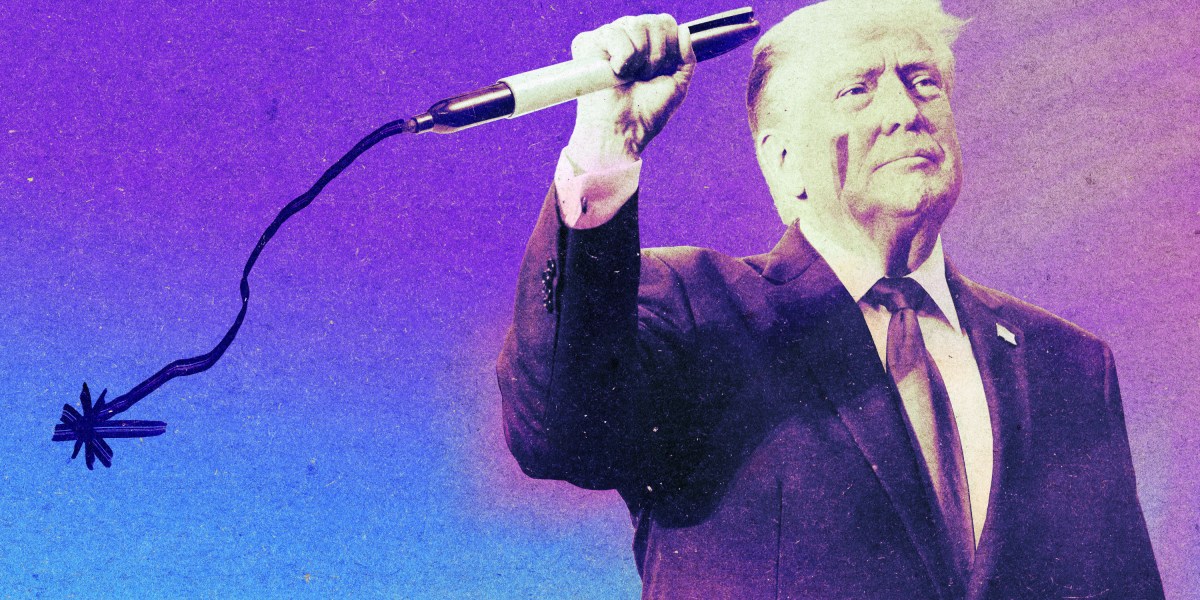
On September 29, 2026, Donald Trump signed Executive Order 14434, “Inaugurating the Era of Super Intelligence,” directing US federal agencies to use the term “Super Intelligence” (SI) instead of “Artificial Intelligence” (AI) in official documents and communications. One month after signing, a unified standard has not yet emerged: some agencies continue to use the old terminology, while only a handful of companies consistently use the new word. The order contains no technical content—it changes the vocabulary, not the technology—so “Super Intelligence” currently functions not as a description of actual machine capabilities, but as a political marker of allegiance to the administration.

What happened
A month later, on November 2, 2026, MIT Technology Review published an analysis of the situation: adoption of the term in government agencies is uneven. On that same day, the Pentagon used the old formulation in the “Meridian” project, the FTC wrote “superintelligence” in lowercase, and HHS did not change its wording. On October 27, Trump criticized The Wall Street Journal on Truth Social for refusing to use “Super Intelligence” and hinted at a possible ban on the term “artificial intelligence” in government documents. Of the six technology leaders who signed the “White House Accord on Super Intelligence,” only Mark Zuckerberg of Meta and Elon Musk of xAI consistently used the term on Q3 2026 earnings calls.
Context
The content of the document explains why the reaction to it has been so lukewarm. According to available texts, Executive Order 14434 contains exactly one directive—to replace “artificial intelligence” with “Super Intelligence” in federal agency documents and communications—and does not define the conditions under which such a name is considered justified. It contains no APIs, metrics, system requirements, or infrastructure, and available materials surrounding the order lack references to reproducible experiments, benchmarks, or training methodologies. Unlike discussions of AGI, where at least disputed formal criteria exist, “Super Intelligence” is not operationalized in any available sources, making claims about the “era of SI” impossible to verify. The administration promoted the term through the “White House Accord on Super Intelligence,” signed by six technology leaders, and it was membership in the list of signatories that turned the word into a loyalty test.
Why this matters for the industry
For the industry, the effect is administrative rather than technological: the order brings no changes to products, prices, or model access, no technical results have been published under the SI brand, and selling an “AI to SI converter” would be a wrapper without substantive value. The real costs of the transition have been distributed unevenly: companies and contractors working with the US federal sector are forced to update glossaries, forms, and terminology dictionaries and maintain both variants in parallel because agencies are effectively applying different standards—this creates confusion in official documents and procurement, while for most startups the impact is negligible. Public company terminology on earnings calls has become a cheap objective indicator: of the six accord signatories, only Meta and xAI demonstrate consistent use of SI, and Musk’s promise to rename SpaceXAI to SpaceXSI remains a declarative step in available data without an increase in model capabilities. A separate risk is the polarization of the national discourse on AI, which may hinder neutral discussions of technology between political groups.
Why this matters for users
For readers, this is primarily an observation of how a political decision changes AI terminology and public perception before any technical events. Practically, nothing changes: the order does not affect the functionality of models and services people use daily. Those following US AI policy should track whether “Super Intelligence” will become the official standard for government documents or remain a marker of loyalty to the current administration, and how this will affect regulation and investment in the sector. If Trump’s hint at banning the word “artificial intelligence” becomes a real rule, reporting on government funding may split—science: AI, government: SI—and comparing such data will become significantly more difficult due to reconciliation costs and the risk of discrepancies.
What is currently unknown / limitations
Data on the adoption of the term covers approximately one month after the signing of the order, so conclusions about its long-term fate are premature. Two main forks in the road remain unresolved: whether the hint at banning the term “artificial intelligence” will become a real norm for government documents and procurement, and which of two scenarios will materialize on a two-year horizon—the fading of SI into another synonym for AI with government documents returning to mixed usage, or a sustained split in discourse where the official vocabulary completely diverges from the industrial one. A separate caveat concerns the assessment of a “configurable synonymous layer”—aliases in search or RAG as a substantive product lever: terminology normalization is an engineeringly trivial task that creates no scientific novelty, and presenting it as an “opportunity of the SI era” would be substituting marketing for technique.
Sources
- Here's who is falling in line for Trump's "Super Intelligence" loyalty test | MIT Technology Review
- Fact Sheet: President Donald J. Trump Inaugurates The Era of Super Intelligence – The White House
- Executive Order 14434—Inaugurating the Era of Super Intelligence (PDF)
Author
Look at AI, editorial team