The 'Neuronaut' channel published its 35th roundup of tools for the open-source video model MiniMax-H3, whose base on Hugging Face has accumulated over 6.1 million downloads. The main announcement is MiniMax-H3 Prompt Rewriter 0.32.x with RefMod support: a ready-made character reference, including appearance and voice, from a single file. Together with the Rapid-H3 accelerator and the ComfyUI-H3-RelayHires upscaler, the roundup shows how the ComfyUI ecosystem, without changing the base model, turns single generations into an editable production pipeline.
What happened
The 'Neuronaut' channel published its 35th roundup of tools for the MiniMax-H3 video model. The central announcement is MiniMax-H3 Prompt Rewriter 0.32.x by author @Aleks_101: the pytraveler/ComfyUI-MiniMaxH3Mod package, release v0.32.0 from October 25 in the MiniMax-H3-Prompt-Rewriter-ComfyUI repository. The version brings RefMod support — a ready-made character reference with appearance and voice from a file. The RefMod node received two outputs and a strength parameter, Reference Encode is used instead of slot combinations, the set includes a 'RefMods to video' template, and RefMod tokens are collected from HF files, but generation with them is slower. Rapid-H3 is a ComfyUI package with INT8 sm_121 cores that speeds up H3 by 3–5 times on NVIDIA DGX Spark (GB10) and comes with presets for approximately two minutes per clip. ComfyUI-H3-RelayHires is an anime video upscaler from 0.5 to 2 MP, approximately 4 times faster than native without turbo-LoRA: the full first run is performed in 20 steps, and the package includes 8 workflow examples.
Context
MiniMax-H3 is an open model for generating video from text and images with built-in synchronized audio, distributed via the MiniMaxAI/MiniMax-H3 repository on Hugging Face, and all announcements in the roundup are tools built on top of its unchanged weights. This is not a model breakthrough, but a phase of maturity in the open-source ecosystem: the channel has reached its 35th thematic roundup in a short time, and the ComfyUI stack addresses production tasks around the model, not within it. Notably, quality recipes are essentially compensatory: isolated face refinement and separate post-upscaling patch sampling and resolution limitations without eliminating them in the model itself. This trajectory is already familiar from Stable Diffusion and large language model ecosystems: the layer of scenarios, characters, and assembly gradually decouples from a specific base model, allowing tools to survive weight changes.
Why this matters for the industry
For studios and pipeline developers, the most important thing is that production cycle bottlenecks are addressed without changing the model: consistent characters via RefMod, speed on local hardware via INT8, resolution via post-upscaling, and seriality via scenario pipelines seriesmith and FrameForge, which manage episodes of 280–300 shots with a timeline, LLM scenario, and post-studio, already competing for the same niche. Single generations are turning into editable serial content, and local video generation is emerging as a standard production branch alongside API services. At the current release pace, standardization of reference-conditioning and quantization presets in the main ComfyUI stack is likely: if independent checks confirm INT8 acceleration and RefMod quality, these techniques will become the workflow default; if not, they will remain niche packages. The main risk for wrapper authors is devaluation: the next version of H3 with native reference and voice conditions and a faster sampler may absorb a significant part of this layer.
Why this matters for users
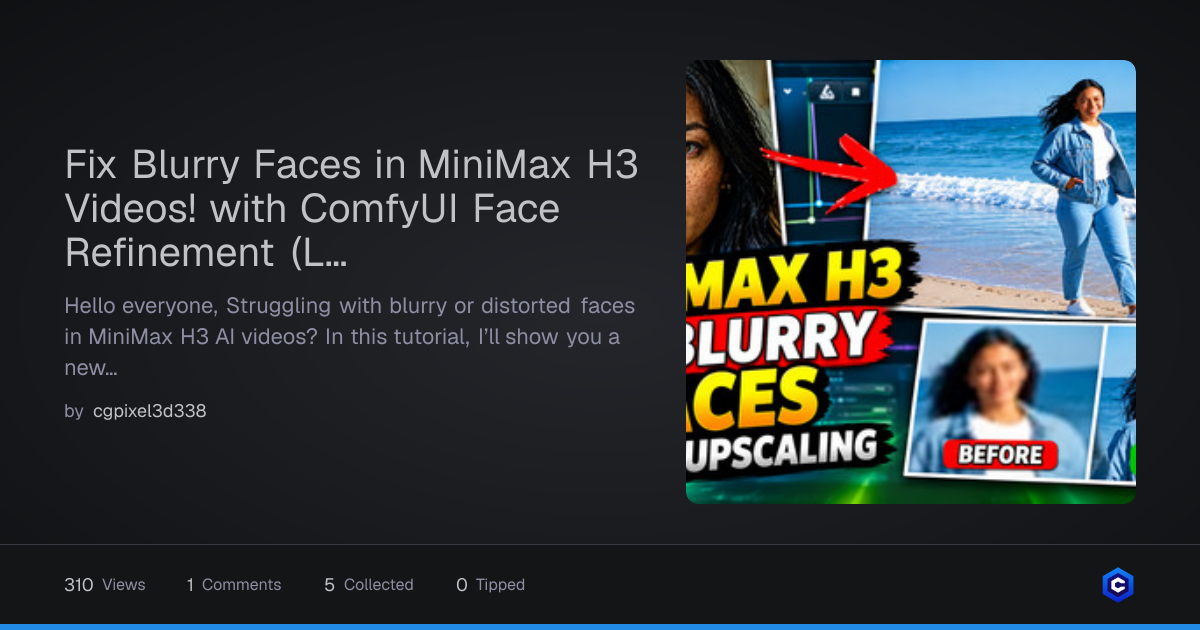
It is convenient to take a solution for a specific problem from the roundup, rather than the entire stack. If MiniMax-H3 is too slow, Rapid-H3 presets come into play; INT8 reduces calculation precision, but, according to the authors, without visible degradation of the result, although this should be rechecked on your own scenes. Soapy faces are treated with a second run with denoise 0.4 in an isolated Face Refiner: on an RTX 3060, the generation itself at 0.6 MP in 8 steps takes about 30 minutes, and the refinement takes another 24 minutes, meaning the full pipeline almost doubles the working time. The same character in different scenes is fixed via RefMod in Prompt Rewriter 0.32. Anime content is upscaled in resolution via RelayHires with its eight ready-made workflows. Long episodes are assembled in seriesmith or FrameForge, which have a timeline, LLM scenario, and post-studio; choosing between them, as well as between speed and quality, will have to be done based on your own hardware and task.
What is currently unknown / limitations
Key quantitative claims — multiple accelerations and 'no visible degradation' in quality — remain claims by the tool authors: there are no independent quality metrics after INT8 or comparisons with native precision in the sources. The Rapid-H3 demonstration is tied to NVIDIA DGX Spark (GB10), and the benefit on mass-market GPUs is not confirmed. RefMod has no metrics for appearance and voice drift, and the cost in the form of slowed generation is known from the description but not measured. Face Refiner metrics on RTX 3060 are a specific recipe with specific hardware, not a general benchmark. The formulation 'bottlenecks are closed' is correct at the level of available tools and demo samples, not verified production; the maturity of serial pipelines on full-size episodes still needs to be tested.
Sources
- MiniMax-H3-Prompt-Rewriter-ComfyUI — release v0.32.0 with RefMod support
- Rapid-H3 — MiniMax-H3 text/image to video+audio 3–5× faster on NVIDIA DGX Spark (INT8 sm_121, ComfyUI node pack)
- Fix Blurry Faces in MiniMax H3 Videos! with ComfyUI Face Refinement (Low VRAM Workflow) — Civitai Articles
Author
Look at AI, editorial team