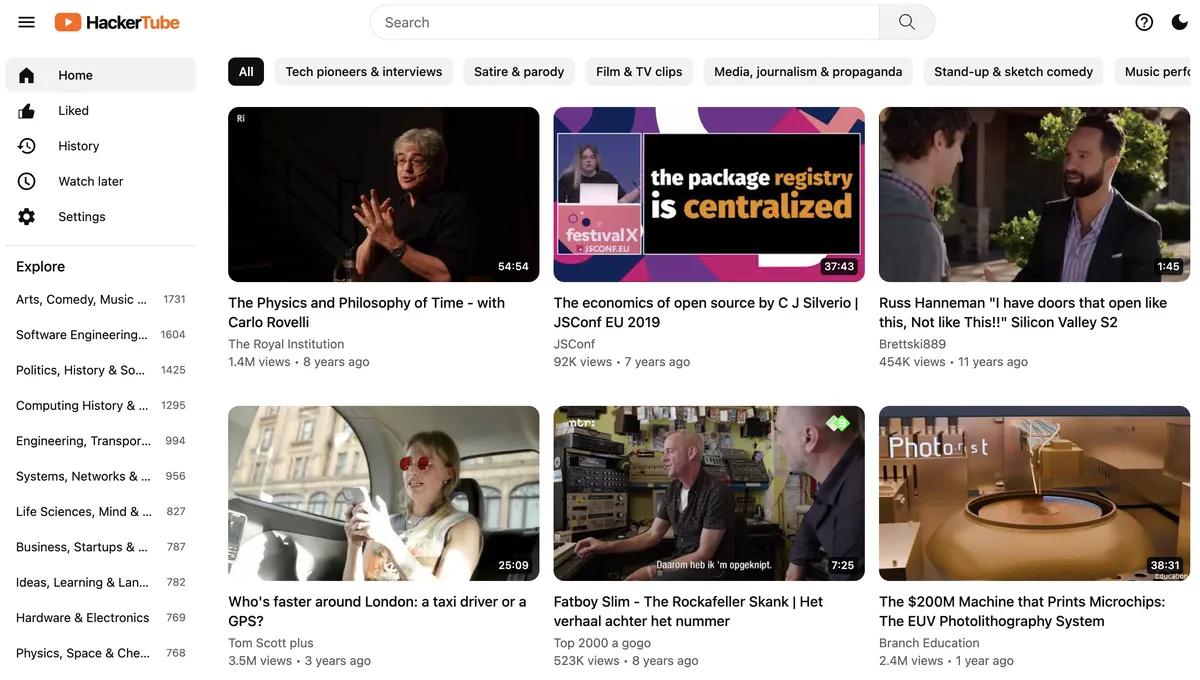
On October 31, 2026, Andrej Karpathy launched HackerTube, a video service composed exclusively of clips that Hacker News commenters recommended to one another between 2007 and 2026. According to the author, the entire path from the raw comment archive to a working site was handled by the Claude Code assistant: the Claude Opus 5.5 model managed architecture and deployment, while Claude Sonnet performed mass filtering of the recommendation stream. The catalog ended up with 6,454 videos across 150 topics, and according to Karpathy, the entire build took about two hours, during which he personally did not write a single line of code.

What happened
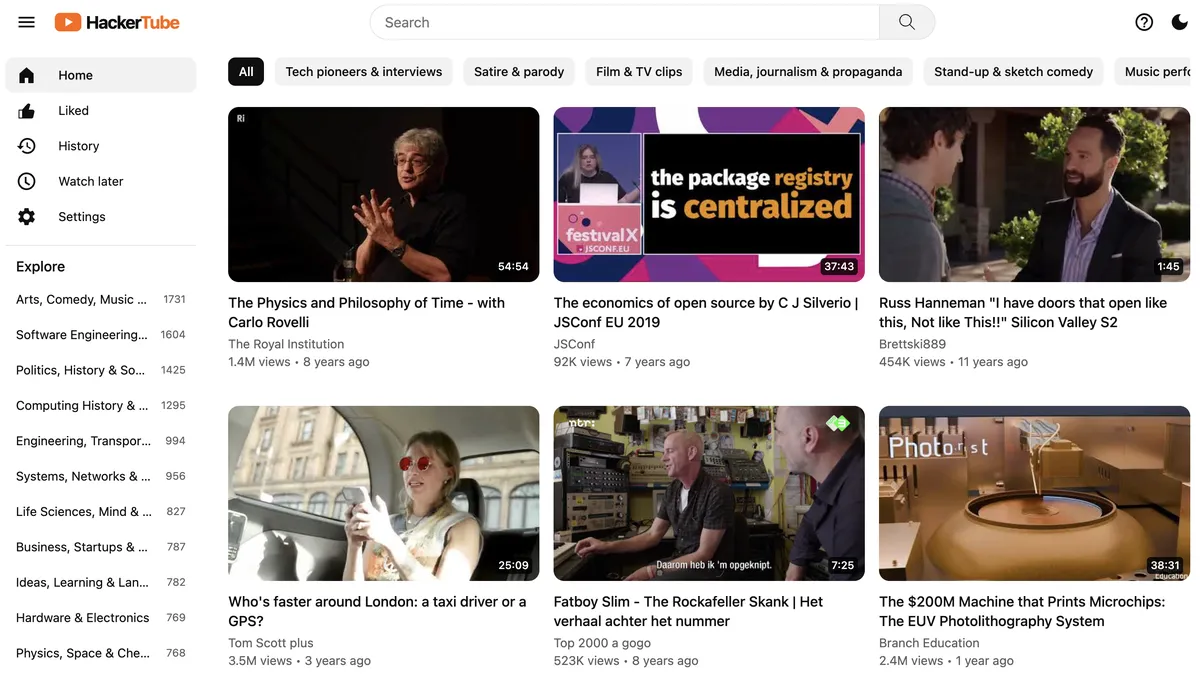
The foundation of the project was the open Hacker News comment archive — the open-index/hacker-news dataset published on Hugging Face. Within the Claude Code Workflow, the Claude Opus 5.5 model downloaded this archive, planned the product architecture, and took it through to deployment, while the cheaper Claude Sonnet performed filtering: it removed spam and identified approximately 40,000 recommendations from community comments. From the selected material, a catalog of 6,454 videos distributed across 150 topics was formed. Karpathy counts exactly three steps that the agent did not cover: creating a Google Cloud API key for YouTube metadata, setting up a VPS, and buying a domain. The site itself works without registration: the personal For You feed is generated and stored in the browser's local session, a frame at the 50% mark of the video is shown instead of clickbait previews, and hotkeys and full data export have been added.
Context
The case should be evaluated not by the video service itself, but by the method of its creation. In Claude Code, the expensive orchestrator Claude Opus 5.5, which according to AICoder News costs $4 per million input tokens and $20 per million output tokens, was responsible for architecture, interface, security, and deployment, while the cheap worker Claude Sonnet ran mass filtering of tens of thousands of comments. Running a homogeneous mass task with an expensive model would be meaningless in terms of costs, so this is a conscious optimization of token expenditure, not a bet on a single universal model. The second line of context is the data itself: Hacker News comments over nineteen years represent an informal but massive layer of human recommendation that had remained buried in discussion threads until now. Publishing the open-index/hacker-news dataset on Hugging Face made this layer accessible for machine processing, and from years of "crowd" curation, a ready-made media catalog can be extracted — a counterpoint to algorithmic feeds built on behavioral signals.
Why this matters for the industry
The industry significance of the case is a benchmark for speed and cost. If the two-hour estimate is confirmed, the full cycle of releasing a small web product — from a raw dataset to a site on a dedicated VPS, including interface, security, and hardening — fits into hours rather than weeks, and proceeds without manual programming. The consequences are twofold: product creation costs collapse, but any economic moat built on code as such also becomes cheaper, down to the level of a reproducible pipeline. The "expensive orchestrator plus cheap worker" pattern is already being copied within Claude Code, so in the coming months, a wave of niche builds of the "HackerTube for X" variety on open datasets and replicas handed to their own agents is likely. In parallel, demand for evals and observability specifically for agent pipelines is growing, and the orchestrator-plus-worker scheme risks becoming the default in agent development tutorials. On a two-year horizon, with independent confirmation of the pattern, the economics of small web products shifts toward a "one person plus agents" model, and the value of the engineer moves from writing code to designing pipelines, evals, and operational ownership of the product.
Why this matters for users
For the reader, the benefit is direct and twofold. On one hand, hackertube.org opens without registration: you can browse nineteen years of what the Hacker News technical community considered worth watching, build a personal For You feed that lives only in the browser's local session, use hotkeys, and not see clickbait previews — instead, a frame at the 50% mark of the video is shown. On the other hand, the entire dataset is exportable, so it can be handed to your own agent to build an analog on a different corpus, for example on recommendations from another community, repeating the same "cheap model filters, expensive model orchestrates" scheme. Thus, HackerTube works simultaneously as a video service and as an open-source example of a product build executed by agents without manual code.
What is currently unknown / limitations
The key figures of the case remain the author's self-report for now. The "about two hours" estimate and the "did not write code" claim are not supported by methodology: there is no number of agent iterations, process logs, token cost accounting, or filtering quality metrics — it is unknown how accurately Claude Sonnet separated real recommendations from spam and what was lost in the process. The figure of 40,000 identified recommendations is also cited from the author's words. The pattern "reproducible today" is a statement about model capabilities, not a documented replication: there are no independent replications of the case confirming the timelines and quality yet. Until such replications occur, it is correct to interpret "two hours" as a marketing estimate, while the verifiable parts remain the artifacts themselves: the hackertube.org site, the open-index/hacker-news dataset on Hugging Face, and Karpathy's blog post.
Sources
- Andrej Karpathy — post about HackerTube on his blog (October 31, 2026)
- HackerTube — project website
- AICoder News — analysis of the HackerTube case
Author
Look at AI, editorial team