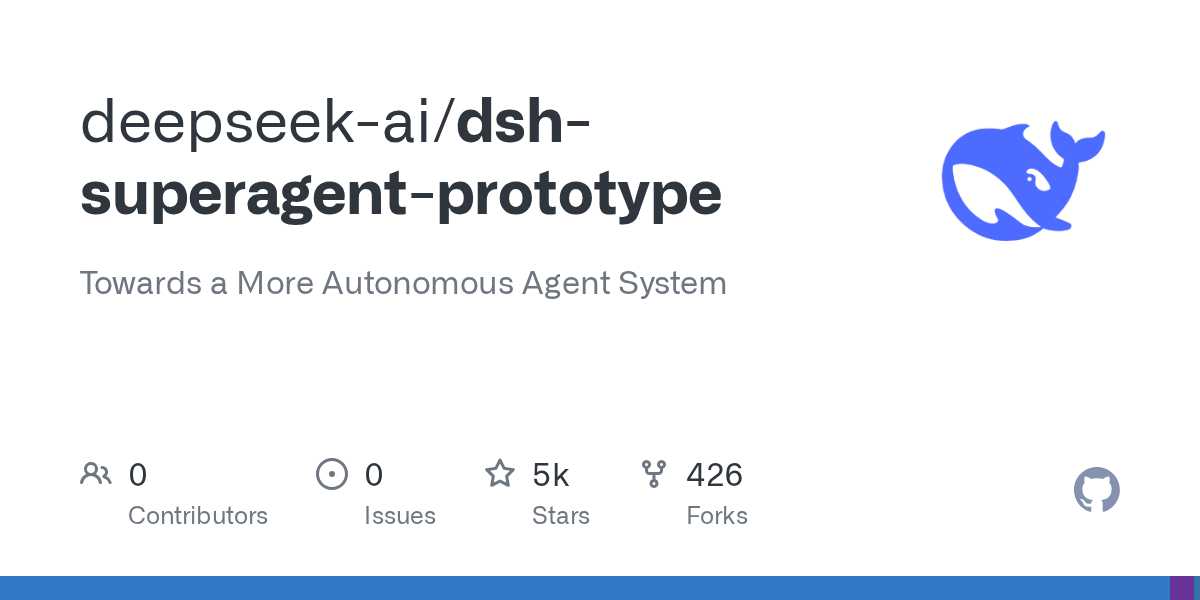
On October 31, 2026, the DeepSeek Harness team published a research prototype of a proactive coding agent, dsh-superagent, on GitHub: the repository deepseek-ai/dsh-superagent-prototype is available under the MIT license, and the code is written in TypeScript. The agent works with a single GitHub repository, listens to GitHub events and optionally Feishu, and returns the result of its work, such as a pull request. DeepSeek itself describes the project as research rather than a product, although the press immediately framed it as a direct challenge to Anthropic's Claude Code.
What happened
The release took place on October 31, 2026: the DeepSeek Harness team uploaded the repository deepseek-ai/dsh-superagent-prototype and the accompanying article “Exploring Super-agent Design” to GitHub. The prototype is tied to a specific GitHub repository: the agent subscribes to GitHub events and, at the team's discretion, to Feishu, converting authorized requests into parallel work items, each of which is executed in a separate session; the outcome is returned as a result, such as a pull request. The orchestration is built on a Router-Worker scheme: a persistent router receives incoming events and distributes tasks to isolated workers. Community attention has been high — as of November 1, 2026, the repository had gathered approximately 4,600 stars and 426 forks.
Context
Development agents have long been a frontier of competitive rivalry: Anthropic with Claude Code and OpenAI's tools have formed a category of assistants that take on part of an engineering team's routine. DeepSeek is entering this territory with record resources: ahead of its IPO, the company raised its largest funding round — approximately 100 billion yuan, roughly 15 billion dollars. The decision to publish the prototype under the MIT license changes the plane of competition: instead of closed orchestration development, the market receives an open framework against which its own projects can be benchmarked. A characteristic design detail is authorization-first: the prototype listens to channels but acts only upon explicit permission, reflecting the team's thesis that the bottleneck in multi-agent systems is shifting from model capabilities to human attention.
Why this matters for the industry
For the industry, the release functions not as the launch of a finished competitor, but as a signal: a company with a resource surplus ahead of its IPO is deliberately entering development agents and releasing the Router-Worker architecture into the public domain, providing everyone with a free public reference. This accelerates the commoditization of the agent layer on top of GitHub: the pattern of “listening to channels, parallelizing work, and returning a pull request” can now be read in code and transferred to one's own products without licensing restrictions. Resources of this scale have the potential to put pressure on the prices of agent tools, although there are no pricing commitments in the release materials themselves. If the prototype survives the closure of open issues, it risks becoming a forking point for derivative systems and a reason for the first independent comparative benchmarks of proactive agents; a more distant perspective is a shift in competition from model quality to the reliability and manageability of agent infrastructure: authorization, observability, and execution cost.
Why this matters for users
The practical value for the reader is open right now: the repository can be cloned, and the documentation can be examined by sections — Philosophy, Domain model, Authorization, Execution, and Architecture — this is a rare case where the workings of a proactive agent system are visible not through a press release, but through code. From there, specific decisions can be extracted: how to listen to GitHub and Feishu events, how to limit the agent to explicit team permission so that it does not consume the attention of the entire group, and how to format the final work as a pull request. These findings are applicable to one's own tools regardless of the fate of the prototype itself. However, using dsh-superagent as an everyday working tool is still premature: this is research code, and it should be treated as a constructor of ideas and a task list for one's own agent platform.
What is still unknown / limitations
The main question remains open — how well the prototype works: there are no benchmarks, SWE-bench equivalents, comparisons with Claude Code, or data on latency, cost, and quality in the public materials, so the status of “competitor” is a press framing, not a technical conclusion. DeepSeek itself indicates that parts of what is described in the article “Exploring Super-agent Design” are not yet implemented, and the assumption of parallel work items without quality degradation remains an unverified hypothesis. Repository statistics are provided as of November 1, 2026, and change rapidly; conclusions about the impact of funding on price competition are an interpretation, not a confirmed plan.
Sources
- GitHub — deepseek-ai/dsh-superagent-prototype (Towards a More Autonomous Agent System)
- DeepSeek launches Super-agent coding tool to rival Anthropic — The Straits Times
- DeepSeek releases open-source Super-agent coding tool to rival Claude Code — AI Understanding
- DeepSeek drops enhanced coding agent with aim to rival Anthropic — Bloomberg
Author
Look at AI, editorial team