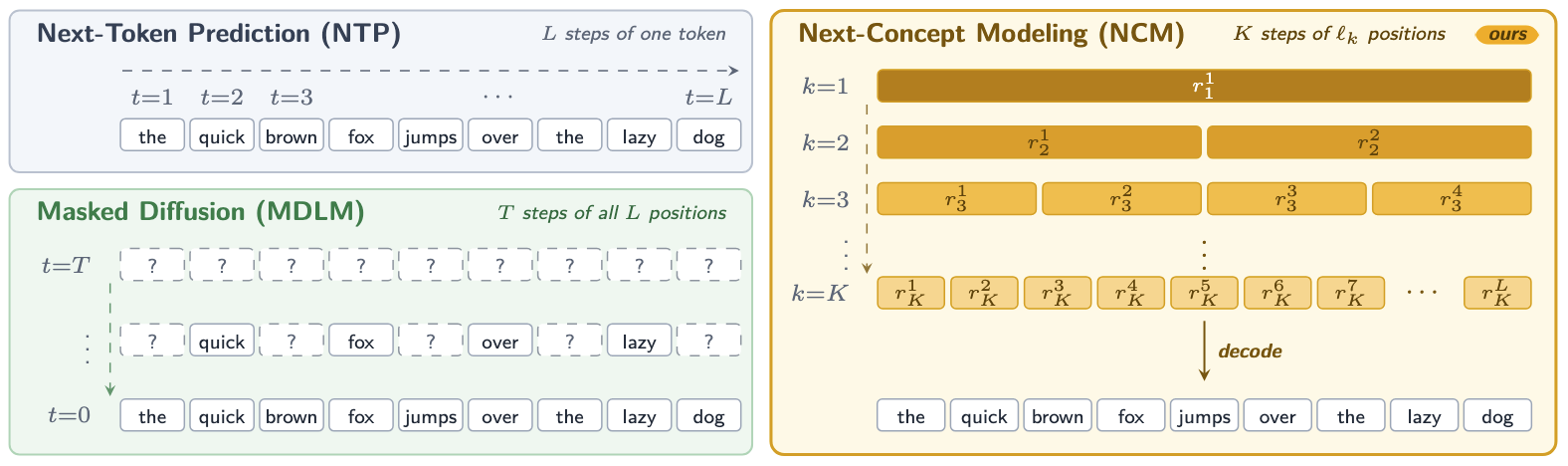
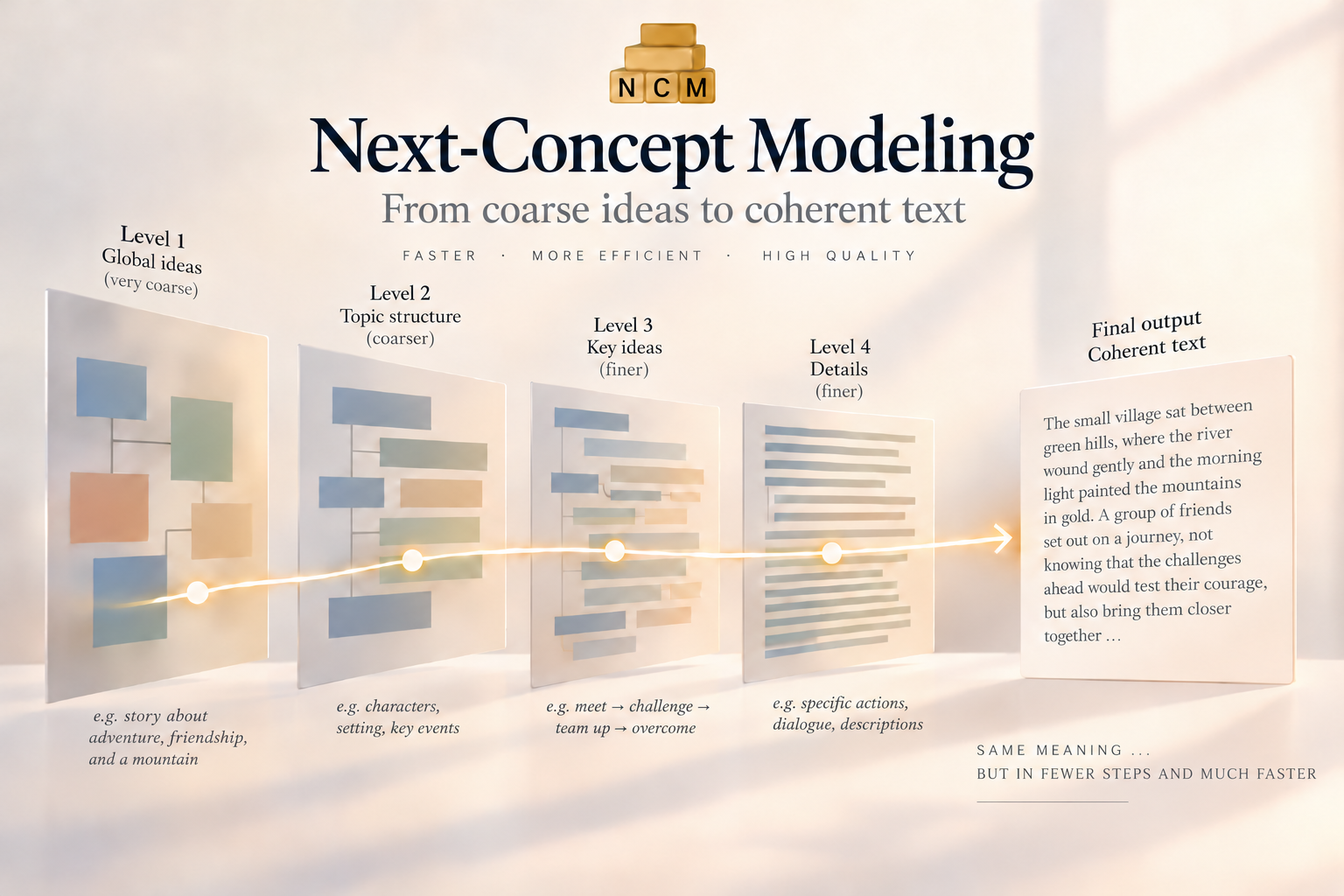
Researchers from Stanford Hazy Research — Hermann Kumbong, Ishan S. Khare, Simran Arora, Azalia Mirhoseini, and Christopher Ré — have presented Next-Concept Modeling (NCM), a non-autoregressive text generation framework. The model writes text from coarse 'concepts' to details, navigating a hierarchy of discrete codes, instead of the word-by-word unfolding typical of today's LLMs. According to measurements published by the team, on a single GPU, NCM outpaces the strongest diffusion baselines by tens of times, while consuming significantly less data for training. The code, weights, and datasets are available in open access, allowing all key results of the paper to be verified independently.


What Happened
The work was released in several steps: on October 9, 2026, preprint 2610.14162 appeared on arXiv, on October 12, 2026, the laboratory published an explanatory blog post, and along with them, the code, weights, and datasets became available in open access. The framework is structured as follows: text is represented as a hierarchy of discrete codes, where upper levels encode large semantic 'concepts' and lower levels encode details, and all codes at a given level are predicted simultaneously in a single parallel pass of the transformer. On a single NVIDIA H100 SXM 80GB, the authors report generation 21 times faster than the strongest diffusion baseline on LM1B with the best perplexity, 10 times faster on OpenWebText, and 31 times faster on XSum summarization with comparable quality. On the reasoning task of Sudoku, NCM solves 99.5% of easy, 96.5% of medium, and 86.1% of hard boards, compared to 14.6%, 5.1%, and 1.0% for autoregressive models. The code is open under the MIT license; weights for task-specific models (XSum, WMT14 De-En, Sudoku, LM1B, TinyStories, OpenWebText) and datasets are located in the HazyResearch/ncm GitHub repository and in a collection on Hugging Face.
Context
The news is easier to assess against the backdrop of two existing families of generation. Autoregressive models write text token by token: each next token requires a separate pass of the transformer, so processing stretches with the length of the response, while diffusion language models reprocess the entire sequence multiple times and also spend many passes. Next-Concept Modeling occupies a third niche between these extremes: generation is organized by levels of the hierarchy, rather than by tokens or iterations over the entire sequence. Important context for perception: acceleration of generation in this field is almost always bought at the cost of quality, primarily perplexity, so the combination of speed, quality, and training data efficiency reported by the team appears rare and deserves attention beyond just another engineering optimization.
Why This Matters for the Industry
For the AI industry, the work directly concerns the fastest-growing expense item in LLM services — inference cost. Generating codes by levels rather than token by token reduces the number of transformer passes for a given text length; if the ratio is confirmed on larger models, serving large volumes of text will become cheaper in proportion, currently known only from the authors' measurements. The second economic promise is training: the claimed reduction in the training corpus by 4–5 times, if it survives scaling, will make experiments with new architectures cheaper and recalculate budgets for large projects. The test of both promises will be scaling: comparisons of NCM in the 1–10B range with optimized autoregression at equal compute will show whether the direction is viable for service generation. Until then, product stack changes are not happening: there are no public APIs or pricing, and open weights cover small task-specific models, not a universal assistant. In the coming months, it is logical to expect independent replications on open weights and follow-up works, and on a two-year horizon, a fork of scenarios is possible: in the optimistic branch, hierarchical coarse-to-fine generation becomes the third standard inference family for tasks with regular structure — summarization, translation, tasks with verifiable solutions; in the pessimistic branch, the method remains a research novelty.
Why This Matters for Users
For the reader, the main practical effect now is verifiability: the publication is accompanied by open code, weights, and datasets, and, according to the authors' calculations, the entire verification fits on a single NVIDIA H100 GPU, which is a rare level of transparency for a brand-new architecture. An engineer with such a card can reproduce the claimed accelerations and already build a demo of fast summarization or a draft generator today, although all integration wiring will have to be written by hand: hosted access and ready-made connections to popular stacks are not presented in the materials. For readers without their own H100, it remains to follow replications: if independent checks confirm the numbers on larger models, the first tangible effect will be faster and cheaper batch services like mass summarization or draft preparation, and later, potentially, more responsive assistants.
What Is Still Unknown / Limitations
Several circumstances require caution. The evidence base is built on small corpora (LM1B, OpenWebText, XSum, TinyStories) and specialized tasks (Sudoku, WMT14 De-En), so there is currently no basis to generalize the findings to larger models, long contexts, and live production; data on latency and throughput of real serving is also not published. Furthermore, the claimed acceleration is measured against diffusion baselines, and there is no direct comparison with optimized autoregressive generation in the materials, so NCM cannot be called fast relative to familiar LLM services based on these figures. Sudoku is a task with a single solution and deterministic verification, and the result on it does not prove the ability to reason in free form, for example in mathematics or programming. Finally, there are currently virtually no independent replications or significant community response, so all key figures remain author claims until independent verification, and confidence in them should be kept moderate.
Sources
- Next-Concept Modeling: Fast, Parallel Coarse-to-Fine Text Generation — Stanford Hazy Research blog
- Next-Concept Modeling: Fast, Parallel Coarse-to-Fine Text Generation (arXiv:2610.14162 paper)
- HazyResearch/ncm GitHub repository — NCM code, weights, and datasets
Author
Look at AI, editorial team