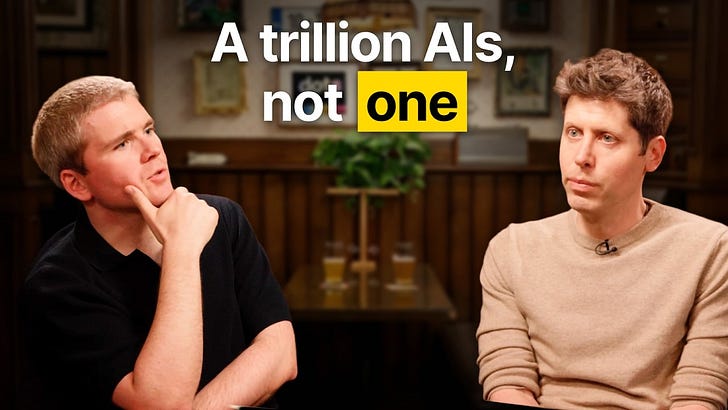
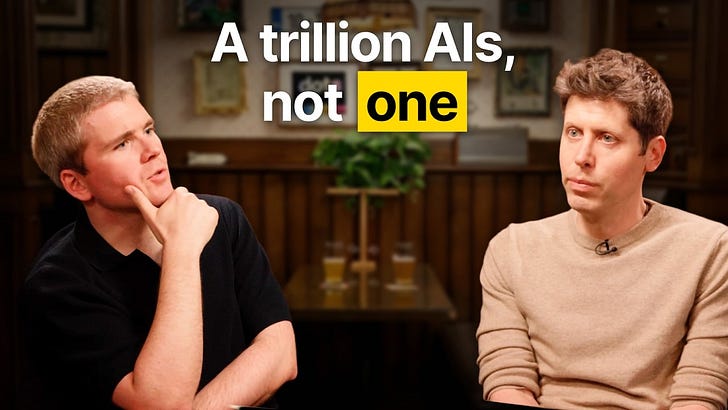
In the Cheeky Pint podcast, hosted by Stripe co-founder John Collison (who was mistakenly referred to as 'Patrick' in a Telegram post), Sam Altman stated that OpenAI's robotics program will be directed toward building data centers: AI-controlled robots are to launch chip factories, assemble turbines with solar panels, and construct new data centers, while 'self-replicating' data centers are, according to him, already 'within grasp.' Altman also announced that OpenAI has developed its own chip with high 'intelligence per watt' output, and estimated the construction of one gigawatt of compute with five years of operation at approximately $70 billion, against a target of $20 billion. For now, these are words from a conversation, not public results: the company has not shown the methodology, timelines, or specifications of the chip.
What happened
Sam Altman became a guest on the Cheeky Pint podcast, hosted by Stripe co-founder John Collison; in the Telegram post from which the news spread, Collison was mistakenly called 'Patrick.' In the conversation, Altman explained that OpenAI's robotics program will be directed toward building data centers: according to his description, AI controls robots that launch chip manufacturing plants, assemble turbines and solar panels, and build new data centers. He characterized the scheme of self-replicating data centers with the phrase 'within grasp.' There, he also stated that OpenAI has developed its own chip, outputting many 'units of intelligence per watt' — the amount of useful model work per one watt of energy. Altman estimated the current cost of building and operating one gigawatt of computing power for five years at approximately $70 billion, naming $20 billion per gigawatt as the target level. Explaining this economics, he referred to the fact that demand for sufficiently smart models at a sufficiently low price 'goes only one way.'
Context
The podcast statements describe a course toward vertical integration: OpenAI is trying to close the entire compute value chain — from its own chip to robotic construction of data centers and production of turbines and solar panels, meaning controlling not only models but also hardware, construction, and energy for new data centers. The link between the course and economics is the announced chip: in the company's logic, the 'intelligence per watt' metric should determine how much quality compute can be obtained for a given power and, consequently, at what price. However, the entire structure currently exists only at the level of words in a conversation: no metrics, benchmarks, or specifications have been published, and the only element of the block that can be checked with numbers is the stated gigawatt economics.
Why this matters for the industry
For the industry, this is a signal for cost planning, not for immediate action: the statement contains no timelines, API prices, or chip specifications, so building products 'on this' right now is not possible. The first practical consequence concerns everyone who signs or renews multi-year contracts for computing power: such agreements should include the right to renegotiate prices, because OpenAI publicly aims for a multiple reduction in the cost of owning compute, and if the plan is at least partially materialized, today's fixed rates will become suboptimal. The second concerns product teams and startups: do not build pricing on the expectation of falling inference prices, but keep a 'tokens became much cheaper' scenario in the backlog — a list of places where expensive model calls currently cut product quality, so they can be quickly enabled when costs drop. The expected market reaction is statements from competitors about their own chips and automation of production and construction, which, if the course is confirmed, will accelerate infrastructure cost reduction across the industry.
Why this matters for users
For the reader, nothing changes today: this statement adds no new prices, tariffs, or service availability. The significance of the event is practical and delayed: if the economics work at least halfway, inference and model training will become significantly cheaper, API prices will fall, and agentic products with a large number of model calls can be sold via subscription without risk to margin — with a lag, this will make long dialogues, deep RAG, and constant assistants more accessible. Words should be checked with numbers using three markers: an announcement of the OpenAI chip with public metrics against comparable hardware, the first pilot robotic data center constructions, and the first movements in API prices. If none of the markers work in the coming months, the statement should reasonably be set aside as rhetoric and not repeated.
What is currently unknown / limitations
Everything stated requires caveats. The target $20 billion per gigawatt is not a ready-made benchmark, but a claim from a party with a direct conflict of interest: the calculation basis, cost composition, and comparison points are not disclosed, and this figure can only be used as a public benchmark after the methodology is revealed. Claims about the chip are not supported by benchmarks, methodology, or a reproducible test: 'intelligence per watt' is not a standard public metric, and without specifying models, tasks, and comparable hardware, it is impossible to evaluate. Self-replicating data centers combine several currently unsolved tasks — autonomous construction, automation of chip fabs, and robotic assembly of turbines and panels — so the phrase 'within grasp' looks like an extrapolation of wishes rather than an engineering conclusion. Publicly verifiable results of robotic data center construction should not be expected in the next six months: at best, these will be demonstrations. A working loop of self-replicating data centers in two years is extremely unlikely given the current level of evidence; a realistic scenario for this period is a shift in compute economics and a reduction in the cost of owning power, if the target trajectory is at least partially materialized.
Sources
- John Collison's Cheeky Pint podcast (Substack) — recording of the conversation with Sam Altman
- Crypto Briefing — article 'Sam Altman says OpenAI aims to use robots to build its data centers'
Author
Look at AI, editorial team