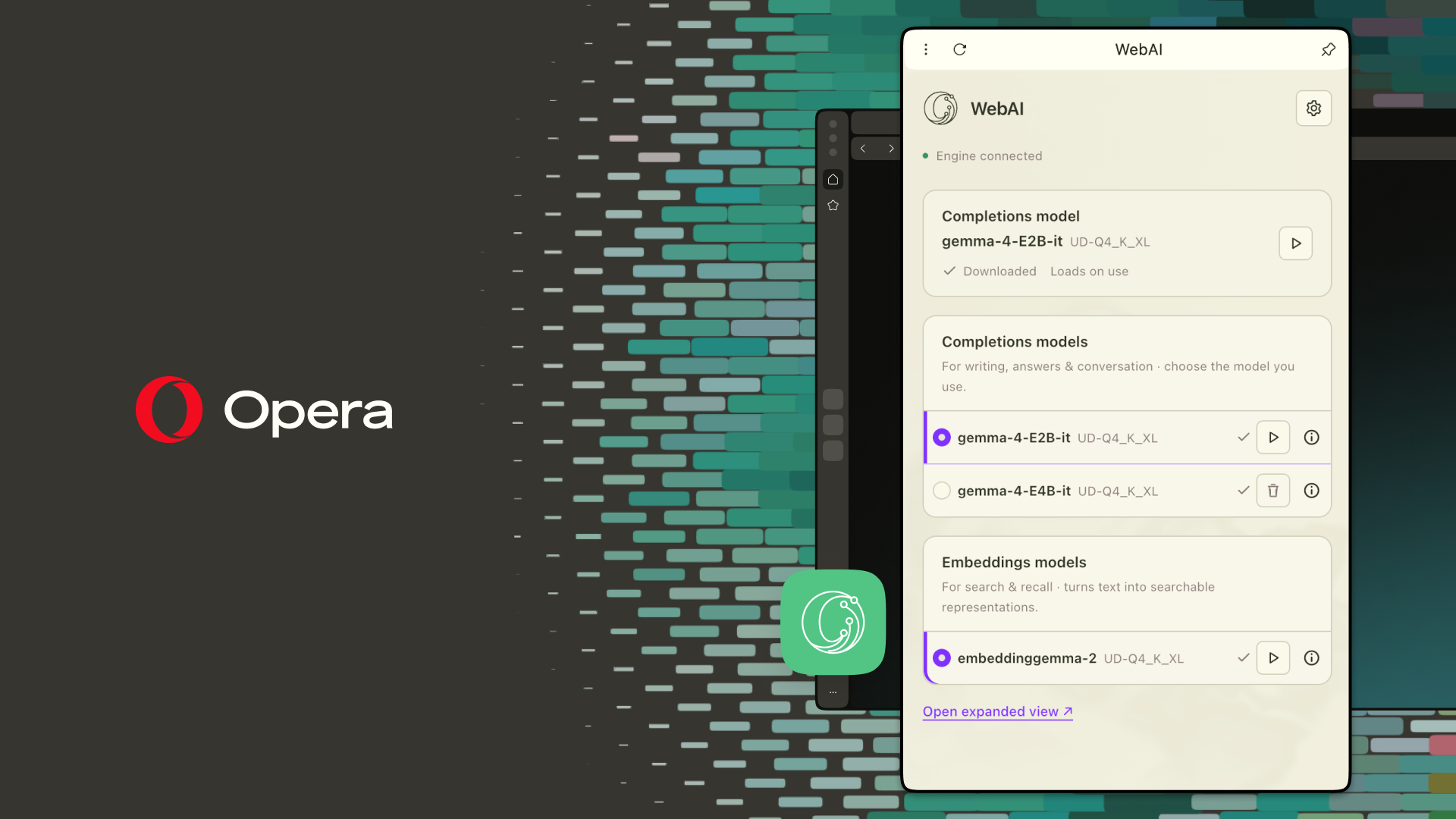
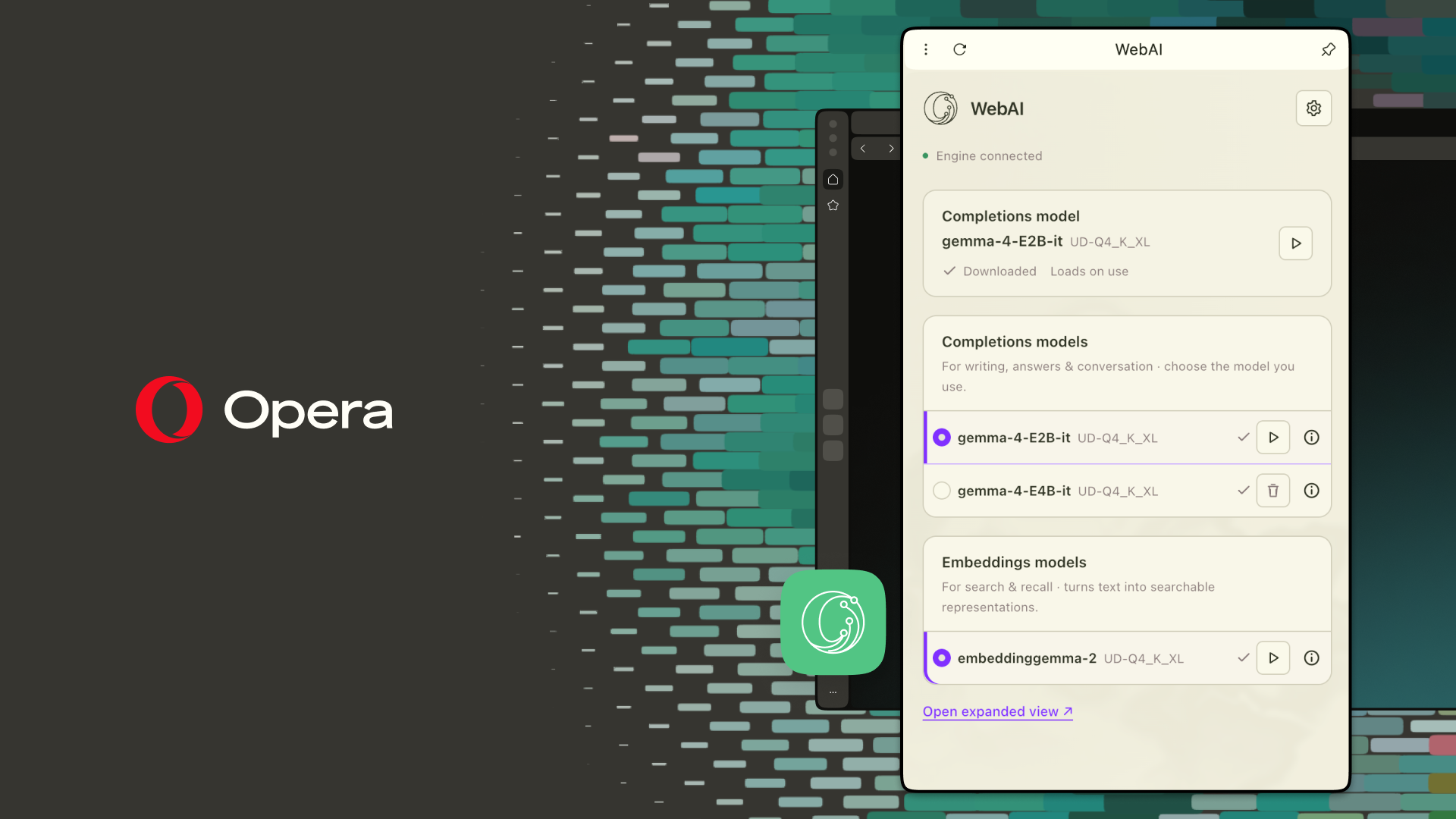
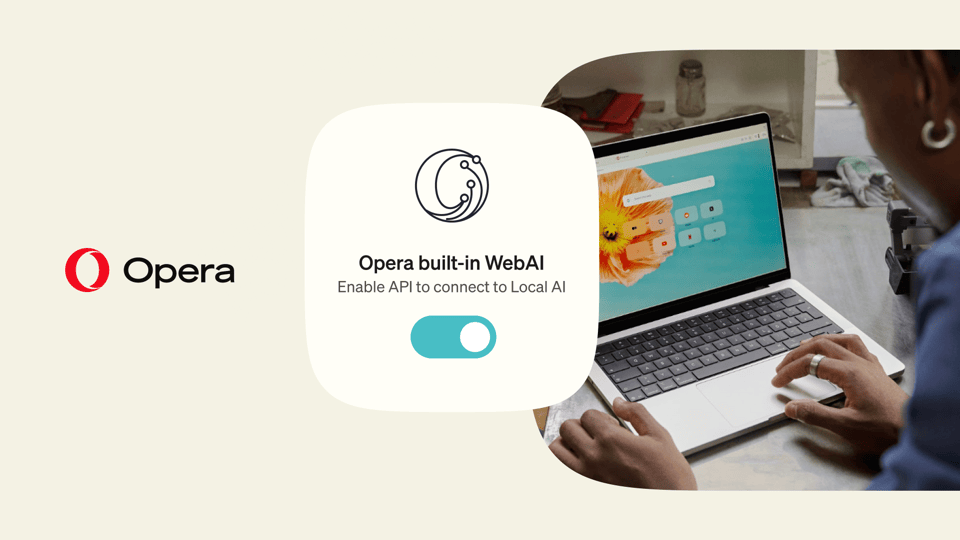
On October 27, 2026, Opera launched an early preview of the WebAI feature in the Opera One browser and proposed a web standard supported by Google and Microsoft: sites and extensions gain access to local AI models running directly on the user's device. Initially, the feature uses Google's open-weight Gemma models and Apple's built-in on-device model on Macs. The feature is manually enabled in settings, access is granted to each site via a separate permission, and data does not leave the computer.
What happened
The WebAI standard provides sites and extensions with three APIs: Prompt for text generation, Decision for content classification, and Semantic Embeddings for finding connections between fragments. There is no hard binding to a specific model: initially, it supports Google's open-weight Gemma models and Apple's built-in on-device model on Mac computers. Nothing is downloaded until the user manually enables the Web AI API in the browser settings, after which access is granted to each site via a separate permission. Operation is guaranteed on 64-bit Windows with Intel or AMD processors and on Macs with Apple Silicon; speed depends on the hardware. Opera GX and Opera Neon will receive the feature later. In parallel, Opera demonstrated HTML-in-Canvas—a way to insert live interactive HTML pages into 2D and 3D scenes.
Context
The main point of this event is not a new model, but the distribution channel. Opera is turning the browser into an execution environment for local inference and framing it as a proposed open web standard rather than a closed feature of a single vendor: support from Google and Microsoft increases the chances that WebAI will not remain a single-company experiment. The model-agnostic layer, without binding to a specific model, separates the site or extension code from the model choice, so developers do not become dependent on a single weight provider. Privacy in such a design is ensured by the architecture itself: generation, classification, and embeddings are computed on the device, and data does not need to be sent to the cloud. The chosen set of primitives—text generation, classification, and semantic embeddings—matches the typical set of tasks for web extensions.
Why this matters for the industry
For the industry, this shifts part of the AI workload from cloud APIs to the device: extension and web product developers get generation, classification, and embeddings for free, on the user's hardware, and without paying per request. The cost of simple AI functions is reduced to zero, and the barrier to entry is lowered for teams that previously required paid cloud inference. If other browsers adopt the standard, the economics of web extensions will change: local AI will become a built-in feature, and "data does not leave the device" privacy will become an expected requirement for products. The price for this is heterogeneity: the same code on different configurations will yield different quality and latency, result reproducibility for developers is limited, and without a specification with minimum quality guarantees, the ecosystem faces fragmentation of results.
Why this matters for users
Owners of Opera One on 64-bit Windows (Intel/AMD) or Macs with Apple Silicon only need to enable the Web AI API in settings via Settings → Opera AI: until then, nothing is downloaded, and each site that needs models will request a separate permission. Local text generation and article classification work without subscriptions or per-request payments, personal data remains on the computer, and speed depends on hardware power. For familiarization, Opera shows six demo extensions, including Project Lens, Got It?, and Semantic Art. Separately, you can play with HTML-in-Canvas without any setup on the next.opera.com/html-in-canvas page—these are live interactive HTML pages inside 2D and 3D scenes.
What is still unknown / limitations
The quality of Prompt, Decision, and Semantic Embeddings has not been confirmed by independent measurements: there are no benchmarks for these APIs in the sources, so the assessment that on-device models handle product tasks at an acceptable level remains a hypothesis. Model size, quantization, and execution backend are not disclosed, and speed directly depends on hardware. The participation of Google and Microsoft relates to supporting the standard; there are no public plans in the sources for them to ship WebAI in their browsers. The feature exists in early preview status only in Opera One, will appear later in Opera GX and Opera Neon, and the claim that the browser has "for the first time" become a local inference platform is a press release formulation that should be checked against other vendors' roadmaps.
Sources
- Opera adds local AI to its browsers — Opera Newsroom
- WebAI: Local AI for the web, now in Opera — Opera blog
- Opera introduces a new web standard to let users deploy AI locally in their browser — TechCrunch
Author
Look at AI, editorial team