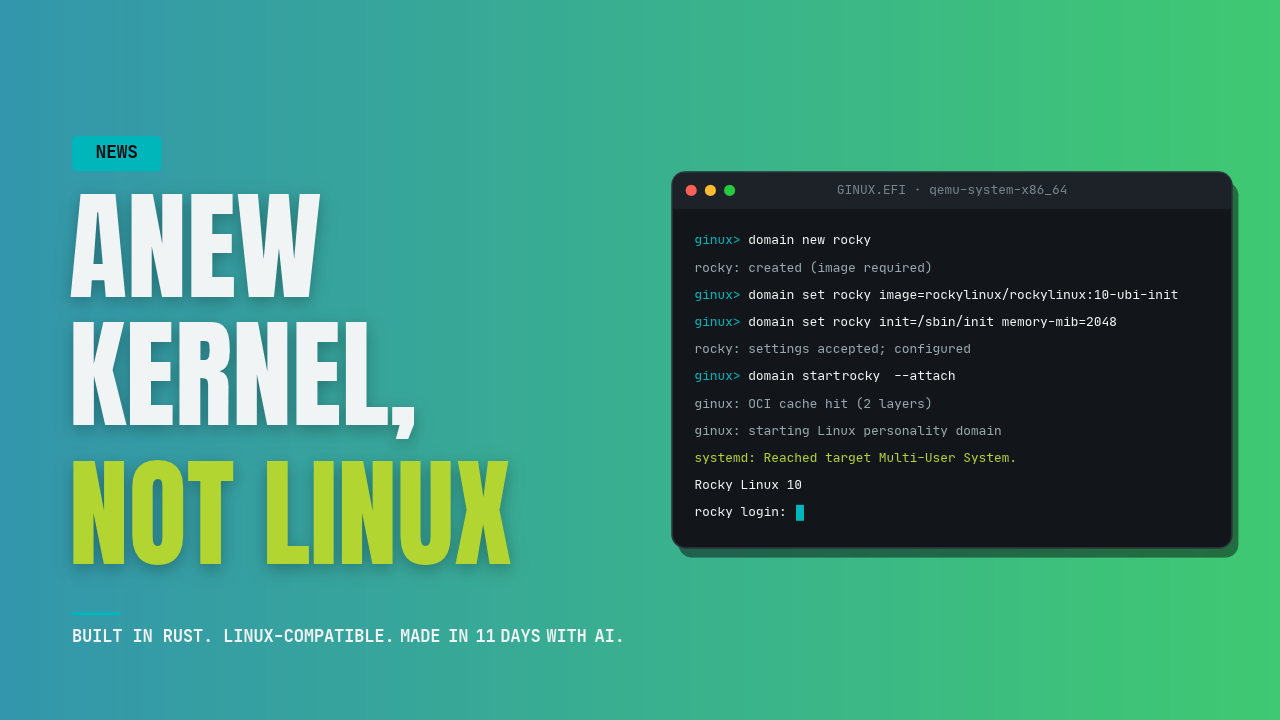
Gregory Kurtzer, creator of CentOS, founder of Rocky Linux, and co-founder of CIQ, built the independent Ginux operating system kernel in 11 days. This Rust-first solution for the x86-64 architecture was written from scratch; it is not a Linux fork but maintains ABI compatibility, allowing programs compiled for Linux to run without modification. The code was generated by a persistent OpenAI Codex agent task on the GPT-5.6 Sol model, while the author, following the Human-Directed Agentic Engineering (HDAE) methodology, was responsible for architecture, constraints, and acceptance criteria. The project has been published as an open research prototype.
What happened
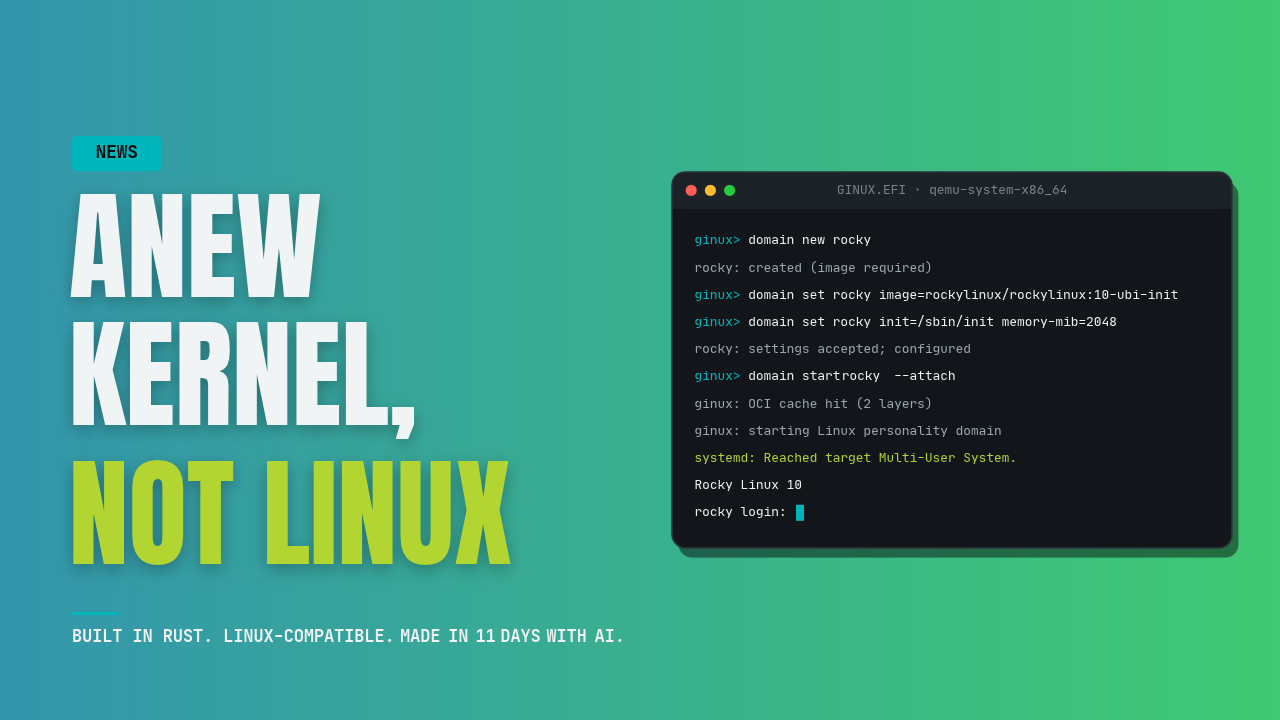
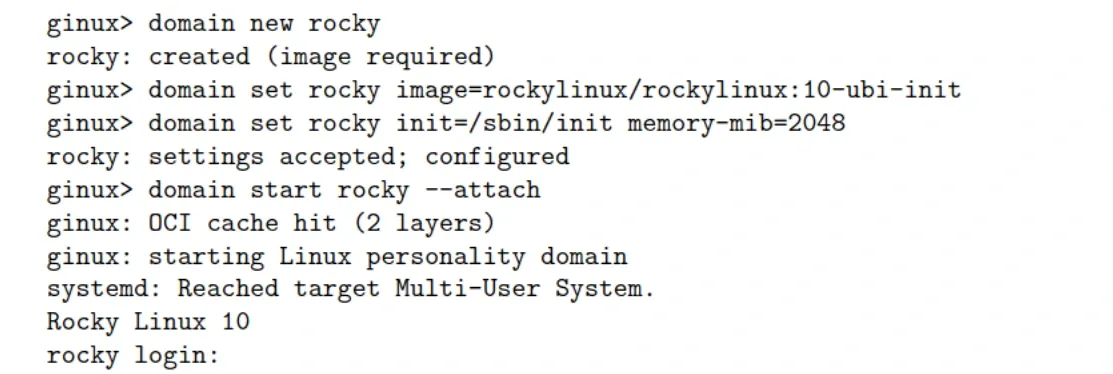
The experiment resulted in a specific artifact: over 11 days, approximately 139,000 lines of saved code and 1,097 commits were accumulated. The system compiles into a single GINUX.EFI image that boots directly via UEFI. On the test stand, unmodified Alpine binaries (musl and BusyBox) are launched, and the full Rocky Linux 10 userspace with systemd reaches multi-user.target. The degree of compatibility is detailed: of the 375 Linux 6.12 system calls, 82 are fully implemented, 245 are partially implemented, and 48 are rejected. The platform limitation is explicitly stated: Ginux currently works only in QEMU with a Q35 profile, OVMF, and virtio, without GPU or NVMe support.
Context
To assess the scale, it is important to understand who the author is. Kurtzer created CentOS, then founded Rocky Linux, and is a co-founder of CIQ, meaning he is directly involved in projects that underpin corporate Linux. He positions Ginux as an embodiment of the "Not Linux" idea: an independent kernel that consciously replicates the Linux ABI for compatibility with existing userspace. The second key part of the story is the Human-Directed Agentic Engineering (HDAE) methodology: a human formulates the architecture, constraints, and acceptance criteria, while a single persistent OpenAI Codex agent task on the GPT-5.6 Sol model handles the entire implementation. This effectively demonstrates a combination of an experienced systems expert with a frontier agent, rather than autonomous kernel creation by a model. The artifacts are open: the code is distributed under the Apache 2.0 license, accompanied by a technical report on Zenodo, and environment isolation is implemented via Ginux domains, which the author assesses as stricter than OCI containers and Linux namespaces.
Why this matters for the industry
For the industry, the main signal is not the kernel itself, but the changed economics of systems development: a top-level expert plus a single persistent agent task compressed a cycle that traditionally takes teams years. This speed is not ensured by automatic design—architecture and acceptance remain with the human, while the agent removes the bottleneck of code writing, as explicitly stated in the HDAE methodology. This pattern is reproducible for other narrow greenfield tasks, so in the coming months, it is logical to expect independent case studies and initial replications, and in the long term, the emergence of tools where formalized acceptance criteria become a separate development artifact. However, Kurtzer himself defined the boundary: compatibility, security, hardware support, and long-term maintenance remain the "moat" of Linux that cannot be generated in a few days, so nothing changes in production for now, and Ginux cannot be embedded into a product.
Why this matters for users
For readers, the project is useful primarily as a working open stand. The gmkurtzer/ginux repository on GitHub can be cloned and run in QEMU using the make doctor and make run commands, after which the domain new and domain start scenarios allow launching a test environment and seeing the domains work in real time. The technical report on Zenodo helps verify the author's methodology and conclusions against what is actually in the code. A separate value for engineers is the breakdown of a live case of collaboration between an exceptional systems expert and a frontier agent, which went from the first commit to a running userspace. Expectations should remain sober, however: 41 stars on GitHub and systemd in a virtual machine do not make Ginux a replacement for Linux on one's own hardware.
What is currently unknown / limitations
Key caveats here are significant. The case is singular and was executed by an exceptional systems expert, so the conclusion that the ceiling of a single engineer's capabilities has risen is based on a sample of one case. The contribution of GPT-5.6 Sol is not separated from the contribution of Kurtzer himself and the auxiliary scaffolding, and the method of marking system calls and tests was described by the author independently, with no independent verification. The number of lines and commits are known weak proxies for quality, and an external filter effectively did not exist at the time of publication: the Hacker News discussion had two points and one comment. The assessment of the isolating properties of the domains remains the author's opinion, and no third-party security audits have been published. Finally, it is unknown how stable the operation of partially implemented system calls will be under real loads, and whether another team can replicate this pipeline.
Sources
- It's FOSS — Ginux case study: Rocky Linux Creator Builds "Not Linux" Kernel in 11 Days Using AI
- gmkurtzer/ginux — official project repository on GitHub (Rust, Apache 2.0 license)
- Kurtzer, G. — Ginux: Building an Independent Kernel That Runs Linux Userspace through Human-Directed Agentic Engineering (technical report on Zenodo)
Author
Look at AI, editorial team