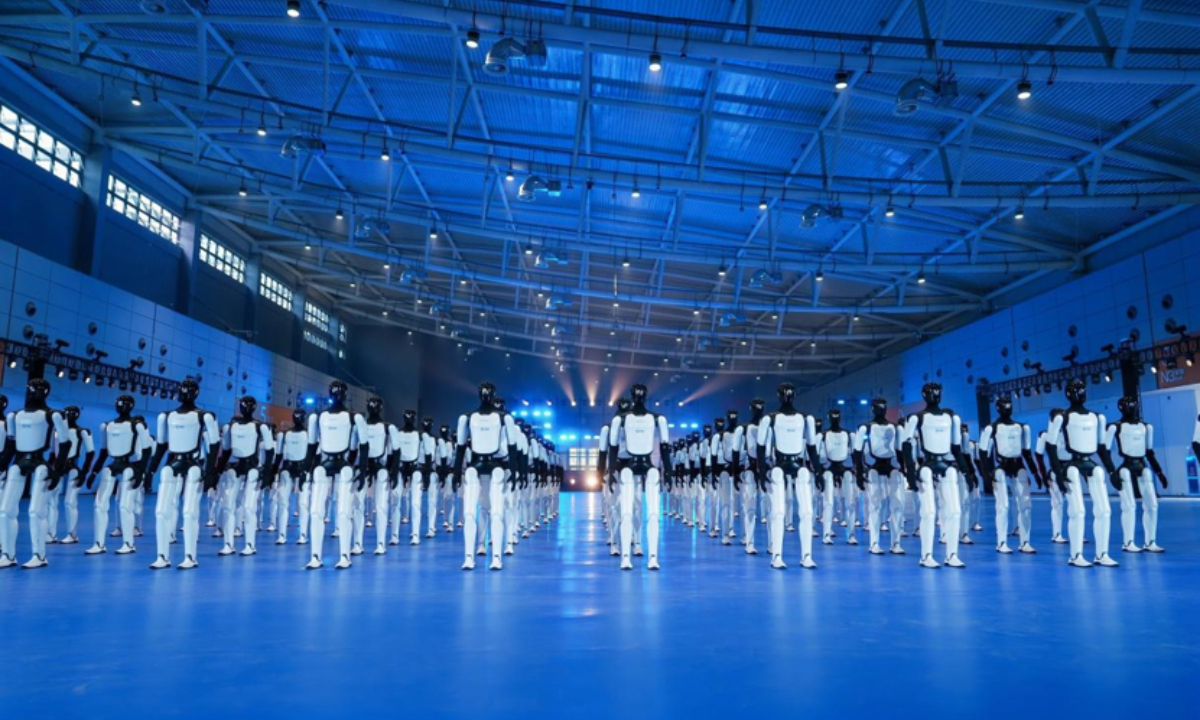
On October 24, 2026, Chinese robot manufacturer AgiBot (智元机器人) set a Guinness World Record in the category of "largest number of humanoid robots dancing simultaneously." 110 serial full-size Expedition A3 humanoids in Jinan flawlessly executed a synchronized routine involving formation changes, jumps, and flips, with coordination managed by their proprietary mass control platform, LinkBots. Essentially, this was a test not of choreography, but of readiness for mass control of a fleet of humanoid machines.
What Happened
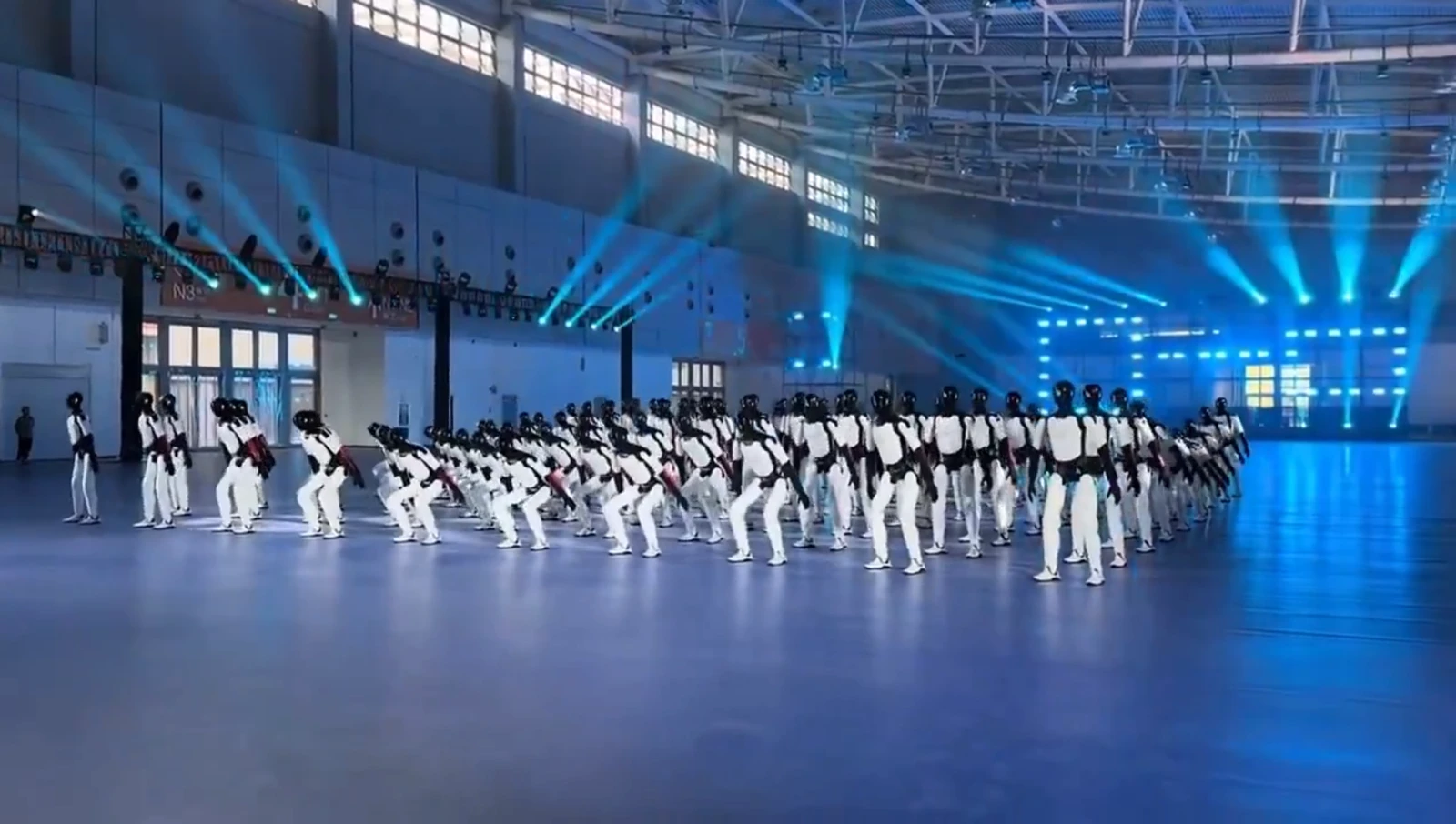
The performance took place on October 24, 2026, at the Yellow River International Convention and Exhibition Center in Jinan, Shandong Province. Each participating Expedition A3 robot stands 1.73 meters tall, has 52 degrees of freedom, and is equipped with a 1.8 kWh battery. According to AgiBot Senior Vice President Wang Chuan, all 110 machines were serial units that underwent unified conveyor calibration of joints and torques. The routine lasted 5 minutes and 43 seconds and included formation changes, jumps, and flips; according to sources, no robot made a mistake. The LinkBots platform recalculated trajectories in real time based on the live state of each machine. Positioning operated via Ultra-Wideband (UWB) radio navigation with centimeter-level accuracy, while connectivity was maintained through 5G-Advanced and Wi-Fi networks. If communication was lost for an individual robot, neighboring machines automatically compensated for its section of the formation, meaning the performance primarily demonstrated fleet fault tolerance.
Context
The key difference from typical robot dance shows is that trajectories were calculated from the current state of each machine in real time, rather than replaying a rigid, pre-recorded script. The event coincided with rapid growth in the segment: in the first half of 2026, China produced over 40,000 humanoids, according to data cited in publications. The industry forecast for the year exceeds 100,000 units, and Chinese suppliers account for more than 95% of global supply. In this landscape, AgiBot competes with Figure AI and Tesla Optimus not with a single smart model, but with factory scalability and swarm management. Discussion of the demo reveals a shift in the industry's competitive axis: value is shifting from the quality of an individual robot to the fleet coordination layer, which engineers compare to the role Kubernetes plays for servers.
Why This Matters for the Industry
For the industry, the record served as a test of fleet industrial readiness: mass deployment of humanoid robots in ports, metro systems, warehouses, and exhibitions requires exactly the components tested on stage—a uniform batch of machines, real-time distributed coordination, and centimeter-level positioning. A batch of identical factory-built units promises buyers predictable fleet behavior, rather than a unique prototype tailored for a demonstration. For vendors, this is a signal that at a production scale of over 100,000 humanoids per year, the differentiator may become the fleet orchestration layer and calibration standards for serial units: within a horizon of about two years, the category of fleet management as a service could emerge as a distinct market. The demo cannot be directly reused: the LinkBots platform is closed, with no public API, SDK, or pricing. For developers of multi-robot systems, the practical value lies in the reference architecture, where recalculating plans from the live state of agents and local compensation for failures by neighboring nodes are built-in fundamental properties.
Why This Matters for Users
The synchronized performance was filmed and published on YouTube: even without visiting Shandong, one can live-assess that a swarm of hundreds of humanoid machines has become serial production with an independently verified record. According to AgiBot's plans, Expedition A3 will move beyond the stage into services, tourism, science, and education; materials specifically mention the Jinan metro, parks, and shopping centers, where the first pilots are logically expected in the months following the record. There are no direct purchasing consequences yet: publications do not name prices, contracts, or confirmed deployments—there are only deployment plans and the record as a reputational argument.
What Is Still Unknown / Limitations
Expert Wang Peng from the Beijing Academy of Social Sciences explicitly warns against generalizations: a synchronized show in a controlled environment is not equivalent to reliable operation in unpredictable conditions where lighting and obstacles change and errors accumulate; this gap has not yet been closed by public data. The scientific value of the recording is limited: sources contain no preprint on LinkBots, mentions of learned policies, or quantitative metrics—such as synchronization error distribution, drift over 5 minutes and 43 seconds, or the frequency and duration of communication failures with subsequent compensation. Guinness certification records the fact of the event, but not the reproducibility of the method or comparison with control baselines; Wang Chuan's statement about unified serial calibration of all 110 machines has also not yet been confirmed by independent verification.
Sources
Author
Look at AI, editorial team