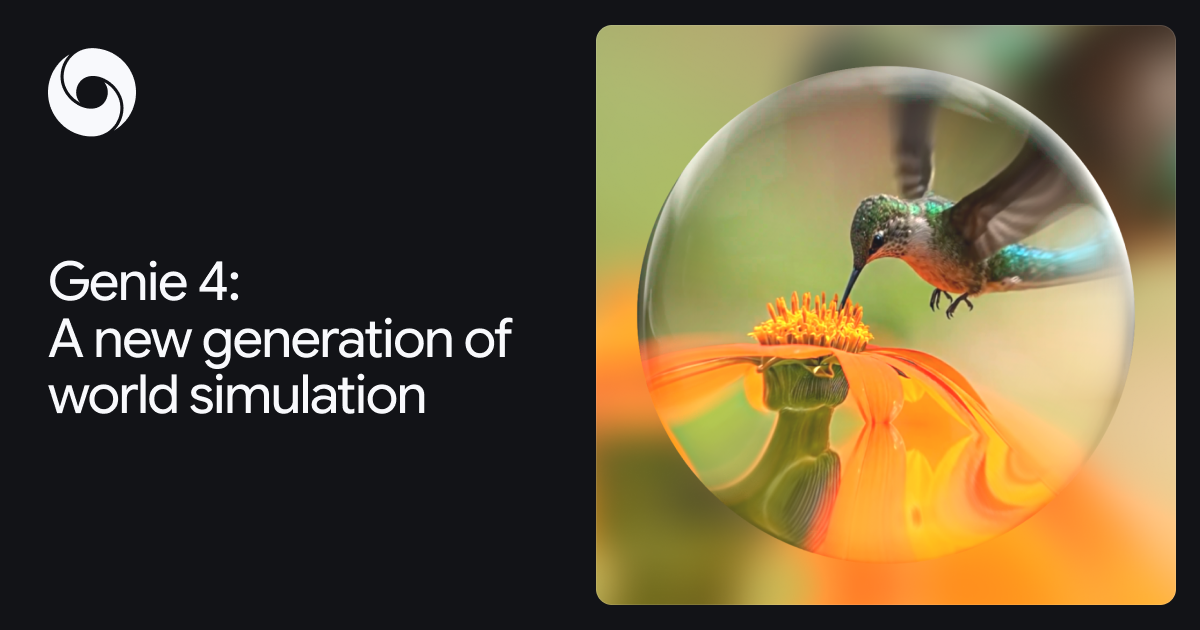
On October 27, 2026, Google DeepMind announced Genie 4 — a research "world simulation" model (world model) that creates interactive virtual worlds in real time: photorealistic visuals with simulated physics, native sounds, music, and character speech. Such a world can be edited with text commands directly during the session — from weather to camera angles, while multi-step planning within it is driven by a suite of Gemini family models. There is no mass access yet, and all published evidence consists of demos and two Google blog posts, so key claims regarding physics and performance remain to be verified by a future technical report.

What Happened
On October 27, 2026, Google DeepMind presented Genie 4, a research model in the world model class for real-time interactive generation of virtual worlds. The system is natively multimodal: it outputs photorealistic video with simulated physics — aerodynamics, collisions, fluid dynamics — and simultaneously synthesizes background sounds, music, and character dialogue. Control is built around text commands: during a session, users can change the weather, shift the camera to a different angle, and introduce new objects into the scene. Along with the announcement, a closed preview was launched: currently, the system is being tested by trusted testers, and the access circle will later expand — to Google AI Ultra subscribers within Project Genie and to early partners of Gemini API and AI Studio.
Context
Genie 4 continues the Genie series but focuses on continuous interactivity: the world lives within the session and is edited on the fly, rather than being delivered as a finished video. The main technical interest of the announcement is the division of roles within the "hybrid world model." Gemini Omni anchors the simulation to realistic object appearance and behavior, scene observation and goal decomposition into steps are handled by Gemini 3.8 Flash, while Gemini 4 Argon decomposes tasks into subtasks and passes them to Genie 4 as text captions for frames — this is how the demonstrative interaction with the Apptronik Apollo humanoid robot is structured. In this scheme, the language model acts as the planner, and the pixel simulation as the executor, with DeepMind offering it as a template for agentic systems, not just as an improved video generator.
Why This Matters for the Industry
The Genie 4 industry offers a way to create training environments "from scratch": robotics and agentic systems need safe simulations for learning, and now they can be generated by description rather than programmed manually. Game development and cinema receive a "draft mode" — level prototypes and scene previsualizations from text before writing engine code or filming. The announcement also cements a platform shift: draft creation of interactive worlds ceases to be a task for development teams and engines and becomes a matter of API access, and the "planner from the Gemini family, renderer — Genie 4" combination can be analyzed by builders as an orchestration example. The novelty cannot yet be monetized — access is closed, there are no public prices, and distribution goes entirely through Google, so a reasonable strategy today is: apply, analyze the demo, build a backlog of cases (previsualization, level prototypes, training environments), and prepare a "prompt — world — automatic validation" pipeline for the future API. The long-term scenario depends on whether the problem of long-term world consistency is solved: in a positive case, world models of this class may become a standard component for training robots and long-horizon agents and form a separate API layer alongside image and video models; in a negative case, the niche will be limited to short sessions: previsualization, draft environments, and marketing.
Why This Matters for Users
For the reader, this is a format change: instead of watching a generated video, a walk inside a world that can be edited with text on the fly is offered, with sound, music, and character dialogue; the announcement wording presents Genie 4 as the first real-time "world" generator with native sound. Today, only selected testers can try the system themselves, so the reader's role is currently observational: demonstrations are published in the DeepMind blog, and a wide opening is promised through the Google AI Ultra subscription and the Gemini API partner program. Those watching the technology should track these publications and access channels to not miss the moment when the system can be tested independently.
What Is Still Unknown / Limitations
The evidence base for the announcement is limited: open materials contain only two primary Google blog posts, with no technical report and no quantitative metrics — frame rate, latency, session length before degradation, permanence indicators. Claims about physics — aerodynamics, collisions, fluid dynamics — and spatial audio are not supported by benchmarks or comparisons with Genie 3 and competitors, so the assessment relies on selected demos that third-party groups cannot reproduce while access is closed. DeepMind itself names current limitations: visual drift and object permanence violations in long sessions, meaning long-term consistency of world state is not solved — short sessions work, long ones degrade. Prices, SLAs, and exact timelines for access expansion have also not been published; if a technical report with metrics does not appear in the coming months, this itself will become an important signal about the maturity of the technology.
Sources
- Genie 4: A new generation of world simulation — Google DeepMind
- We're announcing Genie 4, our new world model for real-time interactive simulation — The Keyword (Google)
Author
Look at AI, editorial team