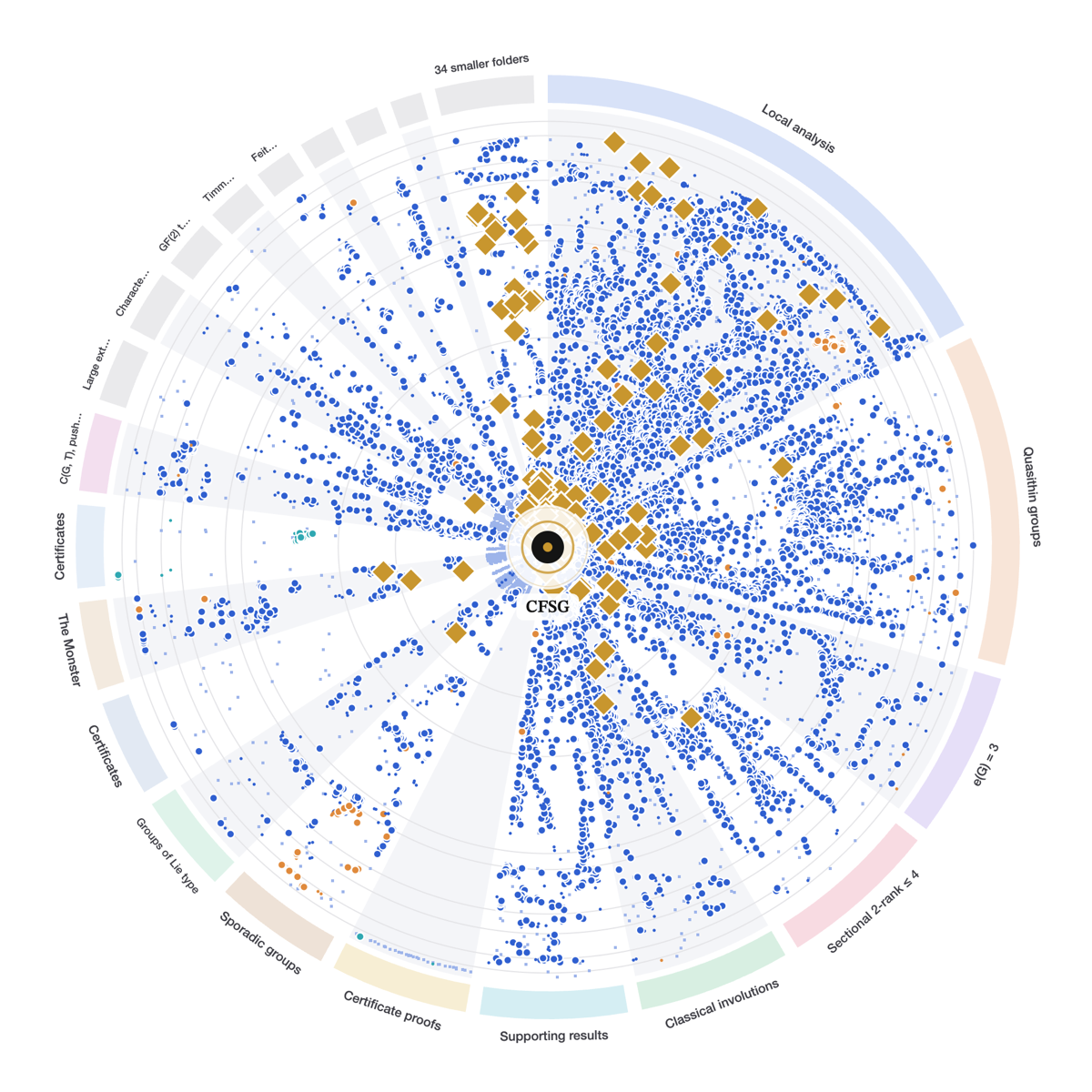
Axiom Math announced on October 26–27, 2026, the first fully computer-verifiable proof of the Classification of Finite Simple Groups (CFSG, the "Enormous Theorem") in the Lean proof assistant. The multi-agent system AxiomProver—a swarm of AI agents under the guidance of mathematicians—completed the formalization in 24 days, generating approximately 43.1 million lines of code. The work also identified 34 significant discrepancies with published literature, including a counterexample that was resolved by a new result in group theory. The code and project materials are open, allowing anyone to verify the result independently.


What happened
The project started on October 1, 2026: in 24 days, AxiomProver agents with roles for decomposition, search, writing, and proof review, acting under the guidance of mathematicians, generated approximately 43.1 million lines of Lean code. The formalization was divided into 108 milestones and approximately 380 tasks, and the company announced the completion of the work on October 26–27, 2026. Cross-checking with original publications revealed 34 significant discrepancies with published literature. The most notable was a counterexample to a closure claim in the Unbalanced Groups Theorem (UGT) from John Walter's 1986 memoir, which was resolved by a new result in group theory. Another milestone occurred on October 10: the agents formally proved the simplicity of the Monster group—a rigorous result within the general corpus. The final code and materials are open, so the formal proof can be compiled and verified independently.
Context
The Classification of Finite Simple Groups (CFSG) theorem, known as the "Enormous Theorem," provides a complete list of finite simple groups and is called the "periodic table of symmetries." The "first-generation" proof spans approximately 15,000 pages across more than 500 articles by roughly 100 mathematicians—a corpus of this scale has been practically impossible to manually re-verify from start to finish for decades. Lean is a proof assistant in which every step of reasoning is mechanically checked by a computer. The completed formalization shifts the question of correctness from the realm of expert trust to the realm of compilation: the code either compiles or it does not. Moreover, the classification underpins algebra, number theory, and mathematical physics, and the Monster group, one of the key objects of the theorem, is linked to monstrous moonshine.
Why this matters for the industry
The main industrial signal here is not the mathematics itself, but the architecture: a swarm of specialized agents with roles for decomposition, search, writing, and review is closed by an external machine verifier, Lean, which acts as a compiler of truth. In such a setup, hallucinations physically cannot pass the final check—the result is either machine-correct or it does not exist. Formal verification of massive knowledge corpora is transforming from years of manual expertise into a measurable pipeline, where productivity is expressed in lines of verifiable code per day. The expected dynamics over the next few months include a wave of tooling: orchestrators with configurable roles, Proof CI-class services with caching and parallelization of Lean builds, integration of proof checkers into existing agent frameworks via a "generation—verification—review" cycle, and the likely emergence of agent-based formalization projects for other major theorems modeled on AxiomProver. In the next couple of years, the "LLM proposes—verifier decides" pattern may become the standard for high-stakes tasks, and formal verification environments may become a typical platform for training and evaluating reasoning models, where the correctness of a step is objectively confirmed.
Why this matters for users
Axiom's code and materials are open, so it is already possible to build the formal proof independently and verify the result directly, rather than relying on the announcement. The open repository is also valuable as educational material: it shows how a massive task is broken down into manageable milestones and tasks, how review agents are structured, and how distributed Lean builds are organized. The pattern itself—agent roles, an external machine verifier, and a human reviewer at critical nodes—can be transferred to one's own applications in small domains: automated tests, specification checks, and verifiable configurations. For a broader audience, this is a clear demonstration that AI is already working as a full mathematical co-author—writing proofs, finding counterexamples, and correcting errors, not just solving olympiad problems. The openness of the project turns the story from mere news into an invitation: to verify, study, and replicate.
What is currently unknown / limitations
As of the announcement date, this is a statement by a single company: it is supported by Axiom Math's research blog and one media note from Crypto Briefing, with no peer-reviewed publication, and independent verification based on available materials was not described at the time of the announcement. A technical article, comparative benchmarks, and an analysis of what proportion of the 43.1 million lines of Lean is the agents' own contribution relative to dependencies on existing libraries are missing. The phrasings "the longest proof in mathematical history" and "the first fully computer-verifiable CFSG" belong to the company itself. Independent compilations and audits of the repository, reactions from group theory specialists to the 34 discrepancies, and verification of whether the AxiomProver pipeline is reproducible in other domains lie ahead; until these confirmations, predictions about industrial consequences should be read as expectations, not as established facts.
Sources
- Formalizing the Enormous Theorem: CFSG in Lean — Axiom Math Research Blog
- Axiom's AI agents formalize a 15,000-page math proof in 24 days — Crypto Briefing
Author
Look at AI, editorial team