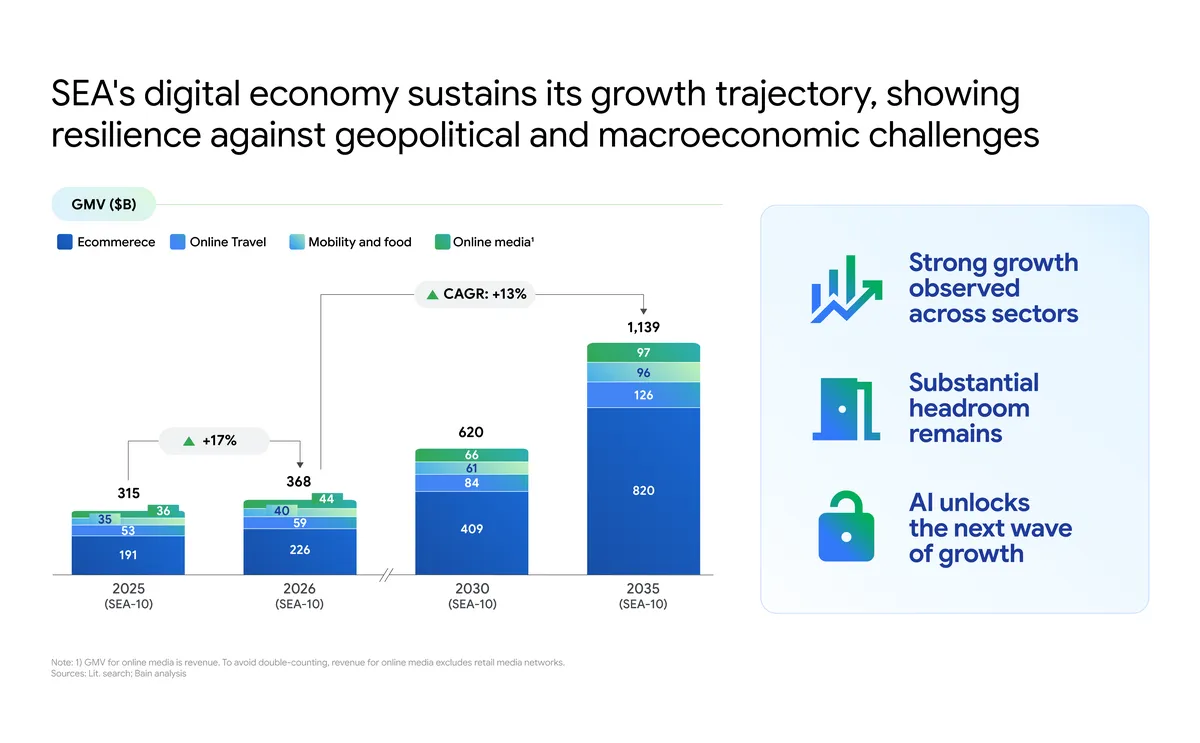
Google, Temasek, and Bain & Company released the 11th annual e-Conomy SEA 2026 report, 'Building the Intelligent Economy.' The report states that Southeast Asia's digital economy will grow 17% year-over-year to $368 billion in GMV in 2026 and, according to the authors' forecast, will exceed $1 trillion by 2035. Generative AI is named the main growth driver, with hundreds of millions of people in the region using it daily. The report links the market's next phase to 'agentic commerce,' where AI agents guide users to purchase.
What happened
The 11th edition of the annual e-Conomy SEA series, prepared by Google, Temasek, and Bain & Company, is dedicated this year to the region's transition to an 'intelligent economy.' Key figures: the volume of Southeast Asia's digital economy will reach $368 billion in GMV in 2026 with a 17% annual growth rate, and will exceed $1 trillion by 2035. Generative AI is used daily by 243 million people in the region—58% of the working-age population—and its adoption is proceeding four times faster than the rollout of mobile internet in its time. The authors forecast a 60-fold increase in AI usage by 2030 and highlight 'agentic commerce' as the key driver of the next stage—scenarios where AI agents guide users from product selection to payment. The report also notes an influx of capital: in the first half of 2026, the region attracted $21 billion in funding compared to $11 billion for all of 2025, and total data center capacity has grown to 5.8 GW.
Context
e-Conomy SEA is the 11th edition of an annual study that has long served as the main barometer of Southeast Asia's digital economy, a market with a population of over 650 million. The new edition marks a phase shift: 'digitalization'—connecting people and businesses to mobile internet and online services—is being replaced by the construction of AI infrastructure. The key contrast in this edition is between the mass scale and depth of AI usage: generative tools cover a large part of the working-age population, but per capita AI consumption here is 12 times lower than in the US—about 5 million tokens versus 60 million. The region is at the beginning of the adoption curve, and the main growth in consumption is still ahead. The political context adds to this: the ASEAN DEFA agreement is expected in November 2026, which could become the first regional digital trade pact and simplify cross-border data and service flows.
Why this matters for the industry
For the industry, the main point of the report is not the market size, but where capital is moving: investors and corporations are concentrating in data center infrastructure (STT GDC deals worth $11 billion and DayOne deals worth $5 billion), and a shortage of computing power is already named the main growth limiter for the region. The plan to triple data centers and the forecast of multiple growth in AI consumption by 2030 create long-term demand for chips, energy infrastructure, and cloud services. For engineering teams, there is a current demand for inference and token cost optimization: if the trajectory holds, by 2028 the bottlenecks will be energy, chips, and cloud capacity, not model quality, and engineering value will shift toward inference optimization, distillation, and smart request routing. Product teams get a ready-to-replicate scenario from the report: multimodal search in e-commerce increases conversion by 10%, which can be used as a ready justification for budgets for similar implementations, and agentic prototypes can already be built on existing catalog and payment gateway APIs. For startups, a rare configuration is emerging: mass demand with low per capita consumption—this is a window for launching localized products at local prices, with entry through local partners in one or two regional countries being cheaper and faster than starting from scratch.
Why this matters for users
For readers in the region, the mechanics of purchasing are changing. According to the report, 75% of Southeast Asian users are ready to entrust price comparison and deal completion to an AI agent, and agents are already described as tools that book trips and pay for purchases: instead of a dozen open tabs—one delegated task. Search is also changing: products are found and selected via photo and voice, not just text. The lag in usage depth compared to the US also means the reverse opportunity: tools that have long been standard there have not yet become a daily habit here, so the choice of services that regional residents will trust with routine tasks will largely be determined in the coming years.
What is still unknown / limitations
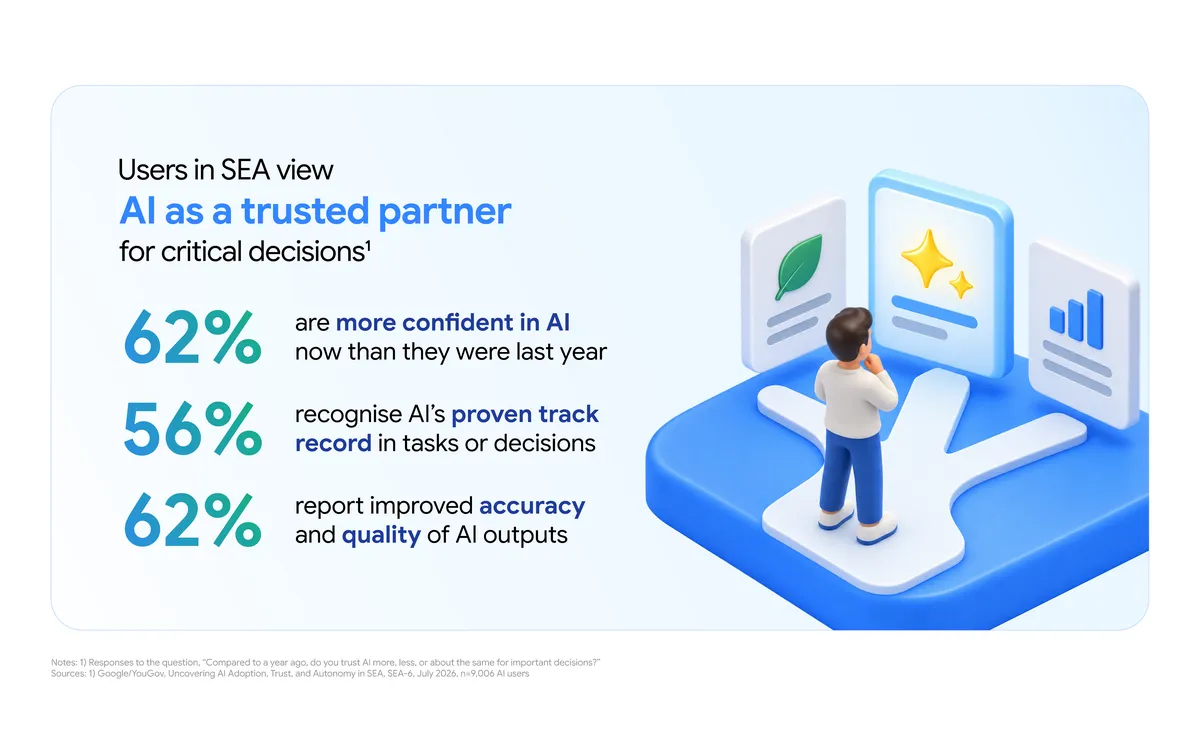
The report's figures should be treated as a scenario from an interested party, not an independent measurement: the publishers are Google, Temasek, and Bain & Company, and the methodology for estimates and forecasts is not disclosed. The forecast of a 60-fold increase in AI usage by 2030 is a point estimate without ranges or a description of assumptions, and given the history of inflated adoption forecasts in the industry, it is reasonable to interpret it as the upper limit of a favorable scenario. The stated 75% readiness to trust agents with deals is a measurement of intent through a survey, not confirmed behavior: the report does not demonstrate the functionality of agentic pipelines in real transactions, and autonomous payment is described as stated readiness and a forecast, not as a working product. The token consumption metric is the most engineering-oriented of those provided, but it is not specified which models and segments were considered in the calculation. Finally, the report itself contains no APIs, prices, or latency data: this is market analytics from which nothing can be implemented directly.
Sources
- Google blog: e-Conomy SEA 2026 'Building the Intelligent Economy' — Southeast Asia's digital economy to hit $1 trillion by 2035
- The Business Times: South-east Asia digital sales to rise 17% to US$368 billion in 2026
Author
Look at AI, editorial team