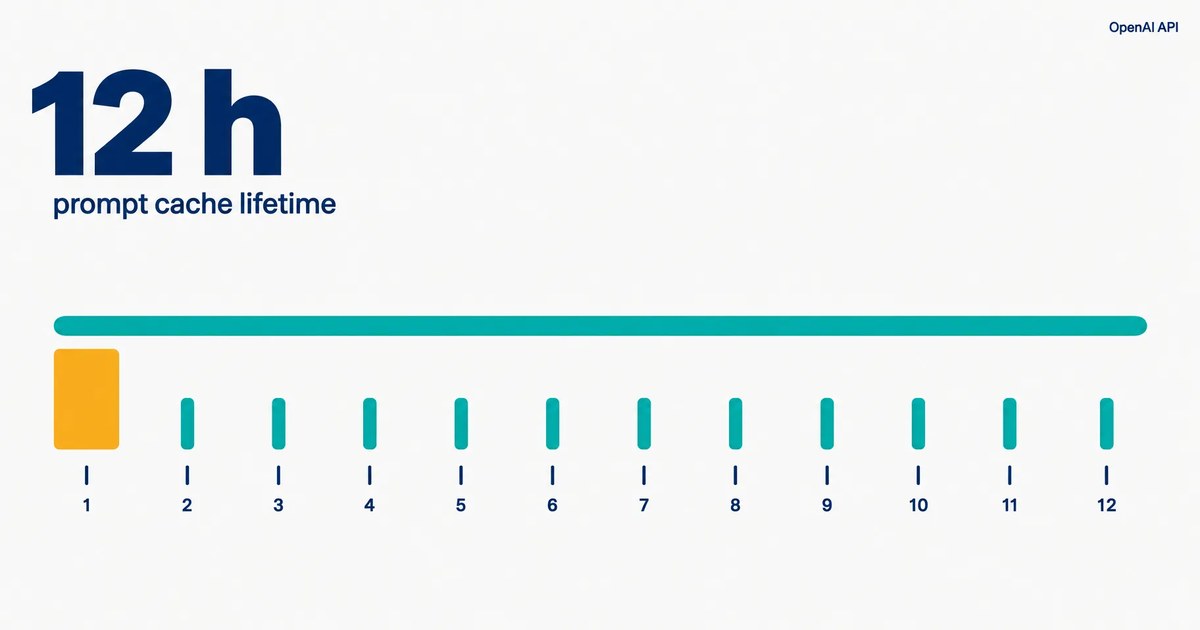
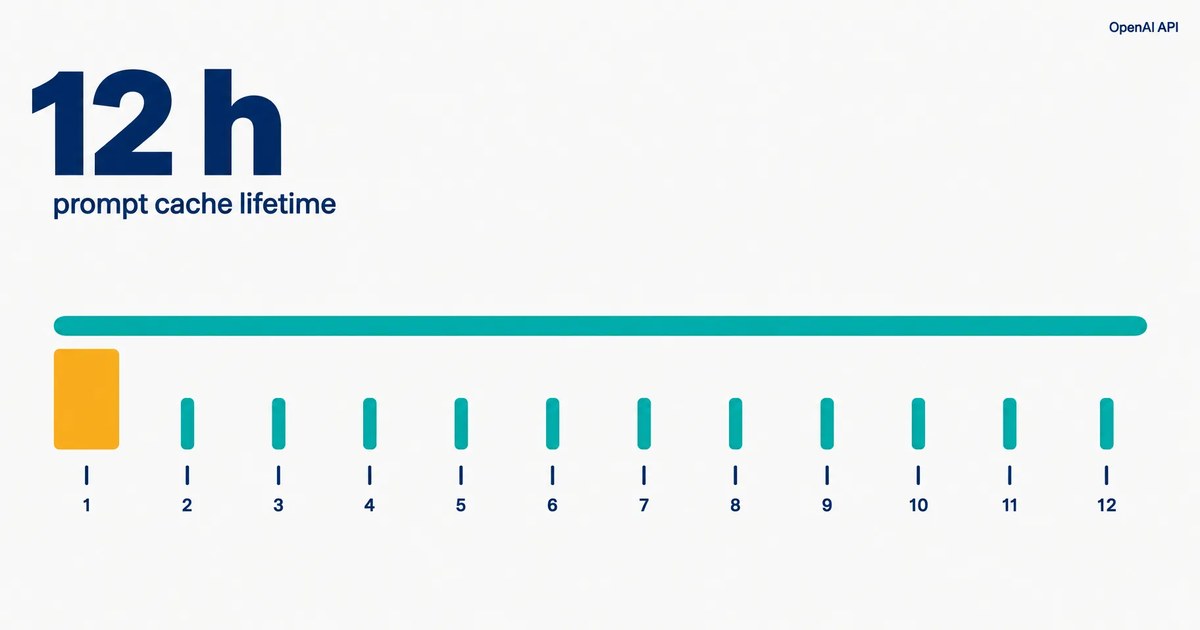
On October 20, 2026, OpenAI enabled 12-hour prompt caching in its API: the Responses API now includes a prompt_cache_options.ttl = 12h parameter, extending the cache life of a request's common prefix from 30 minutes to 12 hours. For logged-in Codex and ChatGPT Work users, the cache has become 'eternal': resuming an old session no longer loses the cache. For agents that call the model once an hour or less frequently, savings on input token costs can reach ~75%.
What happened
On October 20, 2026, OpenAI documented a new option in the official API Changelog: in the Responses API, you can set prompt_cache_options.ttl = 12h, and the request's common prefix — system instructions, tool descriptions, static context — will be cached for up to 12 hours instead of the standard 30 minutes. Writing to the 12-hour cache is billed at 2.5x the input token price, compared to 1.25x for the 30-minute cache, while reading from the cache costs 0.1x the input price; for GPT-6.1 Sol, writing costs $5.00 per 1M tokens versus $2.00 for standard input. The option works only in the Responses API and only on GPT-5.6 and newer models. Simultaneously, Thibault Sottiaux, an OpenAI employee, announced that for logged-in Codex and ChatGPT Work users, the cache now 'persists forever': returning to an old conversation or resuming a session after several hours is guaranteed to hit the cache without a penalty.
Context
Prompt caching is not a new technology: the model reuses computations for the common prefix of a request, so the provider charges a premium for writing to the cache and drastically reduces the price of repeated reads. Prior to this update, OpenAI's cache lived for 30 minutes, which is normal for interactive chats but broke the economics of scheduled agents: if calls occurred less frequently than once every half hour, the cache expired, and the large static prefix was recalculated at the full input price on every cold start. It is precisely the combination of a long, unchanging prefix and rare but regular calls that distinguishes long-lived agents from conversational scenarios — and it was the most expensive workload profile until the introduction of the long TTL.
Why this matters for the industry
OpenAI is directly reducing the cost of long-lived agents. CellCog's calculation for an agent with a 100k token prefix, called once an hour on GPT-6.1 Sol: $0.61 per day instead of $2.40. This is a competitive move in the price war for agentic workloads: Anthropic and Google are under pressure to respond by extending their own cache TTLs, and separate write/read cache pricing risks becoming a de facto standard among all major providers. Infrastructure will subsequently need to be restructured: cost dashboards and observability tools must separate cache write and read expenses, and cache configuration must become a standard part of LLM orchestrators as an abstraction over providers.
Why this matters for users
Developers using the Responses API only need to set prompt_cache_options.ttl = 12h — or ttl: 12h on a specific cache breakpoint; the option is available on GPT-5.6 and newer models. Savings begin with approximately the third use of a single prefix within 12 hours: due to the 2.5x premium for writing, one-off calls with large intervals may make the long cache more expensive than having no cache at all. Converting an existing 30-minute cache to the 12-hour rate is billed as a full new write. Codex and ChatGPT Work users do not need to configure anything: old conversations resume instantly and without extra charges for reprocessing context.
What is currently unknown / limitations
The claim about an 'eternal' cache currently relies on a single post by an OpenAI employee: the implementation is not disclosed, there are no hit rate metrics, invalidation conditions, or explanation of how guaranteed hits are ensured with an unlimited TTL — technically this implies either a large persistent KV-cache storage or aggressive prefix-matching, but costs and volume limits are not specified. CellCog's calculation is correct as arithmetic at the given prices, but it is a model assuming an ideal hit rate, not a measured benchmark: independent reproduction on real agentic trajectories is not yet available.
Sources
- OpenAI API Changelog — Oct 20: 12-Hour Prompt Caching (v1/responses)
- OpenAI Developers (@OpenAIDevs) on X: You can now choose 12-hour prompt caching in the API
- Thibault Sottiaux (OpenAI) on X: cache is kept forever for Codex and ChatGPT Work
- OpenAI 12-Hour Prompt Caching: When It Pays Off — CellCog
Author
Look at AI, editorial team