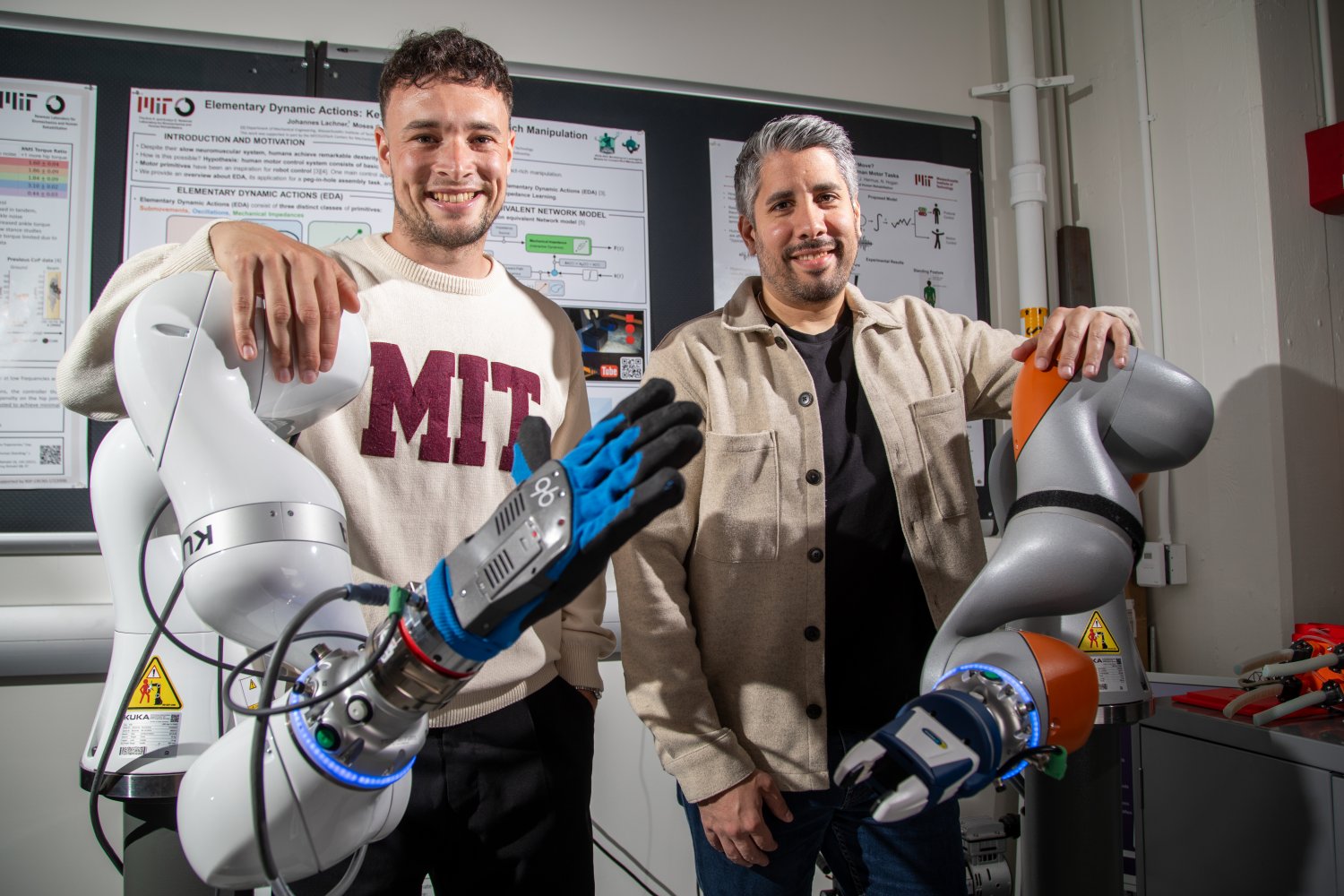
MIT alumni Johannes Lachner, now an assistant professor at Purdue University, and Noah Geiger from Robert Bosch GmbH, formerly a visiting student at MIT, developed a bimanual robotic system for physical rehabilitation after a stroke. At its core is a transformer-based diffusion model, a generative architecture in the spirit of ChatGPT, applied to robotics: the model learns not trajectory planning, but dynamic force interaction—touch, pressure, and resistance. The method is described in the paper Diffusion-Based Impedance Learning for Contact-Rich Manipulation Tasks, published in the peer-reviewed IEEE Transactions on Robotics. The work shows how generative AI is moving beyond text and images to begin operating with physical contact.

What happened
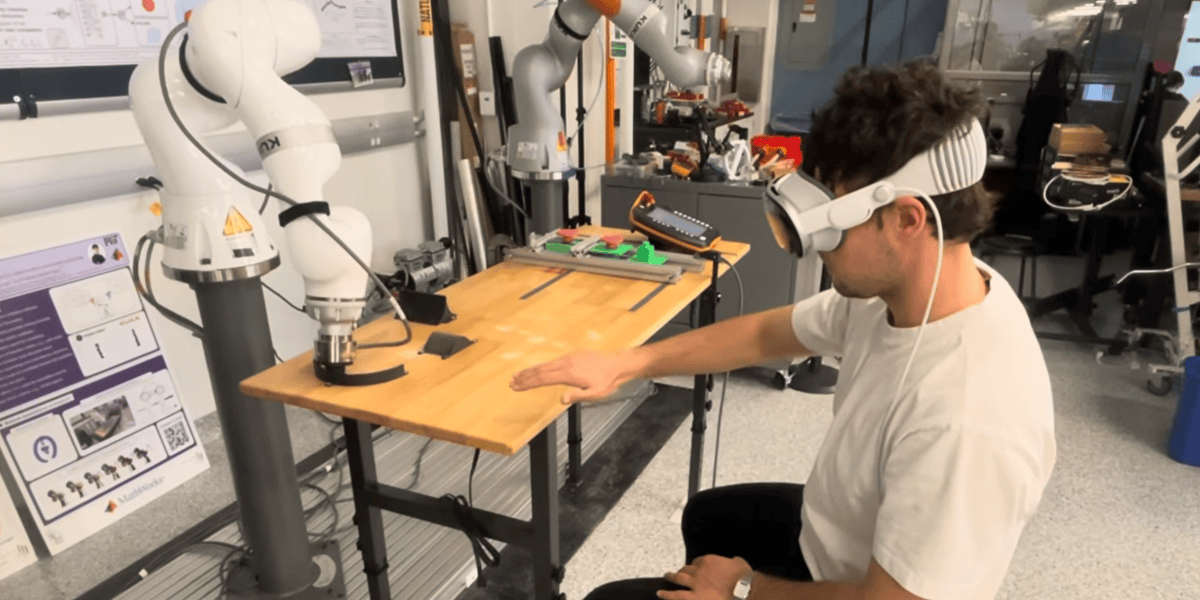
Training data for the system was collected in two ways: an operator controlled the robot via telemanipulation in Apple Vision Pro with force-sensitive gloves, and additionally, healthy people performing therapeutic movements with varying levels of effort were recorded. On these examples, the diffusion model mastered impedance interaction: it doses the force of touch, pressure, and resistance and takes into account the intensity of the person's own movements. The team is now moving to the next stage: at the Technical University of Munich and the Pfennigparade rehabilitation center in Munich, physiotherapists are being recorded in force gloves to train personalized models for each specialist.
Context
Diffusion models are known primarily as generators of text and images, and in robotics they have until recently been used mainly for motion planning: the manipulator learned where to move, but not how hard to press or how to react to resistance. Tasks with dense contact, or contact-rich manipulation, require impedance control—the dynamic balance of stiffness and compliance, which in classic industrial robots is set by hard-coded settings. The social scale of the problem is large: stroke leaves lasting impairments in approximately 5 million people annually, and upper limb recovery requires regular exercises with personalized load dosing, which are systematically lacking due to a shortage of physiotherapists. Hence the interest in robots that could take on the physical part of therapy, leaving the specialist with setting and quality control of the sessions.
Why this matters for the industry
For the robotics industry, this is one of the first demonstrative examples of transferring generative diffusion models to the area of physical interaction: the model operates in force and impedance modes, not just motion planning. The authors claim the method's transferability to contact-rich industrial tasks and collaborative workspaces, which is a potential expansion of the service robot and cobot market, where adaptive and safe physical contact with humans remains the main engineering barrier. The second transferable element is the data pipeline: telemanipulation with force feedback and specialist recordings turn professional expertise into a training asset, setting a template for an “expert-in-the-loop” mode in the robotics stack. The appearance of a peer-reviewed paper in this area reduces the cost of explanation for investors and clinical partners, where the category of robots that can feel is heading.
Why this matters for users
For patients with upper limb impairments after a stroke, the point of the development is the ability to exercise more often and regularly: the robot takes on physical support and doses effort in real time to what the person is currently able to do on their own, while the physiotherapist is not displaced but receives a tool for scaling personalized care. Since this is a research system, patients have no direct product benefits today; however, engineers and enthusiasts have access to the paper Diffusion-Based Impedance Learning for Contact-Rich Manipulation Tasks and the project page strokeairobotics.github.io, where they can study the impedance learning mechanism and reproduce the pipeline on their own stands. For a broad audience, the material is a clear genre shift: generative AI is ceasing to be just a generator of texts and pictures and is beginning to control grip force in the physical world.
What is still unknown / limitations
Key unknowns are concentrated in the clinical and engineering parts. Training relied on telemanipulation and recordings of healthy people, not real patients, which creates a possible domain shift when transitioning to therapeutic sessions; a clinical trial is only planned, and there is no data yet on sessions with patients. The claimed real-time adjustment of assistance requires verification: diffusion models by default require iterative sampling, and the latency and control loop frequency are not disclosed in open materials. There is also no information about target hardware or a business model, because this is a research system without an API and pricing. Finally, large-scale conclusions require caution: one peer-reviewed publication does not make the method an industry precedent, and claims of transferability to industrial tasks remain the authors' hypothesis until independent replications on other platforms.
Sources
- Robotic therapy for stroke patients — MIT Technology Review
- Personalized physical therapy: Stroke rehabilitation powered by AI — MIT News
- Diffusion-Based Impedance Learning for Contact-Rich Manipulation Tasks — project article (IEEE Transactions on Robotics)
Author
Look at AI, editorial team