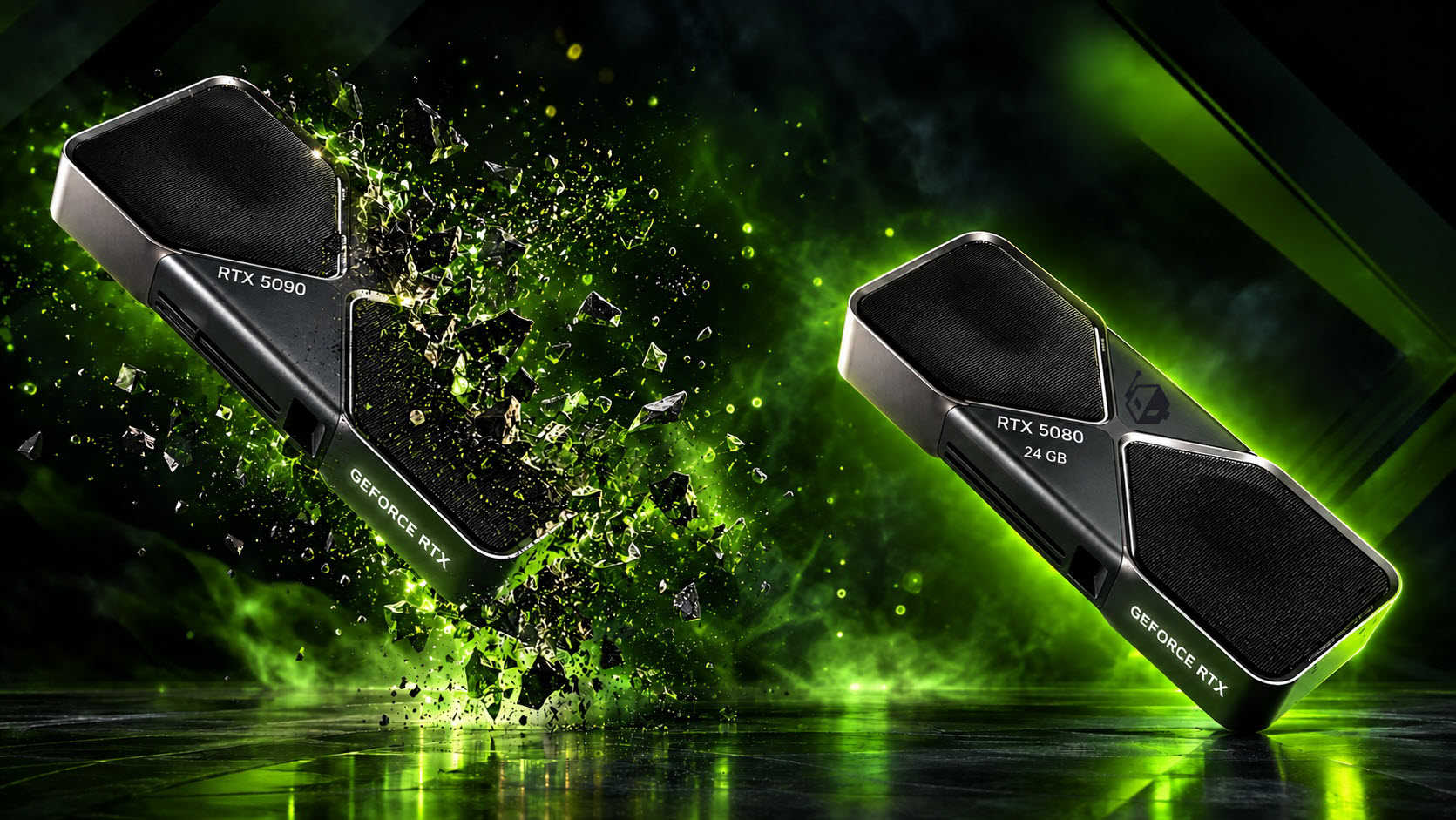
According to insiders, Nvidia is scaling back production of the GeForce RTX 5090 and directing all remaining GB202 dies to the professional RTX PRO line. The card has disappeared from Nvidia's US store, retailers are moving it to Discontinued status, and prices for remaining stock have risen by tens of percent in just a few weeks. If the reallocation is confirmed, the new consumer flagship will be the RTX 5080 24 GB.

What happened
Insider MEGAsizeGPU, citing the supply chain, stated: "All future GB202 supplies are RTX Pro exclusive." The GeForce RTX 5090 has already disappeared from Nvidia's US store, and major retailers mark the card as Discontinued. The shortage is hitting prices: in China, the 32-gigabyte version increased from 35,000 to 54,000 yuan in a month and a half; in Germany, the cost exceeded 5,000 euros, which is 73% higher than in January; and on the US secondary market, the card is trading for $6,500–$9,500. Nvidia has not officially commented on this.
Context
GB202 is the flagship die of the Blackwell architecture, used in both the GeForce RTX 5090 and professional RTX PRO accelerators, so the question is literally: who gets the scarce silicon. Demand from workstations and AI equipment is stable, and GDDR7 memory prices are rising, which further pressures consumer card production. This is compounded by consumer demand from AI servers and teams buying consumer GPUs for local inference: remaining stock is being drained from both sides. If MEGAsizeGPU's hypothesis is correct, Nvidia is consciously pushing the gaming segment to the background because professional accelerators generate multiples more revenue per die.
Why this matters for the industry
For ML teams and startups, the main consequence is that flagship consumer GPUs can no longer be planned as a reliable base for local inference and fine-tuning. Flagship-class purchases should be frozen, and unit economics recalculated: the guaranteed path to 96 GB of GDDR7 on a single card is currently only the RTX PRO 6000 at approximately $16,000, which excludes startup budgets. The consumer memory ceiling shifts to 24 GB, and this is a window of opportunity: products designed for 24 GB VRAM and around the GPU rental segment will have an advantage over those waiting for the return of cheap flagships.
Why this matters for users
If you were planning to buy an RTX 5090 at the recommended price of $1,999, it is no longer available: the markup on the secondary market reaches 260–375%. It is more reasonable to consider the RTX 5080 16 or 24 GB or a used RTX 4090, and those who already have the card should do nothing—your units continue to work as before. Within 6–9 months, according to source estimates, the RTX 5080 24 GB will be released: 24 GB GDDR7, 32 Gbit/s, approximately 1,024 GB/s bandwidth, TGP 415W. For gaming, this is a step back in memory bandwidth, but 24 GB removes the main barrier for local LLMs that did not fit in 16 GB.
What is currently unknown / limitations
The key claim about the full transfer of GB202 supplies to RTX Pro relies on a single insider, MEGAsizeGPU, and remains without official confirmation. The disappearance of the card from the store, the Discontinued status, and price increases are verifiable, but these are indirect market signals, not proof of production cessation. The release date of the RTX 5080 24 GB (6–9 months), its price, and production schedule are source estimates not confirmed by Nvidia; it is also unknown if prices for remaining RTX 5090 stock will return to MSRP. Claims about the sufficiency of 24 GB for local LLMs are not yet supported by measurements: there are no tokens/s figures or quality degradation estimates for quantized weights across task classes.
Sources
Author
Look at AI, editorial team