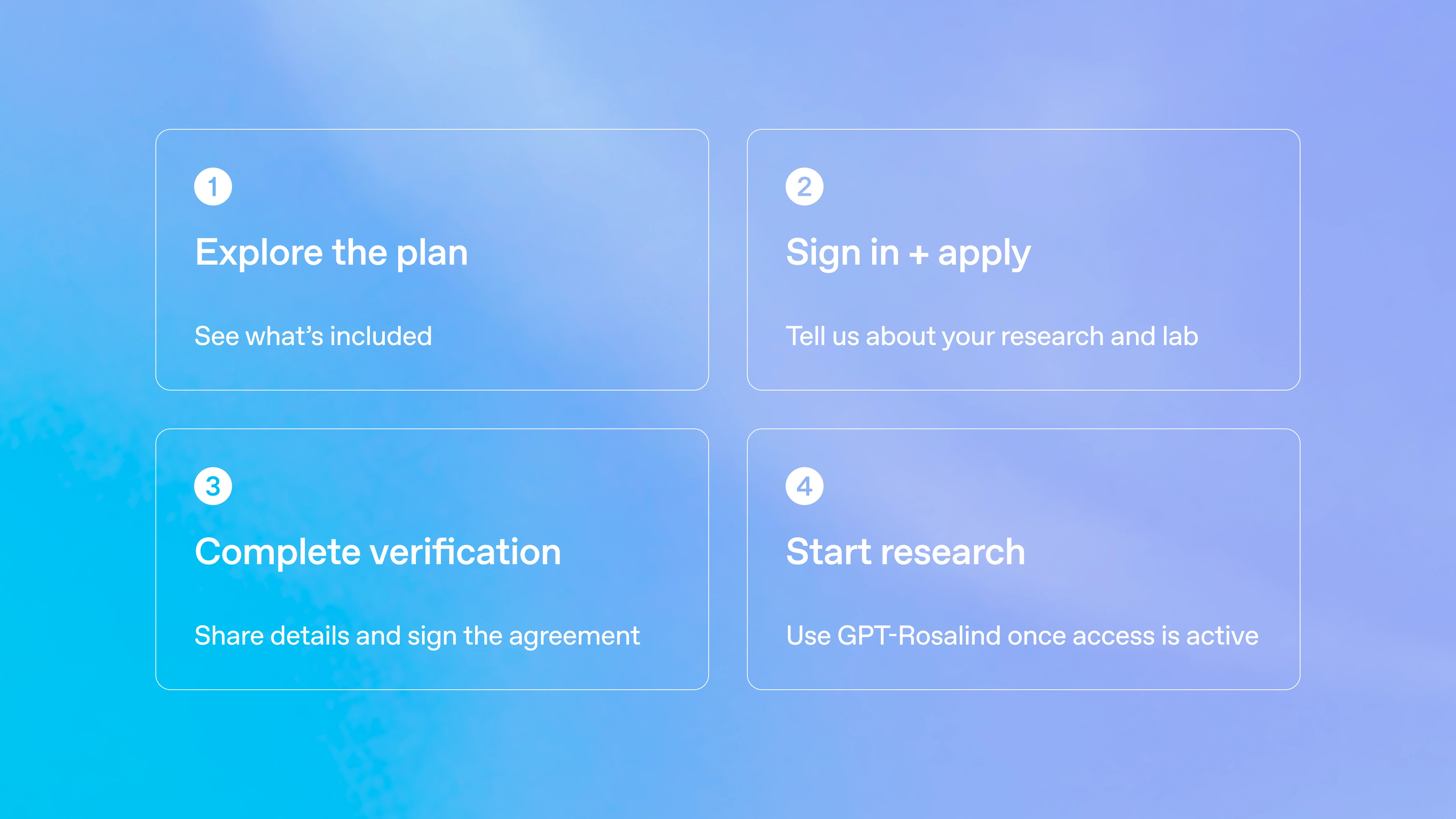
On October 15, 2026, OpenAI introduced the Rosalind Academic Plan: academic labs — currently only US universities — receive up to 30 Business Standard seats free for up to 12 months. The plan includes the life sciences-specialized model GPT-Rosalind and the Rosalind Workbench environment, however access is granted only after lab verification, and API access is not yet included in the program.
What happened
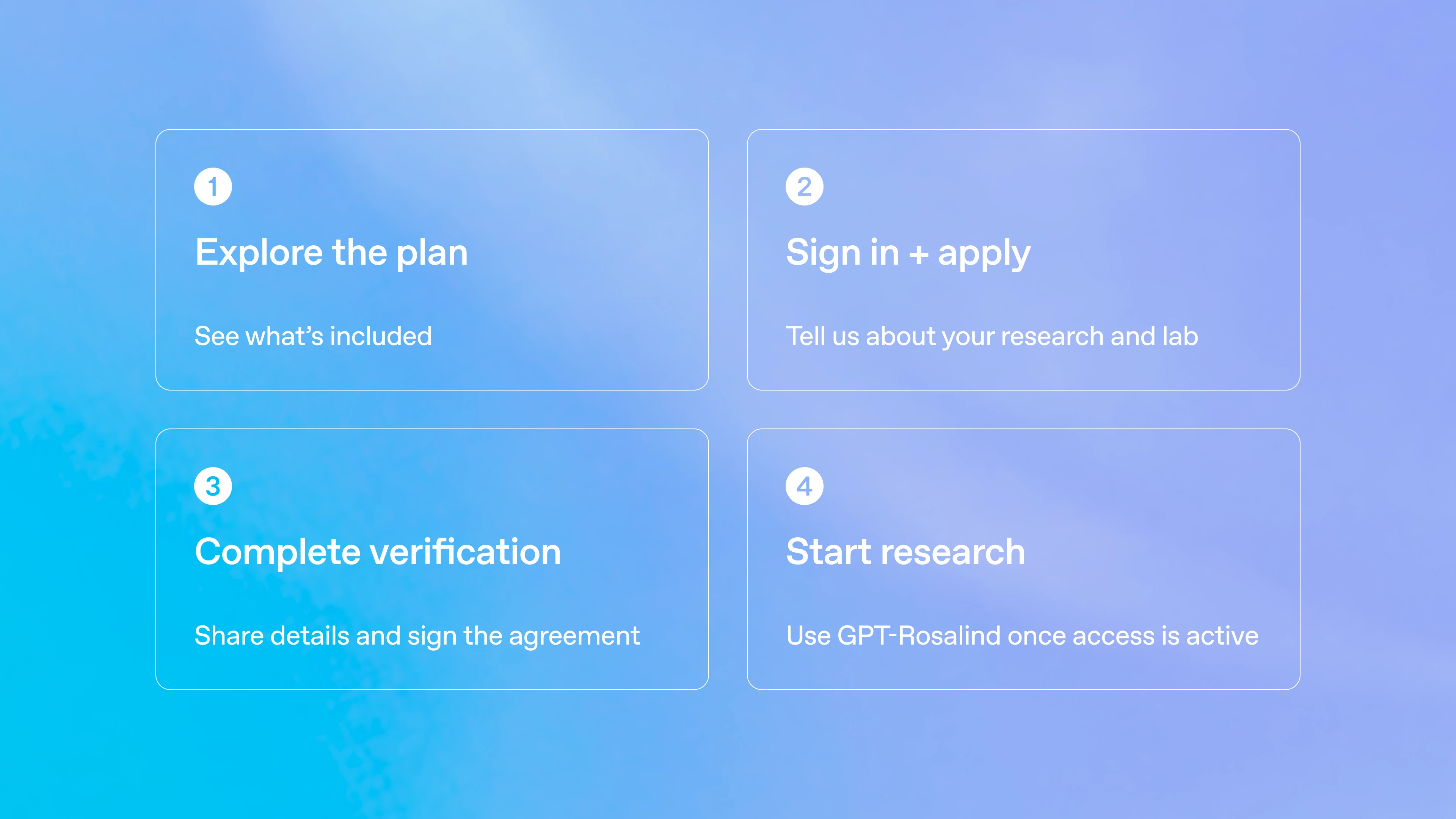
The program is aimed at eligible labs at US universities: an application is submitted on the plan page, and after passing trusted-access approval, the lab receives up to 30 free Business Standard seats for up to 12 months. Access to GPT-Rosalind, which OpenAI describes as a specialized model for life sciences with deep reasoning on complex biological tasks, is provided only after verification, and access management for lab members is entrusted to verified PIs and lab leads. Along with the model, labs receive Rosalind Workbench — a tool orchestration environment for medicinal chemistry, genomics, and wet-lab assistance. OpenAI specifically notes that research data is not used by default to train its models, and API access is not yet included in the plan.
Context
GPT-Rosalind is not a universal chatbot, but an example of a vertical scientific product from a frontier lab: a highly specialized model combined with its own tooling, where a significant part of the value may lie precisely in Rosalind Workbench, rather than in the language model itself. The second constructive layer is governance: the distribution of the model not through an open API, but through trusted-access approval turns each access grant into a decision about who can work with sensitive scientific issues in dual-use areas like biology and chemistry. Access management through verified PIs and lab leaders makes this mode, in essence, a field experiment in regulating access to scientific AI. The academic segment is chosen as an entry point for distribution: a year of free seats in university labs is a way to establish itself in this environment ahead of competitors.
Why this matters for the industry
For the AI industry, the announcement means the entry of a vertical scientific model into the academic segment as a separate product with free seats: OpenAI establishes trusted access with safeguards as a working template for dual-use scientific AI and directly competes for university labs. The "AI for science" category receives confirmation as a large market, but the platform enters the vertical directly with its own tooling, burning the most obvious layer for startups — tool orchestration. Due to the lack of API, there will not be an immediate wave of third-party products based on GPT-Rosalind: for competitors and engineers, this is currently an object of monitoring, not integration. If lab selection proceeds, a corpus of real cases will accumulate, and pressure will arise on other players to launch similar academic programs.
Why this matters for users
Researchers in biology and chemistry working in eligible labs at US universities should check the terms on the plan page and apply: upon approval, this is an immediate win in the form of up to 30 free Business Standard seats for up to 12 months and working with GPT-Rosalind and Rosalind Workbench. The policy of not using research data to train models lowers the barrier to transferring confidential lab data. Practical work is currently limited to a closed environment: without an API, it is not possible to build pipelines and automated agents, so the real scenario is interactive work through the Workbench. For readers outside the academic segment, the news provides a benchmark: frontier labs are building vertical scientific models with their own tooling, not just universal chatbots, and distributing them through verified programs.
What is still unknown / limitations
The only source of details is OpenAI's own announcement: it contains no experimental results, comparison of GPT-Rosalind with universal frontier models, or description of the training method, so claims of deep reasoning in life sciences are currently unverified and are by default perceived as a vendor statement. The criteria for selecting labs in trusted-access approval and the lack of audit of such decisions are not disclosed. There is no information on prices after the end of the free 12 months, usage limits, delays, and SLA. It is unknown whether the program's geography will expand beyond US universities and whether API access and integration scenarios will appear in it.
Sources
Author
Look at AI, editorial team