The ziplab team, bringing together researchers from Zhejiang University, Monash University, BAIR/UC Berkeley, and Adelaide University, released ATAS (Any Time, Any Space) — an open framework for agentic script-to-video generation built around a persistent world state. The framework turns a script into a generated video, maintaining scene and event logic across the entire length of the story. The paper appeared on arXiv on October 14, 2026, and the code has been published openly.


What happened
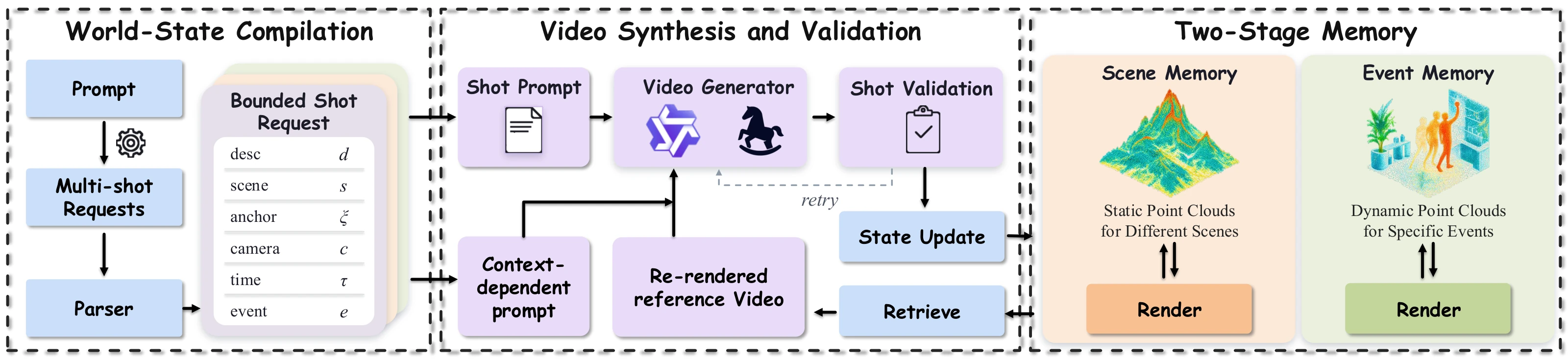
On October 14, 2026, the paper Any Time, Any Space: A World-State-Centric Framework for Agentic Video Generation (arXiv:2610.20571) appeared on arXiv. The author team ziplab published the ATAS framework code in the ziplab/ATAS repository on GitHub under the MIT license; at the time of checking, the repository had 199 stars. ATAS compiles a script into constrained frame queries, each of which explicitly specifies location, camera, and event time. Before generating a frame, the system retrieves evidence from two memories: scene memory stores registered static geometry, and event memory — dynamics indexed by scene, event, and time. Writing to memory is gated: an observation enters the persistent state only after review and state verification. The authors report results on four video generators (MiniMax-H3, Wan 2.7, HappyHorse 1.0, Wan 3.0) against I2V Extension, VGoT, Mora, MovieAgent, and ReCA: ATAS improves all stated inter-frame consistency metrics and receives the highest human ratings on all six criteria.
Context
To understand the essence of the event, it is important to remember the genre's disease: in long agentic video generation, frames and shots are planned step by step according to the script, and the main problem of such systems is consistency between non-adjacent frames. Previous-generation approaches pass prompts and the last generated frames between shots, which causes spatial and temporal logic to diverge as soon as the script returns to an already shown location or alternates events. ATAS builds the picture from the world, not from frames: the persistent world state is split into static scene geometry and event dynamics, so a frame that looks similar to a frame from another event is not randomly pulled into generation. The gate on writing to memory in this scheme works as a protection of the world's canon from contamination by failed takes. ATAS itself, however, is not a new video model: it is an agentic layer for managing world state, placed between the script plan and existing video generators.
Why this matters for the industry
For the industry, what matters here is not just the benchmark, but confirmation of a shift: value in agentic video generation is moving from choosing a base model to the persistent world state layer. ATAS provides an open framework for such a layer that can be embedded in your own script-to-video stacks, and the fact that the layer has been tested on several different video generators makes it portable between models. The entry barrier is low, but the layer is thin and built on top of third-party generators, access to which is via the DASHSCOPE_API_KEY, so a sustainable advantage will be built not on the code itself, but on accumulated world states and data about their behavior. If independent teams confirm the metrics, the pattern of a persistent world plus a gated-write memory risks becoming the default module between the script agent and the video model, and the comparison of solutions will shift to the cost per minute of video. Separate products around the pipeline are also likely: a storyboard editor as a standalone interface, memory services for transferring worlds between projects, and an API for serial content. In the long term, this is a practical step toward multi-episode generated films and series.
Why this matters for users
For a reader who does not write code, the project page is enough: it contains a demo of the framework, and next to it lies the full text of the paper on arXiv. A developer needs one rented NVIDIA GPU server with approximately 20 GB of free VRAM for the geometry service, a DASHSCOPE_API_KEY API key, and a client that is installed via standard pip and does not require a GPU itself. Ready-made script examples bookstore, clockshop, and record are in the examples/ directory of the repository, so the pipeline can be immediately run on your own texts without modifying the code. Today this is a working experimental stand for script-based video generation, not a polished service for content release, but you can test your hypothesis on your own scripts on it right now.
What is still unknown / limitations
There is currently no quantitative data to assess production readiness: the authors do not publish per-frame latency, generation cost, or the frequency of review gate failures. The results are very fresh, the metrics were published on October 14, 2026, and no independent third-party reproductions have appeared yet, and a one-day pipeline run checks its operability but does not validate the paper's numbers. The architecture also implies ambiguity: a frame not accepted into the persistent state still remains in the film, so in long scripts the film and the world's canon may diverge. Results may drift when video generator versions change, and if base models themselves learn to maintain long consistency, such an add-on may turn out to be unnecessary.
Sources
- Any Time, Any Space: A World-State-Centric Framework for Agentic Video Generation (arXiv:2610.20571)
- GitHub — ziplab/ATAS repository (framework code under the MIT license)
- ATAS project page (lhmd.top/atas) with demo
Author
Look at AI, editorial team