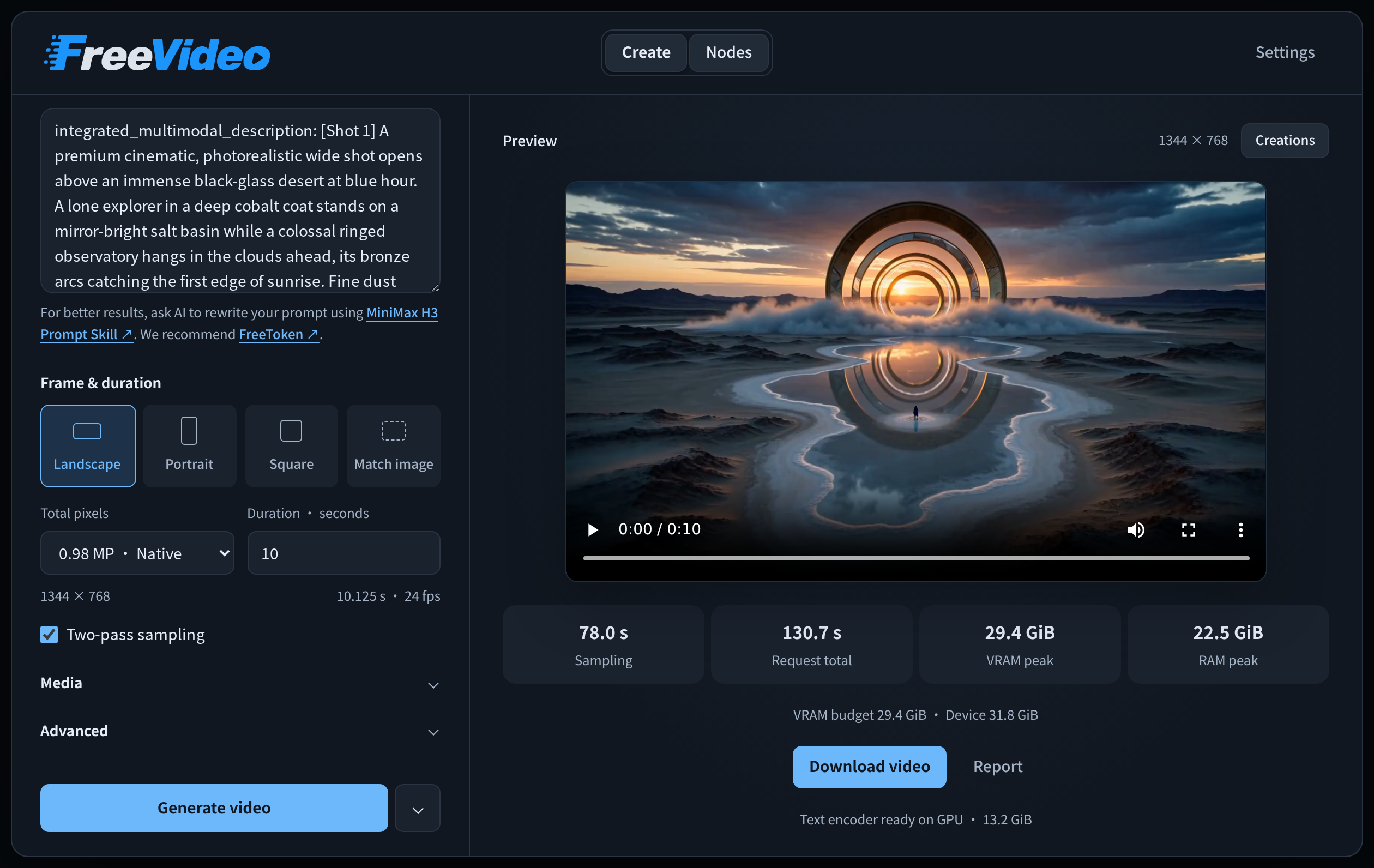
The open-source FreeVideo project from the FlashML-org organization released version v0.4.4: a local engine and a ComfyUI plugin that generate video with the MiniMax H3 model on home hardware with 8 GB VRAM and 16 GB RAM. It is based on the VDN-H3 model with hybrid Video DeltaNet attention. This launch shifts the entry threshold for high-quality video generation from server accelerators to consumer graphics cards, although the 8 GB VRAM minimum has so far been confirmed only by a single community benchmark.

What happened
The project appeared on GitHub on October 2, 2026, under the FlashML-org organization, and in less than two weeks it went from v0.2.0 to v0.4.4, accumulating about 1,900 stars. FreeVideo works in two formats: as a local engine and as a ComfyUI plugin; launchers cover Windows, Linux, and macOS, including an offline installation mode without network access. Generation is performed by the 8-step VDN-H3 model, whose weights are published under the name OpenVDN/vdn-minimax-h3. The execution scheduler splits the 50 transformer blocks, each weighing about 432.5 MB, across VRAM, pinned host memory, and disk, and selects the arithmetic for the card: int8 for GeForce and RTX 30-series, FP8 for higher-end accelerators. Server benchmarks in the documentation show the architecture's potential: 14.4 seconds of video at 768p resolution in 9 seconds on a cluster of eight NVIDIA B200s, and an acceleration of dense H3-DiT on a single B200 from 13.95 to 5.34 minutes.
Context
Hybrid Video DeltaNet attention is described in the arXiv:2609.20744 paper, published on September 17, 2026: exact softmax attention is computed within a window of adjacent frames, while bidirectional linear memory retains the long-range context of the scene. The authors immediately released the code, weights, and SGLang-cookbook, so the approach ceased to be just a publication and became a reproducible engineering standard. A dense DiT block with quadratic attention does not scale well to long video, and the hybrid scheme removes exactly this limitation: coherent clips longer than one minute are already announced in the v0.4.0 release. Importantly, FreeVideo itself is not a model, but an execution layer: it iterates through attention kernels in the chain SageAttention 2, then PyTorch flash, cuDNN, and FlashAttention 2/4, and adapts them to the available memory. Splitting weights across VRAM, pinned host memory, and disk in the video segment looks like a novelty, but for local LLM servers this has long been a routine technique that engineers can rely on.
Why this matters for the industry
For the industry, the change concerns above all economics: high-quality video generation no longer requires renting B200- and H200-level accelerators, and the cost of a clip within a local pipeline is radically different from the cloud. Subscription-based cloud generators lose their monopoly on the accessibility of server hardware and face a price competitor in the form of local pipelines, if the community reproduces the announced configurations. Products in such conditions are designed around queues, batches, and agentic scenarios: video becomes a nightly batch job, not interactive generation on click. Maintaining the release pace from v0.2.0 to v0.4.4, one should expect confirmed benchmarks on 8 GB configurations, further acceleration of attention kernels, and growth of the LoRA ecosystem around VDN-H3, while the template of "hybrid attention plus weight offloading across VRAM, RAM, and disk" risks being repeated for the next media models if the scheduler is packaged as a reusable component. A restraining factor for business is the MiniMax H3 Community License with territorial and acceptable-use restrictions: commercial scenarios need to be checked against its terms, and the weights should not be considered completely free.
Why this matters for users
You can try it on the day of release: the FreeVideo.exe launcher itself deploys ComfyUI, the environment, and models, supports existing model folders, and the engine understands LoRA, setting the first and last frame, and references by image, video, and audio. Benchmarks from docs/execution-planning.md for a 10-second clip at 1344×768 resolution in two-pass mode give about 122 seconds on an RTX 5090 and 486–558 seconds on configurations with 16 GB VRAM: in practice, this is about two minutes of waiting with 32 GB VRAM and eight to ten minutes with 16 GB. Owners of older cards should look at the release history: v0.3.0 introduced an int8 mode, which accelerated the RTX 3090 by about 2.3 times. A realistic working scenario today is offline generation, where minutes of waiting for a clip do not break the process.
What is still unknown / limitations
The main open question is the proof of the 8 GB VRAM minimum. It relies on a single community benchmark of 603 seconds from issue #22, taken without a controlled protocol, and on a capacity grid obtained on a server H200 with artificially reduced memory limits: the figure of 13.8 seconds per step corresponds to the emulation of 8 and 16 GB, not operation on a real home card. There is no full end-to-end benchmark on a real 8 GB card in the official documentation, so until independent reproduction, 8 GB is more correctly considered a hypothesis than a confirmed result. Image quality in int8 mode on older graphics cards has not yet been checked by independent benchmarks, and macOS support remains in preview status.
Sources
- GitHub — FlashML-org/FreeVideo: local engine and ComfyUI plugin for MiniMax H3 (README, releases v0.2.0–v0.4.4)
- FreeVideo documentation — execution plan docs/execution-planning.md with benchmarks (H200 capacity grid, Windows end-to-end)
- VideoDeltaNet (VDN) on MiniMax H3 — official project website
- Video DeltaNet on MiniMax H3 — arXiv:2609.20744 paper
Author
Look at AI, editorial team