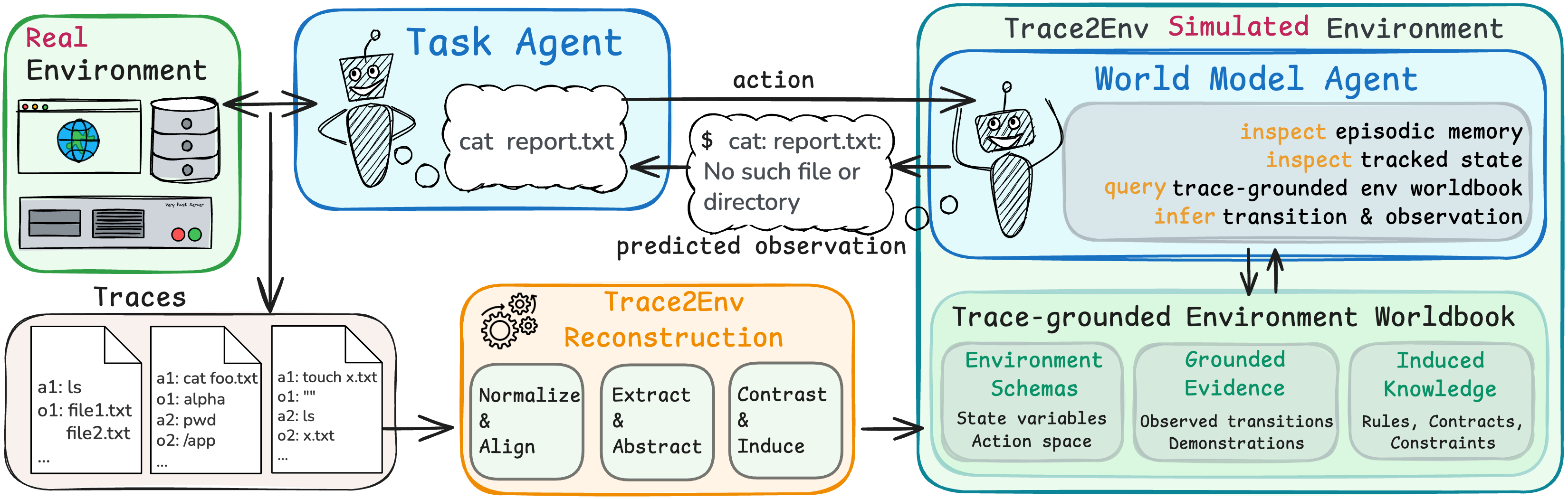
Researchers Quanyu Long and colleagues published the paper 'From Traces to Agentic Worlds: Agentic Language World Models for Interactive Environment Simulation' (arXiv:2610.06100) on October 5, 2026, and released the Trace2Env framework code under the Apache-2.0 license. This is a training-free approach: the environment for an agent solving a task is played out by another agent acting as a world model, while an immutable 'world book' containing action schemas, rules, and constraints is assembled offline from recorded interaction logs. A common harness during simulation validates proposed states and observations and commits only the permissible ones, resulting in a stateful environment simulator without the source code or infrastructure of the real system. A demo is already deployed on Hugging Face Spaces, so the approach can be tested hands-on.


What happened
On October 5, 2026, a paper on agentic language world models for interactive environment simulation was released, assigned the identifier arXiv:2610.06100; the GitHub repository ruyue0001/trace2env appeared the day before, on October 4, 2026, and is distributed under Apache-2.0. The framework operates without training. Offline, from dozens of recorded interaction logs, an immutable environment worldbook is assembled: it contains action schemas, rules, constraints, and original observations as evidence. During simulation, the environment for the task agent is played by another agent acting as a world model: for each action, it selectively refers to the book, the current episode state, and episodic memory, after which it proposes state effects and the next observation. The harness validates these proposals against schemas and invariants and only then commits them. This is exactly why state is maintained: after deleting report.txt with the rm command, reading the file fails with an error many moves later.
Context
Training and evaluating LLM agents require live environments, but real systems are often unavailable, private, or legacy, and their support is expensive. The alternative is language world models, but in a simple prompting variant they poorly maintain long-horizon consistency: the model forgets what happened in the simulation several moves ago. Trace2Env solves this not with a new network, but with an inference architecture: immutable knowledge about the environment is separated from the mutable episode state, and part of the load is shifted from the language model to a deterministic harness, so simulation errors become localizable and environment behavior becomes reproducible. The authors also bet on format portability: converters for traces from Terminal-Bench 2.0, WebArena, ALFWorld, SciWorld, and EnvScaler are claimed, meaning the framework is oriented toward many environment formats, not just one. If the converters work as intended, the cost of creating a new sandbox for agents drops sharply.
Why this matters for the industry
For teams building agents, a practical way appears to obtain training and evaluation sandboxes where the real system is unavailable, private, or legacy: logs are enough, from which a stateful environment model is assembled for agent training, safe testing, or stateful mocks of tools and APIs. This devalues one of the most expensive inputs to agent infrastructure — the environments themselves: the simulator is assembled without source code and without training, and Apache-2.0 and 285 offline tests lower the barrier to entry for a pilot within an existing eval pipeline. According to the paper, agent actions generated against Trace2Env, when replayed in a real environment, remain valid more often than with prompting language world models; the gain is stable on two backbones: 75.94 vs 69.51 on GPT-5.6-Sol and 75.75 vs 68.71 on DeepSeek-V4.1-Flash. However, as a production component, the framework is not yet confirmed: there are no figures on latency and step cost in the open materials, so the realistic stage today is eval stands and prototypes, not live integration.
Why this matters for users
All of this can be tested hands-on right now. A demo is open on Hugging Face Spaces: a terminal that is entirely played out by an agent — state is carried over between commands, and a read file really 'disappears' after deletion. For your own data, it is enough to clone the repository (Python 3.11+): the CLI demo works without a model and without an API key, 285 tests pass without a network, and the README together with docs/WALKTHROUGH.md shows file by file how to build your own 'world book' from your logs. A realistic first step is a prototype of a stateful mock of one of your APIs or terminals and running your agents against it; costs at this stage are limited to engineering time.
What is still unknown / limitations
The only quantitative fidelity evaluation in the open materials is the home-grown benchmark AgentWorldBench, where the official judge with five criteria on a 0–100 scale is controlled by the method's authors; there is no external validator yet, and the baseline pool is limited to Direct Prompting, which weakens the comparability of the figures. Latency and step cost metrics for the simulation are not published. Finally, the portability of the approach is not confirmed by independent replications: it remains unknown whether the validity advantage of actions will be maintained on environments that do not match the original traces — this is the key marker for the next half-year.
Sources
- arXiv — From Traces to Agentic Worlds: Agentic Language World Models for Interactive Environment Simulation (2610.06100)
- Trace2Env — Quanyu Long's project page
- GitHub ruyue0001/trace2env — official Trace2Env repository under Apache-2.0
Author
Look at AI, editorial team