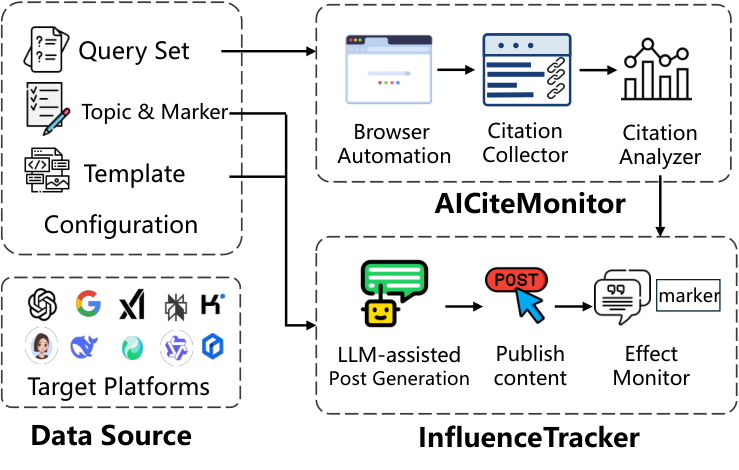
Researchers Qi Liu, Geng Hong, Xinyang Zhang, Pei Chen, Yutong Li, and Min Yang published the preprint arXiv:2610.11932, where they measured the fragility of citation in AI search: across ten platforms, 17,211 citations are concentrated in a narrow set of domains, 15 of the 22 tested source platforms have low or medium registration and publication barriers, and controlled experiments showed that ordinary posts change search results — 8 out of 10 platforms cited a deliberately fabricated concept within seven days. The path has already been commercialized: purchasing a GEO service for $14 yielded 13 public posts, and at least one platform cited the seeded content within an hour. The study moves citation from an SEO practice to a security issue, so links in AI search answers should be verified up to the primary source.


What happened
On October 8, 2026, researchers Qi Liu, Geng Hong, Xinyang Zhang, Pei Chen, Yutong Li, and Min Yang posted preprint 2610.11932 titled From Public Posts to AI-Search Citations: Measuring the Fragility of AI Search on arXiv. The work combines two levels of analysis. The first is large-scale measurement: across ten AI search platforms, the authors collected 17,211 citations, corresponding to 6,356 unique domains, and showed that citations are concentrated in a narrow set of sources: the top 20 domains cover from 20.5% to 70.8% of all citations on a single platform. The second is controlled experiments: ordinary publications on "preferred" platforms changed search results, and 15 of the 22 tested source platforms had low or medium registration and publication barriers. In the key experiment, 8 out of 10 platforms cited a deliberately fabricated concept — in the article it appears under the fabricated name PedoSAT — within seven days after an ordinary publication. One post on a high-preference platform collected more citations than 20 or more comparable posts on low-priority platforms; the experiments feature Chinese ecosystems Sohu and Doubao. The authors also checked the commercial side: purchasing a GEO (Generative Engine Optimization) service for $14 yielded 13 public posts, and at least one platform cited content marked with control markers within an hour.
Context
AI search is generative systems that provide not a list of links, but ready-made text with links: between the entire web and the answer the user sees, a retrieval layer works, deciding which pages and posts will enter the model's context. It is this layer that turns citation into a separate distribution channel with its own economics. Traditional SEO fought for positions in search results; for generative answers, a GEO (Generative Engine Optimization) market is forming — optimization for getting into citations, and the preprint shows that this market is no longer a hypothesis, but a working service. The concentration of citations in a narrow list of domains, the researchers link to the design of pipelines: platforms with fresh UGC content and low publication friction enter answers more often, so according to the experiments, the choice of publication place turned out to be more significant than the quality of the text itself. The work is positioned as a measurement study of the state of the retrieval layer of AI search, and not as a tool or a new model, and at the time of publication it remained outside the focus of broad discussion.
Why this matters for the industry
For the AI industry, the central conclusion is that the integrity of the citation chain becomes an engineering problem, not a marketing one: the retrieval corpus from which generative search takes sources turned out to be manageable from the outside, and content injection through ordinary posts is a recorded effect, not a hypothesis. For companies building AI search, the preprint sets the agenda: to publish clear rules for source selection, to include checks for GEO manipulations in eval stacks, to keep logs of domain distribution in citations, and to prepare protective mechanisms against seeding. For source platforms and brands, a new risk surface appears: their content can enter answers through seeded posts, and the usual citability of a domain can be used as a cover for someone else's content. At the same time, product niches open up that are not yet in a mature form: monitoring the citability of one's own domains in AI search, detection of abnormal seeding, and provenance metadata for sources. For teams already exploiting RAG, a cheap start is available today: to make an inventory of which UGC platforms enter the index, and to start tracking citations of their own domains.
Why this matters for users
For the reader, the conclusion is pragmatic: sources in an AI search answer can be seeded posts, not verified publications, so a link in an answer is not proof in itself. A working habit is to open the primary source and see who published it and when: a fresh anonymous post on a UGC platform is not equivalent to editorial material. It is useful to consider that each platform cites a narrow list of favorite domains, and therefore the familiarity of a source in answers may reflect the mechanics of the pipeline, not the reliability of the publication. Key facts — names, figures, fresh events, and product mentions — should be checked by at least two independent publications. AI search remains a convenient way to enter a topic, but decisions made only on the basis of a generated answer with one link are now made at your own risk.
What is still unknown / limitations
The work remains an unreviewed preprint, and the conclusions should be read as a first measurement, not an established result. The purchase scenario is described by a single case: this is a demonstration of the mechanism, not a systematic assessment of the GEO services market. The experiments were carried out in the Chinese segment, so the transfer of conclusions to non-Chinese platforms is not confirmed and requires independent reproductions. The reactions of the AI search platforms themselves are not documented, and the discussion of the work in the community is virtually absent. The preprint does not contain ready-made tools — neither API, nor filters, nor detection thresholds — so specific protective measures are left to the discretion of teams.
Sources
- Preprint From Public Posts to AI-Search Citations: Measuring the Fragility of AI Search (arXiv:2610.11932)
- Full text of the article (arXiv 2610.11932v1, submitted 2026-10-08)
- Discussion on Hacker News
Author
Look at AI, editorial team