Startup Odyssey, founded by former autonomous vehicle developers Oliver Cameron and Jeff Hawke, released the Odyssey-3 foundation world model on October 8, 2026. From a text prompt, it generates an interactive environment and computes in real time how objects move and interact within it. On the Physics-IQ Verified benchmark, the Odyssey-3 Pro version scored 66.1 points — the best published result, ahead of NVIDIA Cosmos3, FLUX 3, Seedance 2.5, Veo 3.1, and Sora 2. An interactive preview mode is already open for free in the browser, and API access is available upon application.

What Happened
Odyssey-3 was released in two versions at once: the base version with 832×480 resolution and Odyssey-3 Pro with 1280×720. Distillation to a few generation steps using distribution-matching and adversarial distillation allowed the autoregressive diffusion transformer to reach real-time response. Within the generated world, first- and third-person movement, camera control separate from movement, and adding events during generation are supported. On the Physics-IQ Verified benchmark from Anates Labs and DeepMind, Odyssey-3 Pro scored 66.1 points in video-to-video mode under the best-of-8 protocol — this is the best published result: in the table, the model is ahead of NVIDIA Cosmos3-Super and Cosmos3-Nano, FLUX 3, Seedance 2.5, Veo 3.1, and Sora 2. On the WorldMark benchmark, the model took first place in three out of four categories: First-Person Stylized 77.2, Third-Person Real 79.0, and Third-Person Stylized 76.3. Simultaneously with the announcement, a free interactive preview mode in the browser and applications for API access were opened.
Context
Odyssey was founded by Oliver Cameron and Jeff Hawke, who previously worked on autonomous vehicles, so the claim to a universal generative simulator continues their expertise. A foundation world model is a common environment on which different policies for robots, humanoids, and cars can be trained, instead of assembling a private simulator for each domain, as is currently happening with CARLA in autonomy. The key engineering shift here is not the quality of a single frame, but latency: frame-by-frame autoregressive generation, distilled to a few steps, turns a video generator into a simulator with a fast request-response cycle, where the environment immediately responds to user actions and new events. The result should be understood in the context of the ongoing world models race: models of this class are being built by NVIDIA with the Cosmos3 lineup and video model labs, so Odyssey-3's window of sole leadership is unlikely to be long.
Why This Matters for the Industry
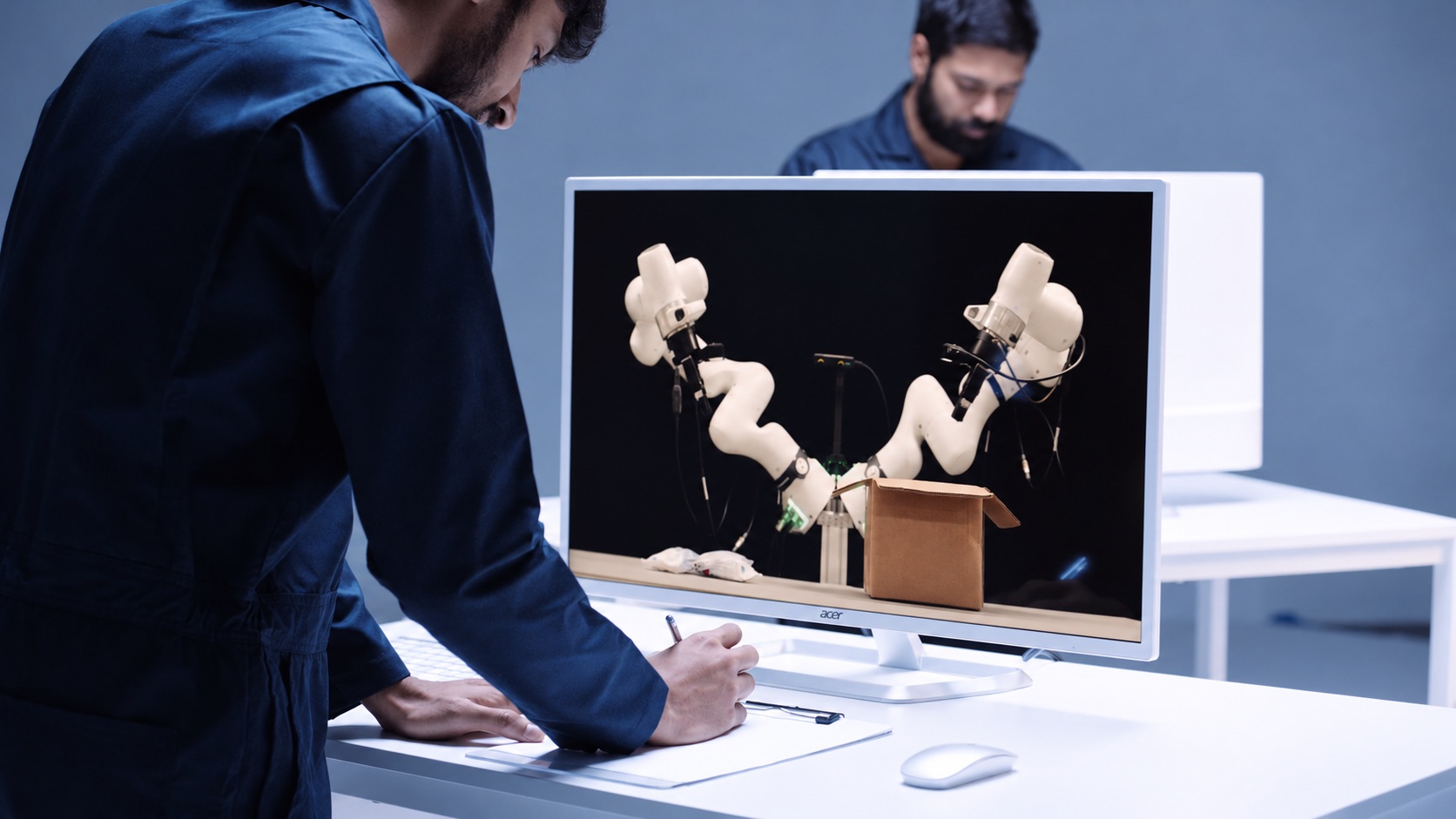
For companies building physical AI, Odyssey-3 is a claim to replace a set of private simulators with a single frozen backbone. Odyssey demonstrates training on top of a model of action decoders for a robotic arm on dozens of hours of demonstrations, policies for Flexion humanoids, and, according to the company, driving a real car in India on just 20 hours of data, with the robotic arm's behavior in the demonstration not present in the training data. If these sim-to-real cases are confirmed by independent verification, the 'one world model for all domains' approach will become viable, and hand-assembled simulators like CARLA risk becoming a niche fallback. Practical entry points are already open: the free browser preview allows running team-critical scenarios in a day and comparing Odyssey-3 Pro with Cosmos3 and your own current simulator, and API access is available upon application via developer.odyssey.ml. However, the API price has not been announced, latency metrics and SLA are absent, so the model can only be included in production as an experiment for now, and no ready-made products based on Odyssey-3 have appeared in the sources at all.
Why This Matters for Users
The main thing for the reader is the free interactive preview mode at experience.odyssey.systems. The world is generated from a text prompt, you can walk through it in first or third person, the camera is controlled separately from movement, and events are added on the fly — this shows how the model computes 'physics' in real time, rather than showing a pre-computed cut of frames. This is an opportunity to manually check where generative simulation behaves convincingly and where it starts to make mistakes: what previously required deploying your own stand today opens directly in the browser. Developers and teams with physical AI projects can simultaneously apply for API access via developer.odyssey.ml. There are no ready-made consumer products based on Odyssey-3 in the sources yet, so today this is primarily a free way to feel for yourself what an interactive generative world looks like.
What Is Still Unknown / Limitations
Some claims currently rely only on Odyssey's own data. The 66.1 result on Physics-IQ Verified was obtained under the best-of-8 protocol, where the score is taken from the best of several attempts, and the correctness of comparison with other models depends on the identity of evaluation conditions. On WorldMark, the model lost to Lyra 2.0 with 84.4 points and AlayaWorld in realistic first-person scenes — Odyssey-3's strengths lie in controllability and stylization, not in pure photometric realism. A technical report with methodology and ablations has not been released as of publication, and there are no independent reproductions of the sim-to-real cases — robotic arm, Flexion humanoids, driving in India. The API price, latency metrics, and SLA have not been announced, so any product plans around the model are premature.
Sources
- Meet Odyssey-3: Our Most Powerful Foundation World Model (official Odyssey announcement, Oliver Cameron & Jeff Hawke)
- Odyssey-3 Research Preview — interactive demo version in the browser
- Odyssey Developer Portal — API access request
Author
Look at AI, editorial team