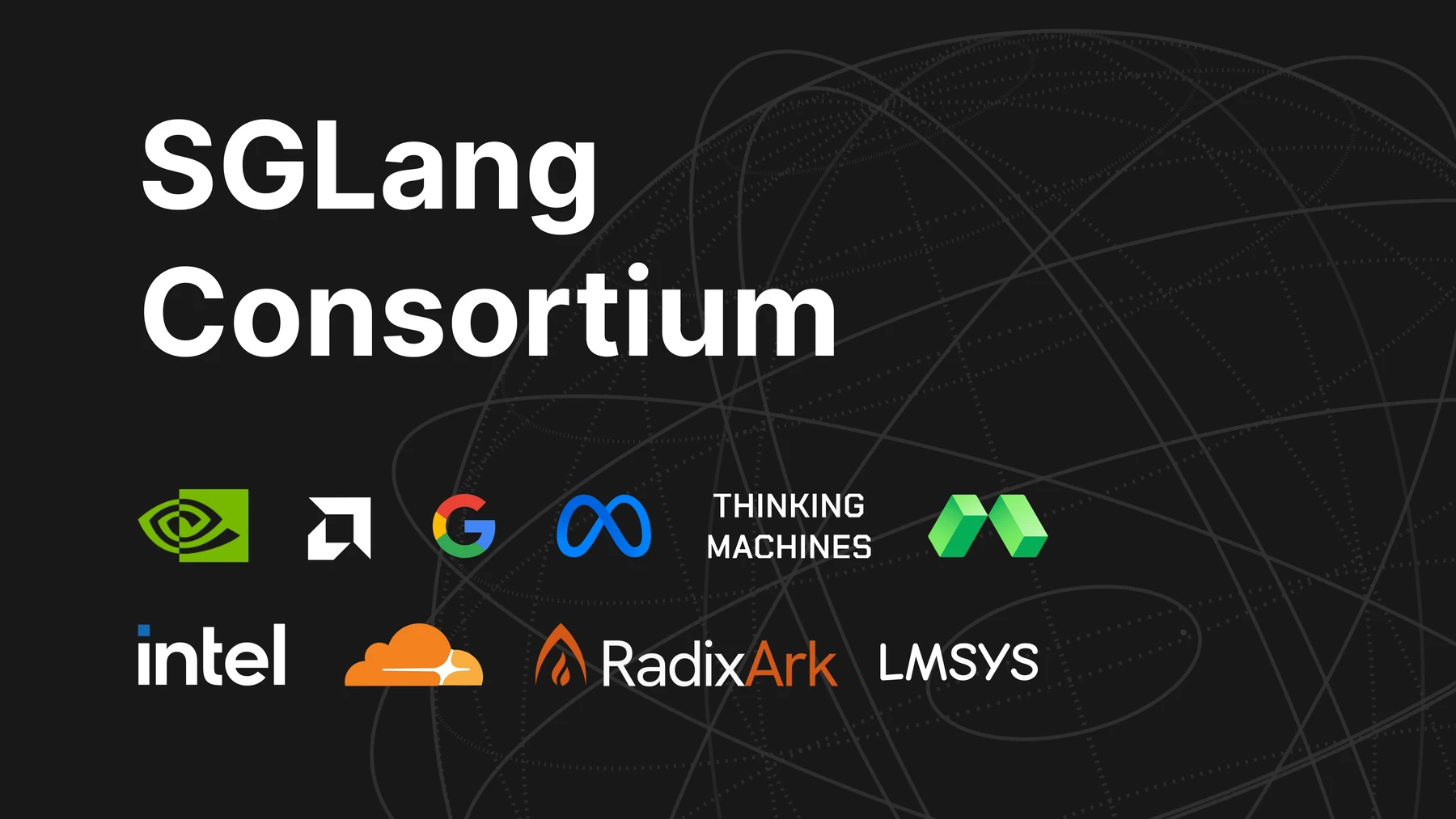
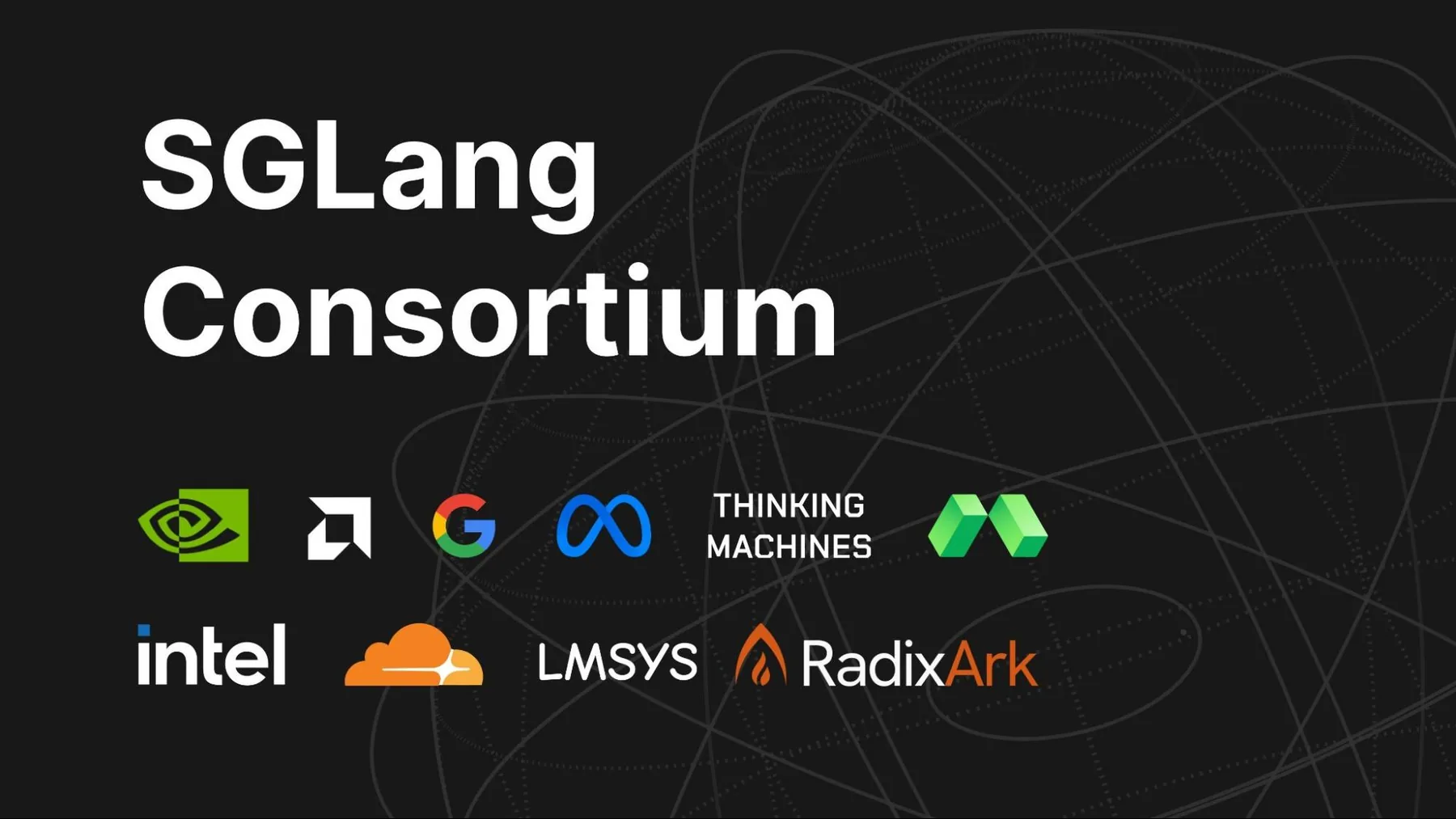
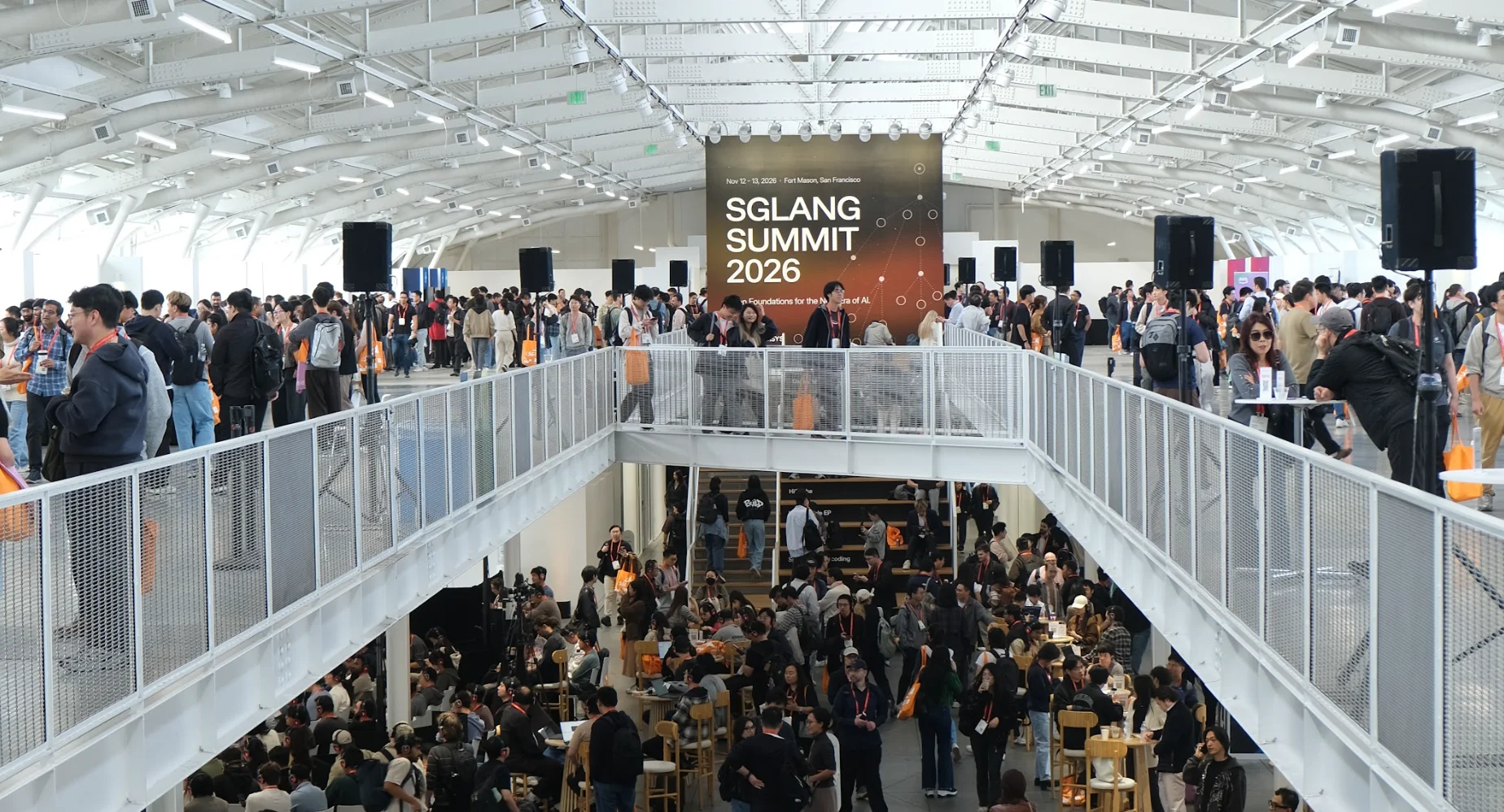
On November 12–13, 2026, the first SGLang Summit was held at Fort Mason (San Francisco), bringing together over 2,000 developers and 90+ technical talks. Key announcements included the launch of the SGLang Consortium, the release of SGLang v1.0, and the rollout of Miles v0.2. The consortium unites nine founding members—NVIDIA, AMD, Intel, Google, Meta, Thinking Machines Lab, Cloudflare, Modal, and RadixArk—while SGLang maintainers retain decision-making authority over the code, and the project remains open source.
What Happened
During the summit, the SGLang Consortium was officially launched, comprising nine founding members: NVIDIA, AMD, Intel, Google, Meta, Thinking Machines Lab, Cloudflare, Modal, and RadixArk. The consortium establishes a joint roadmap for frontier models, reasoning and multimodal workloads, and distributed inference. Simultaneously, SGLang v1.0 was announced, focusing on efficiency and production-scale deployment: unified memory management and the HiCache hierarchical cache for hybrid architectures and long-lived agents whose histories exceed GPU memory. The release of Miles v0.2 by RadixArk expands RL fine-tuning to NVIDIA/AMD GPUs and TPUs (Trainium—coming soon), adds RL for images, video, and audio, and introduces Miles-Diffusion and Multi-LoRA. At the summit, a demonstration showed the reduction of weight update latency for the trillion-parameter Kimi K2 model from 53 to approximately 7 seconds on 32 training + 32 rollout nodes. Recordings and slides from the talks are expected to be published at sglang.io/summit.
Context
SGLang is an open-source inference engine that is becoming a critical infrastructure layer as the share of inference in AI workloads grows. According to Deloitte, inference will account for approximately two-thirds of all AI compute in 2026, compared to roughly half in 2025, meaning engine efficiency directly impacts inference costs. Meta already uses SGLang in production for products serving billions of users and has reported more than a 2x reduction in GPU costs following migration. Support for NVIDIA NIM, AWS Trainium, and Intel expands hardware options, while SGLang-Neuron 0.1.0 has been released as a public preview on Trainium.
Why This Matters for the Industry
SGLang is becoming the de facto standard for open inference: a consortium of nine vendors is synchronizing the roadmap for frontier models, reasoning and multimodal workloads, and distributed inference, while maintainers retain control over the code. Meta’s case study, showing more than a 2x reduction in GPU costs, sets a benchmark for inference unit economics and accelerates the deflation of inference costs. Simultaneously, the engine is becoming commoditized: for startups, value is shifting up the stack—into orchestration, observability, RL fine-tuning, and vertical agents—rather than owning another engine. Miles v0.2 adds an RL fine-tuning pipeline, including images, video, audio, and diffusion models, lowering the barrier to entry for fine-tuning.
Why This Matters for Users
If you are deploying LLMs, SGLang v1.0 (tracker: github.com/sgl-project/sglang/issues/50045) offers the HiCache hierarchical cache, which reduces median TTFT by 60% in multi-turn benchmarks through context reuse. An optimized SGLang deployment demonstrated approximately 1,800 tokens per second per user, which is 1.8x faster than the stock configuration at the same reasoning accuracy. Miles v0.2 is available on GitHub (radixark/miles) for RL fine-tuning on GPU/TPU, including images, video, audio, and diffusion models (Krea-2, Qwen-Image 2.1). For teams already using SGLang, this is an upgrade with concrete gains in TTFT and memory; for those choosing an engine, SGLang emerges as the favorite for open inference with NIM, Trainium, and Intel backends.
What Is Still Unknown / Limitations
The stated metrics—median TTFT minus 60% in multi-turn, approximately 1,800 tokens per second per user, 1.8x faster than the stock configuration at the same reasoning accuracy, and more than a 2x GPU cost reduction for Meta—are cited in the LMSYS blog and why_it_matters, but the benchmark composition and conditions are not disclosed. The demonstration of reducing Kimi K2 weight update latency from 53 to approximately 7 seconds was a showcase at the summit, not a reproducible benchmark with published methodology. Trainium support in Miles v0.2 is currently marked as "coming soon," and SGLang-Neuron 0.1.0 remains a public preview.
Sources
- SGLang Summit 2026 Recap: Building Open AI Infrastructure Together (LMSYS Org)
- LMSYS Org Launches SGLang Consortium with NVIDIA, AMD, Intel, Google, Meta, Thinking Machines Lab, Cloudflare, Modal and RadixArk
- Miles v0.2.0 release notes (radixark/miles, GitHub)
Author
Look at AI, editorial team