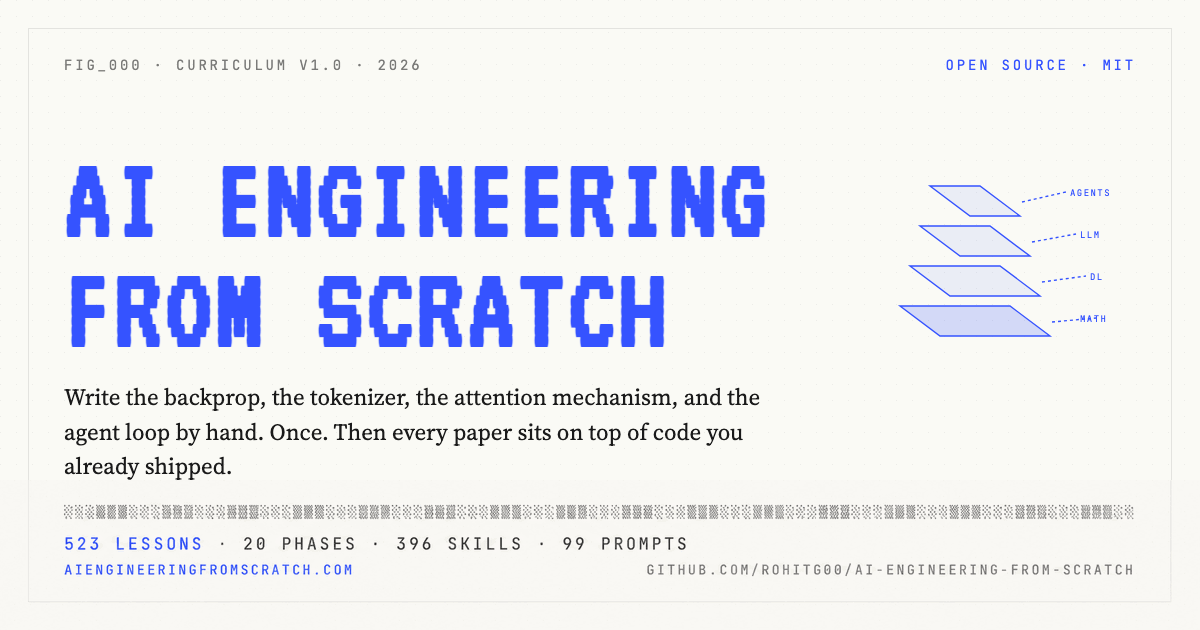
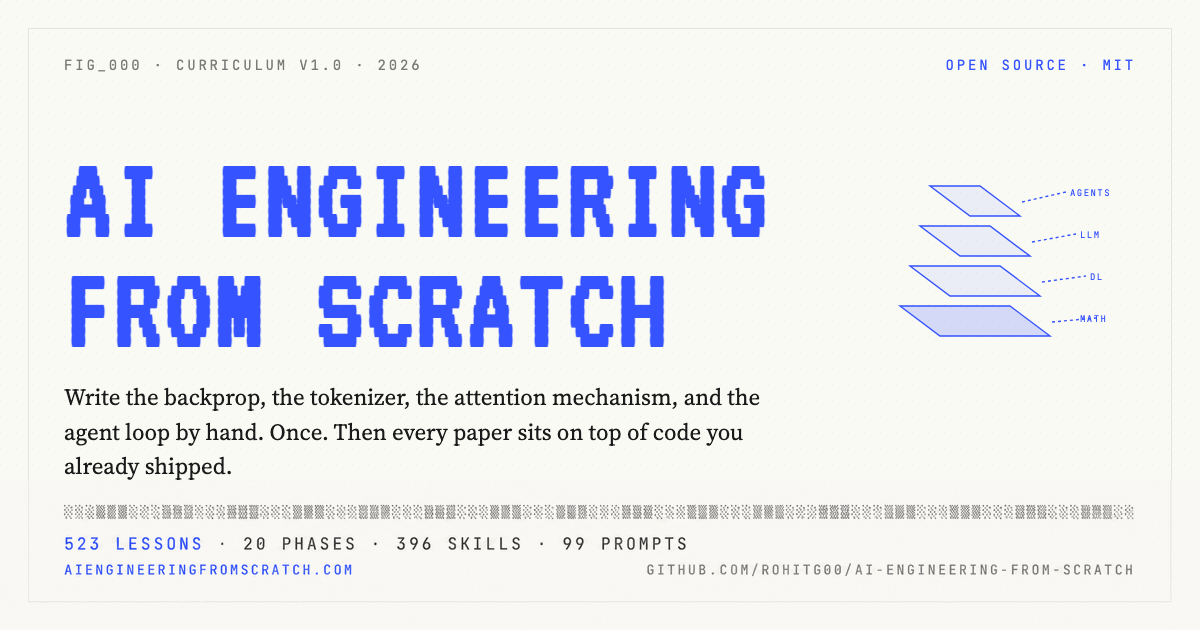
A free course, AI Engineering from Scratch, has been made publicly available: 523 lessons across 20 phases, where every algorithm—from linear algebra and backpropagation to agents and swarms—is first derived from raw math, and only then are frameworks like PyTorch introduced. The project is released under the MIT license, requires no payment or accounts, and its GitHub repository has gathered over 62,000 stars and is actively updated. This is a free path into modern AI engineering—from neural network mechanics to production, safety, and MCP.
What happened
The post about the course appeared on Hacker News on October 3, 2026. The project’s author is engineer Rohit Ghumare (rohitg00), and the materials are open in the repository github.com/rohitg00/ai-engineering-from-scratch. According to GitHub API data as of October 3, 2026, the repository has 62,904 stars, the last push was dated October 2, 2026, and the monthly book release v2026.10 came out on September 27, 2026. The lessons are grouped into four tracks: building and deploying AI applications, engineering fundamentals, agent-assisted development, and product skills, with separate routes for MCP (Model Context Protocol) attached. Code examples are written in Python, TypeScript, Rust, and Julia—the language is chosen to fit the specific topic.
Context
The project reflects a shift in AI engineering education: instead of scattered guides on LLM wrappers, it covers the full engineering stack—attention mechanisms, tokenizers, agent and swarm loops, MCP, reinforcement learning, multimodality, production, and safety. The “derive the math by hand first, then pick up PyTorch” approach has long been known in ML education, so the novelty here is not the idea but the scale and presentation: each lesson follows a reproducible cycle where a problem statement is followed by formula derivations, code, and a test, and any derivation can be independently verified. Open educational materials on the Model Context Protocol are still scarce, making the course’s corresponding routes especially in demand. The project also includes preparation for Claude and MCP Associate (MCPA) certifications—with an explicit disclaimer that the course is not affiliated with Anthropic or the Linux Foundation.
Why this matters for the industry
For the industry, the project demonstrates two transferable patterns. First—content-as-code: the same lessons are automatically assembled into book editions via CI tools, simplifying the maintenance of a large educational corpus in an up-to-date state. Second—packaging education as an agent skill: the repository is distributed in SKILL.md format, and an AI tutor is deployed directly into the developer’s working environment. Systematic explanations of mechanics—attention, tokenizers, agent loops, MCP—before introducing frameworks help engineers consciously manage inference cost and latency and faster find the causes of problems in production systems. For teams, the course looks like a ready-made candidate for onboarding without purchasing licenses, and if the pace of monthly releases is maintained, it could become a de facto open publication on AI engineering; knowledge of MCP in the coming years is likely to become a basic expectation when hiring LLM application engineers.
Why this matters for users
The practical side is simple: just clone the repository with the command git clone https://github.com/rohitg00/ai-engineering-from-scratch and open the first lesson phases/00-setup-and-tooling/01-dev-environment—no payment or account creation is needed. Those who learn in the terminal will appreciate the AI tutor: the command npx skills add rohitg00/ai-engineering-from-scratch deploys it in the working environment and builds a personal route based on the result of a placement test. Those who prefer reading will get a ready-made book edition in six volumes in EPUB and PDF formats, attached to GitHub releases. A solo developer can combine the lessons with familiar tools like Claude, Cursor, or Codex, without switching between scattered articles.
What is still unknown / limitations
The quality of the lessons is currently confirmed only by the repository’s popularity: there are no independent external assessments in available sources, and the figure of 523 lessons remains an author-stated number. Stars on GitHub measure audience attention, not material quality; the Hacker News discussion at the time of data collection had 1 point and 0 comments, so external validation is still absent. The course does not bring new scientific results—it is an educational resource and open reference, not a research paper. The sections on agents and MCP describe a rapidly changing part of the stack, so without regular updates the material risks becoming an outdated snapshot of 2026, and the course’s sustainable value depends on community support and release pace.
Sources
- AI Engineering from Scratch — official course website
- GitHub repository rohitg00/ai-engineering-from-scratch
- AI Engineering from Scratch discussion on Hacker News
Author
Look at AI, editorial team