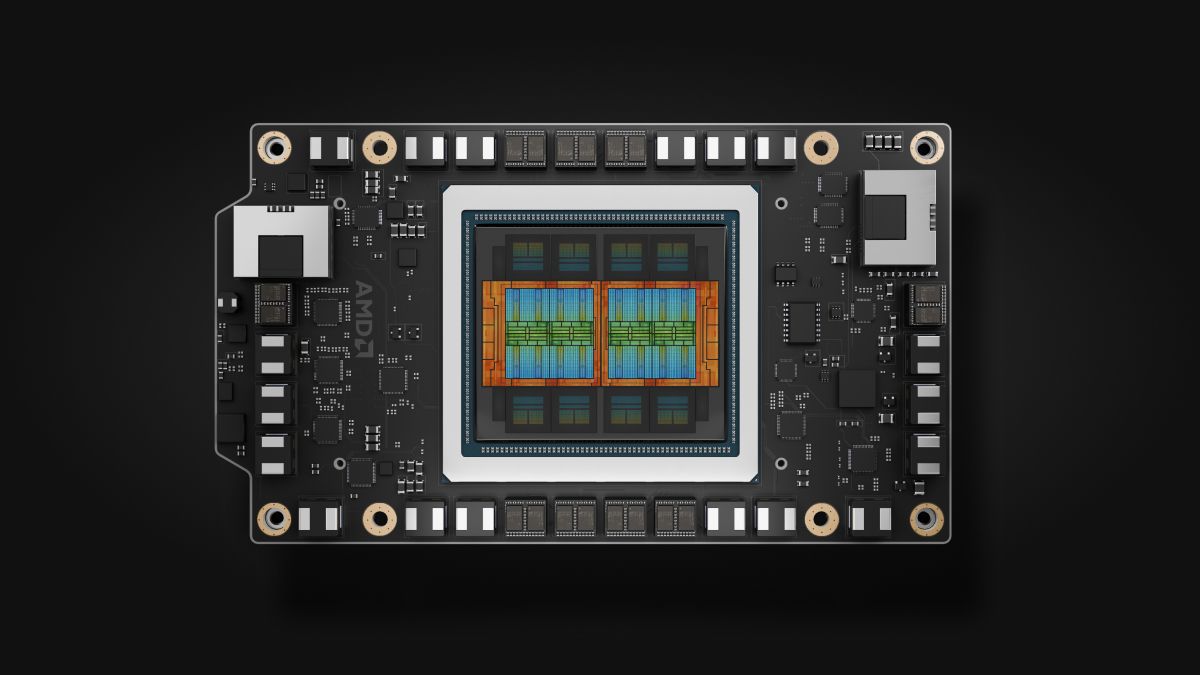
Anthropic told investors during its IPO roadshow that its Claude Mythos Preview model prepared one of the company's models to run on the AMD Instinct MI355X accelerator in approximately three days with almost no human involvement. According to Anthropic's historical experience, adaptation to a new accelerator took from six to twelve months and required a team of dozens of engineers. The statement, dated November 10, 2026, directly impacts Nvidia's main software barrier — the CUDA platform — and changes the conversation about how strongly this "moat" protects Nvidia's position in the accelerator market.
What happened
As part of its IPO roadshow, Anthropic showed investors a slide dated November 10, 2026, stating that the Claude Mythos Preview model ported or wrote "nearly 100% of the kernels" for the AMD Instinct MI355X accelerator in approximately three days with minimal human involvement. The slide itself contains a caveat: the three days apply only to prompt processing, i.e., the processing of incoming requests, and even then "at a useful performance level." Anthropic co-founder and chief compute officer Tom Brown added that one engineer asked Claude to "bring up the rack" of MI355X and left the task "over the weekend."
Context
Kernels are low-level computational functions through which a model is actually connected to specific hardware. CUDA — Nvidia's nearly twenty-year-old software platform — has historically been the main barrier to switching to other accelerators: code for CUDA had to be manually rewritten for ROCm or HIP, AMD's toolset, making the lock-in to Nvidia chips an expensive six-month project for an entire team. It is no coincidence that Jensen Huang formulated Nvidia's advantage with the words "no one knows our architecture better than we do." For Anthropic, the topic is no longer theoretical: for the first time this year, the company is working with AMD GPUs under a supply agreement of up to 2 GW, and the first MI450 chips in Helios racks are expected in the first half of 2027.
Why this matters for the industry
For the industry, the hidden tax of a multi-chip strategy — porting kernels to other accelerators — is becoming significantly cheaper, so the defensive power of Nvidia's twenty-year ecosystem is weakening. This strengthens the positions of AMD, Google TPU, and AWS Trainium, which compete for AI laboratory compute, and gives GPU buyers a negotiating precedent: adaptation can cost days, not months. SemiAnalysis, however, points out that agents still need GPUs to test the code they write, so the bottleneck shifts but does not disappear. If the capability is confirmed, accelerator vendors will start competing not only on price but also on the quality of automatic onboarding — how quickly agents bring up their hardware — and training and inference infrastructure will become multi-vendor.
Why this matters for users
For the reader, this is primarily a visible shift in the professions themselves: the agentic model closed off the work of niche specialists — kernel engineers who previously manually ported computational code to new hardware. Practically, nothing changes yet: this is about the internal adaptation of one Anthropic model, and from available data, it does not follow that Claude Mythos Preview is available as an external product or API; no prices or tools have been published. The first chance to turn the slide into verifiable data will appear after Anthropic's IPO, which is expected next week: public reporting may reveal the size of the deal with AMD, actual adaptation costs, and AMD's share of the company's compute park. For those building products, the pattern itself is already useful today: an autonomous agent takes on a multi-day task of narrow expertise, while a human validates the result on real hardware.
What is currently unknown / limitations
The statement relies on a slide for investors, not a publication with methodology. The three days cover only prompt processing "at a useful performance level"; the status of other onboarding phases — decode, training, and peak optimization — is not disclosed, and the concept of "useful performance level" is not defined anywhere. Anthropic did not report the number of iterations and compilations, nor the performance and utilization of MI355X relative to Nvidia, so a comparison of AMD and Nvidia on AI-written code remained impossible; third parties have not yet reproduced the statement. The story about the engineer who left the task "over the weekend" is a retelling by co-founder Tom Brown during the roadshow, not observed evidence, and "bringing up the rack" of MI355X is an operations task, not equivalent to writing kernels.
Sources
- Tom's Hardware — on Anthropic's statement about onboarding AMD GPUs in three days
- Hacker News — discussion of the Claude Mythos and AMD GPU news
Author
Look at AI, editorial team