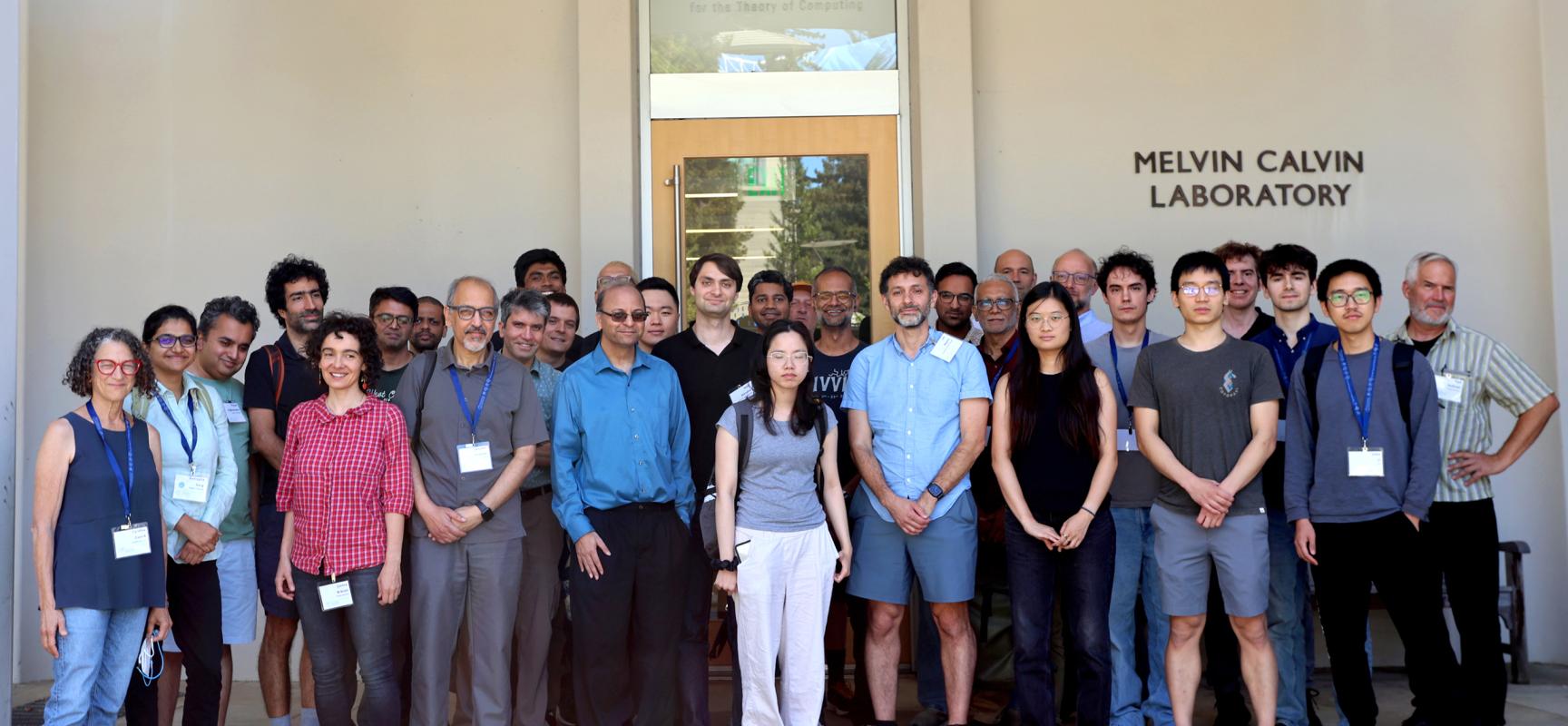
The Simons Institute (UC Berkeley) published the working group report 'AI and TCS: The Next Six Months' on September 28, 2026: 32 participants in a two-day workshop on September 9–10 proposed twelve specific adaptation measures for the theoretical computer science community, from a mandatory 'AI Methodology' section with standardized model contribution tagging to submission limits and author certification at conferences. The STOC 2027 program committee has already promised to adopt nearly all recommendations, so AI contribution disclosure norms will take effect in the nearest review cycle, and the report and accompanying LaTeX template are available for free on the institute's website.

What happened
The 'AI and TCS: The Next Six Months' working group formed around a two-day workshop at the Simons Institute on September 9–10, 2026: 32 researchers participated in the discussion, another 134 people answered the organizers' questions, and on September 28 the institute presented the final public report. It contains twelve actionable measures for computer science theorists (TCS). The key one is a standardized 'AI Methodology' section in every public paper: AI contributions are tagged across six categories, the test is the question 'would such a contribution be given co-authorship?', and the approach is modeled on the CRediT taxonomy applied to human contributions; a LaTeX template for such a section was published alongside the report. A separate block addresses tracing the origin of AI ideas against 'subconscious plagiarism,' discussing the case of Gemini output overlaps on Erdős problems (arXiv:2601.22401). For conferences, a limit of five submissions per author, author certification, the right to reject a paper for poor presentation with a one-sentence justification in the review, and permitted AI assistance for reviewers with mandatory disclosure are recommended. The STOC 2027 program committee has already announced the adoption of nearly all recommendations.
Context
Pressure on theoretical computer science is growing for the same reason as in other scientific fields: generative models have become a significant aid in formulating hypotheses, finding proof sketches, and preparing texts, conference submission volumes are increasing, and the burden falls on reviewers. Until now, the response consisted of individual statements and local policies of specific journals or program committees; the value of the report is that the TCS community has for the first time consolidated its position into a single set of procedural norms, relying simultaneously on an in-person workshop and a mass survey. For tagging machine contributions, the group took a ready-made example — the CRediT taxonomy, which has long standardized co-author roles in scientific publications — and adapted its logic to six categories of AI assistance, so that disclosure is verifiable rather than declarative. The most delicate direction became tracing the origin of ideas: a model's result matching an independently obtained proof may be a statistical inevitability rather than borrowing, as shown by the analysis of cases with models on Erdős problems, where overlaps with known solutions cannot be interpreted unambiguously without additional metrics.
Why this matters for the industry
For the industry, this is an early but real signal of the research compliance infrastructure market: since the top conference STOC 2027 has already promised to implement nearly all recommendations, author certification, the five-submission limit, and AI contribution sections will take effect on the live flow of submissions in the coming months, rather than remaining a slogan. Standardized tagging across six categories with a conditional co-authorship threshold simultaneously provides material for tools: disclosure forms, machine-readable contribution metadata, session logging with models, and idea origin metrics, which today exist only as problem statements. The 'AI Methodology' section model is likely to go beyond TCS: the report is expected to spread to ML conferences and mathematics journals, where the same disclosure questions are discussed without a common standard. There is no direct commercial effect now — these are process rules, not a product with an interface or prices, so the nearest work for product builders is assembling tagging forms and submission fields based on the published template.
Why this matters for users
Everything needed to get started is available for free: the full report text, the LaTeX template for the AI contribution section, and tracking of recommendation implementation are placed on the Simons Institute page, so the template can be implemented in your own documents today. If you are preparing submissions, prepare for certification, the five-submission limit per author, and the requirement for a correct disclosure section; if you are reviewing, AI assistance is now permitted but requires explicit disclosure, and program committees should agree on local rules before deadlines. The next STOC 2027 cycle will take place almost entirely under the new rules, so authors will test them quickly — along with new disclosure fields in submission forms. Students and graduate students are promised a review of dissertation evaluation practices and norms for correct attribution of LLM work, as well as the possibility of officially covering LLM expenses with grants.
What is still unknown / limitations
How well the rules will hold up in practice will be shown by the full STOC 2027 submission cycle. The 'would such a contribution be given co-authorship?' threshold is a subjective expert assessment, and the consistency of such judgments between people has not yet been measured, as no pilot was conducted. AI contribution disclosure remains self-reported for both authors and reviewers: without auditing and session logging, this is weak evidence of actual model use. Idea origin tracing has no ready-made metrics, thresholds, or procedure for resolving disputed cases, and the boundary between coincidence and borrowing is blurred by the statistical inevitability of output overlaps. The five-submission limit curbs volume, not quality, and may distort incentives through reordering author lists and 'guest' co-authorship; the question of appealing rejections accompanied by a one-sentence review remains open. Public response is currently modest: the Hacker News discussion was limited to three points without comments, so it is too early to speak of the norms' reception by a broad audience.
Sources
- Simons Institute — AI and TCS: The Next Six Months working group report
- Simons Institute news — AI and TCS: The Next Six Months report announcement (September 29, 2026)
- arXiv:2601.22401 — case of Gemini output overlaps on Erdős problems
- Hacker News — report discussion (3 points, 0 comments)
Author
Look at AI, editorial team