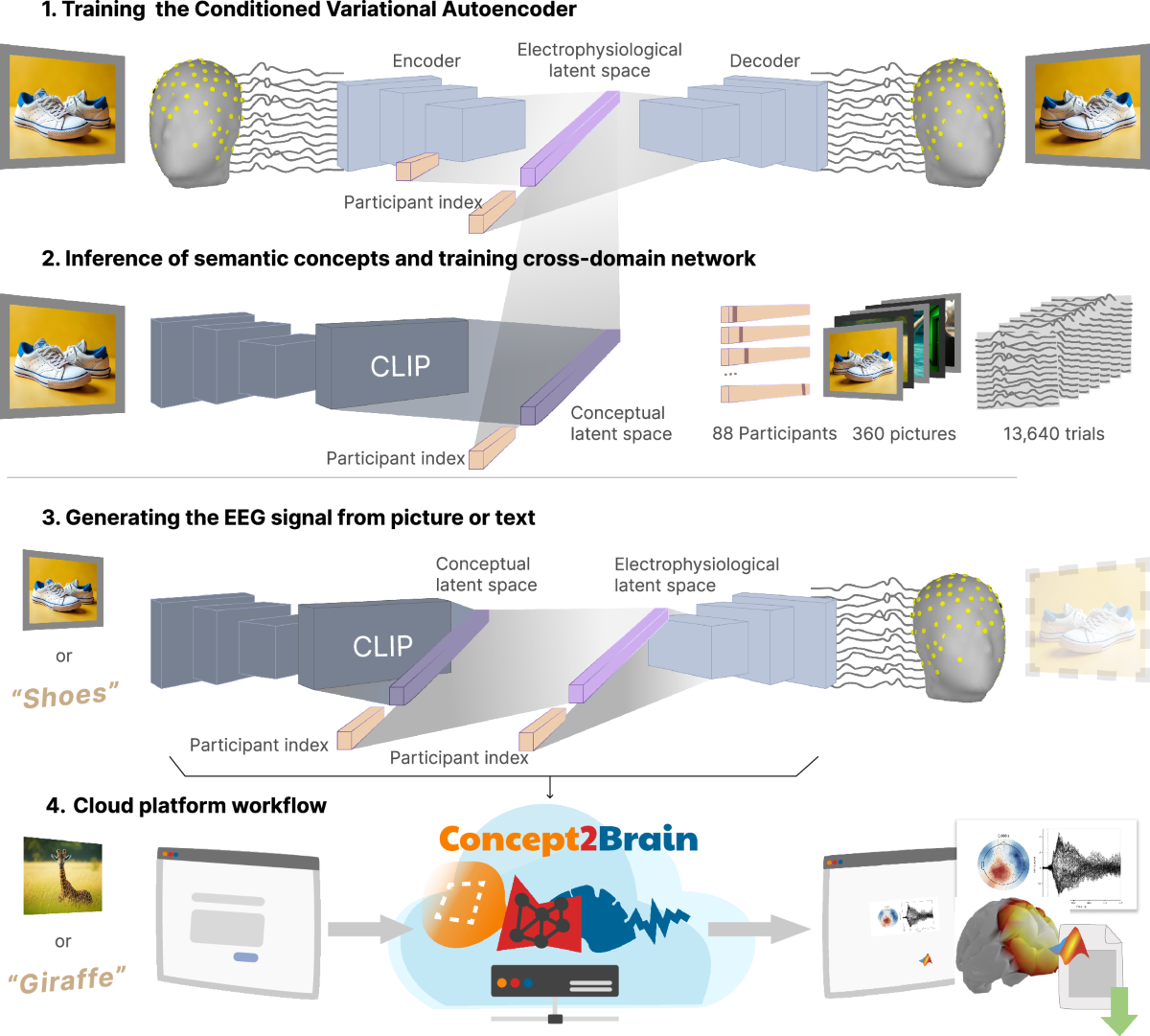
Researchers from the University of Florida (Alejandro Santos-Mayo, Andreas Keil, and co-authors) published the Concept2Brain model in Nature Communications: a deep neural network that generates synthetic EEG recordings from text or images — a prediction of how the brain might react to such a stimulus. The model reproduces canonical components of brain response and individual differences between people, and an open web service already allows generating such a response to any concept or image.


What happened
A team of researchers from the University of Florida, including Alejandro Santos-Mayo and Andreas Keil, published a paper in Nature Communications on the Concept2Brain model — a deep neural network that generates synthetic EEG signals of the event-related potentials (ERP) class from text or images. The architecture connects OpenAI's CLIP, which translates a stimulus into a 512-dimensional semantic representation, and a Conditional Variational Autoencoder, which projects it into a 256-dimensional electrophysiological latent space; the output reconstructs 129 EEG channels of 750 points length, i.e., a 1.5-second recording at a frequency of 500 Hz. The model has a participant ID embedded, so the signal can be generated for a specific person from 88 "virtual participants," modeling individual differences. Training was conducted on 13,640 EEG recordings collected from 88 observers while viewing 360 natural photographs from the IAPS set: 120 pleasant, 120 neutral, and 120 unpleasant images. Synthetic signals reproduce canonical ERP components P100, N200, P300, and LPP with high correlation to empirical data, with late components matching most accurately on parietal electrodes in the 400–800 ms window. An additional validation was cross-validation on external MEG/fMRI datasets THINGS, showing correlations of synthetic signals with activity in V1–V3 and rFFA zones.
Context
The brain's reaction to a stimulus in EEG is registered as event-related potentials — averaged bursts of activity in which early sensory and late cognitive components are distinguished; neurobiologists use them to judge how the meaning and emotional significance of what is seen are processed. Behind each empirical average lies expensive infrastructure: a laboratory, equipment, and participant recruitment, so for decades research has relied on standardized stimulus sets, including IAPS affective photographs, and on averaging over small groups of observers. Concept2Brain appears precisely in this niche: the semantic part of the system is built on OpenAI's CLIP, which links text and images in a common representation space, and the authors showed that this space can be extended to the electrophysiological. The scientific novelty of the work is not in the exoticness of the generative stack — the combination of CLIP and a variational autoencoder is quite standard by generative ML metrics — but in the fact that the "stimulus → neuro-response prediction" chain has become an open and verifiable tool, rather than an internal detail of a laboratory article.
Why this matters for the industry
For neurobiologists and developers in the fields of BCI, UX-research, and neuromarketing, Concept2Brain is a signal of the cost reduction of primary hypothesis validation: what previously required a laboratory and participant recruitment becomes a matter of inference. A working scenario is already prototyping datasets, unit tests of signal processing code, educational demos, statistical power assessment before recruiting real participants, and pre-registration of hypotheses about specific ERP components; the compatibility of synthetic data with data from other registration modalities additionally makes the model a tool for testing neuroimaging hypotheses. However, Concept2Brain remains a research tool, not a production component: there is no documented API, pricing, or latency metrics, so product teams only have access to a manual workflow, and there is no monetization at this stage — this is an exploration phase, not an expansion. If the concept is confirmed and generalized beyond affective photographs, within a couple of years, generative models of physiological response could become part of the standard experimental design stack — virtual cohorts for a "dry run" before collecting real data, and in a favorable trajectory, a product layer could also emerge: synthetic neuro-datasets as a service and experimental pre-screening of visual content based on predicted neuro-response.
Why this matters for users
This is an early example of how generative models predict a person's physiological response to a description or image of a stimulus. The Concept2Brain web service is open, so enthusiasts, teachers, and students can generate a synthetic EEG response to any concept or picture themselves and compare it with real ERP recordings. Such a scenario automates part of the research cycle and makes synthetic data available for educational demos and initial idea checks without contacting a laboratory. Practical value is limited to the training domain — IAPS affective photographs, so generation brings the most benefit for images close to this class.
What is still unknown / limitations
The authors explicitly warn that predictions from text require caution: the model was trained on EEG evoked by pictures, and there is no separate validation result for the text→EEG branch in the published materials. Correlations with empirical data need to be further checked to ensure they do not reduce to an artifact of memorizing specific IAPS stimuli, and external validation was performed in MEG and fMRI modalities, not on new EEG experiments. The key unresolved test is the repetition of correlations above 0.6 by independent groups on new stimulus sets beyond IAPS. The question of the applicability of synthetic data in single-trial BCI tasks also remains open.
Sources
- Concept2Brain: an AI model for predicting neurophysiological responses to text and pictures | Nature Communications
- Concept2Brain web service (open tool for generating synthetic EEG datasets)
Author
Look at AI, editorial team