Author rehan-remade published universal-modder, an open-source framework under the MIT license on GitHub, which allows any coding AI agent to mod almost any single-player PC game. The Python repository was created on September 30, 2026, and collected about 914 stars in the first day. The project combines Agent Skills, the um CLI utility, the fal MCP server, and a shared knowledge base that agents themselves populate via PRs.


What happened
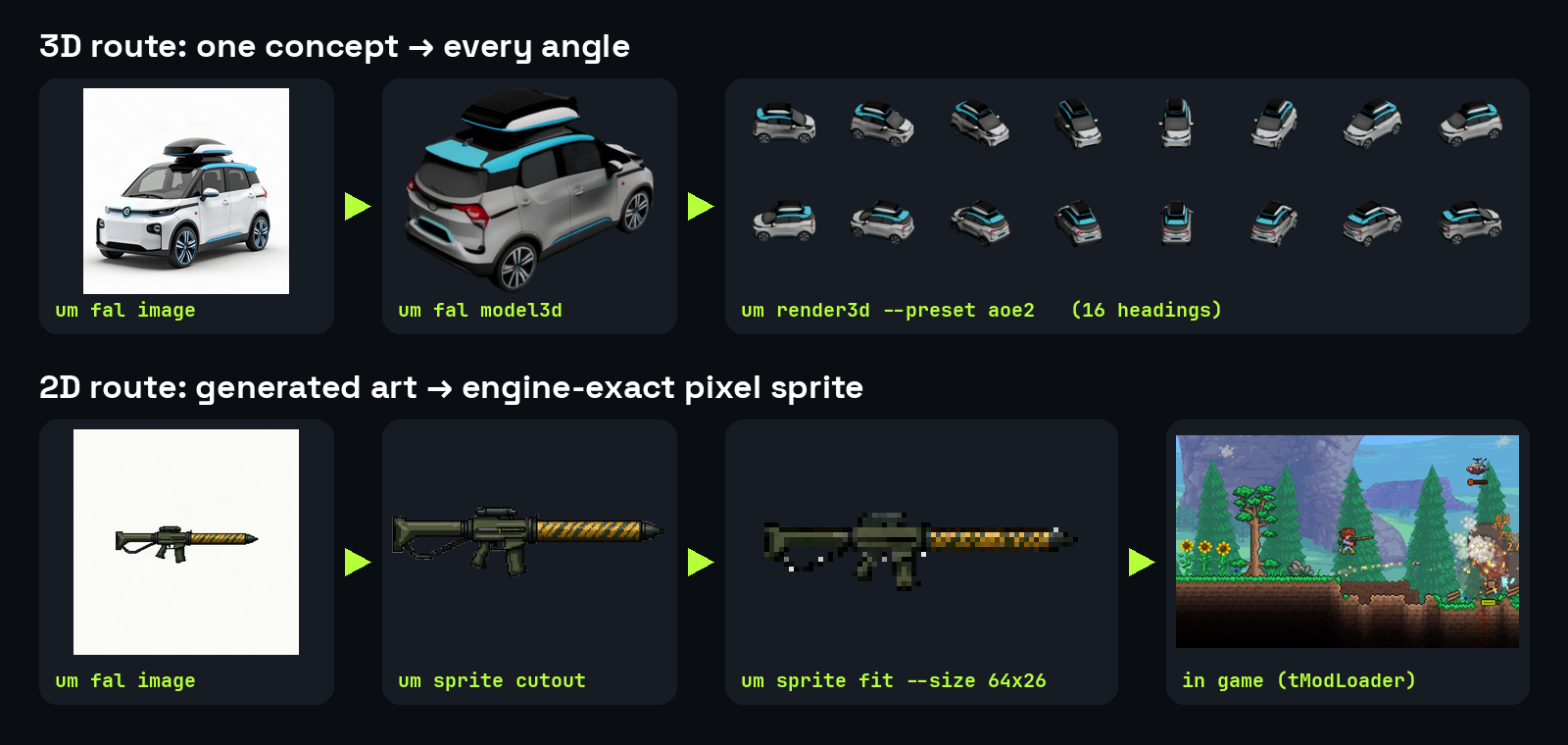
Author rehan-remade published universal-modder, an open-source framework under the MIT license in Python on GitHub; the repository was created on September 30, 2026, and collected about 914 stars in the first day. The project consists of a set of Agent Skills, the um CLI utility, the fal MCP server, and a shared knowledge base, and is designed for any coding AI agent: Claude Code, Codex, Cursor, Gemini CLI, GitHub Copilot, and any agent that reads AGENTS.md. During operation, the agent goes through the same cycle: it searches for notes in the knowledge base, determines the game engine using one of 12 ready-made scenarios (Unity, Unreal, Godot, Source, .NET/XNA, Minecraft, Genie/AoE2, Bethesda, RE Engine, native C++, and others), reads the actual game code via ILSpy, Cpp2IL, Ghidra, or IDA over MCP, generates sprites, 3D models, and sound via fal (GPT Image 2, Nano Banana 2, FLUX, Trellis 2, ElevenLabs), tests the mod in a running game, and records a demo video. After completing the session, the agent formats a field note and opens a PR to the shared knowledge base index.
Context
The project does not introduce a new model or training method — this is orchestration of already existing components: the Agent Skills format, the MCP protocol, decompilers ILSpy, Cpp2IL, Ghidra, and IDA, as well as fal generative services. Against this backdrop, two elements with research value stand out. The first is a live running game as an executable testing environment: the result is evaluated not by synthetic tests, but by operation directly inside the application, which is fixed by a recorded demo video. The second is inter-agent memory of experience: each completed session leaves a field note and a PR to the shared knowledge base, so the observations of one run become the property of all future runs of any agent. The demo examples feature Terraria, Stardew Valley, and Age of Empires II: Definitive Edition.
Why this matters for the industry
For the industry, the value is not modding itself, but a reproducible template: agent plus skills plus MCP plus testing in a live environment plus a collective knowledge base. The same cycle — reconnaissance, determining the system structure, reading code, generating assets, testing in a real application — is transferred to the automation of any closed proprietary system that has no API and will not have one. The PR mechanism to the shared knowledge base is a rare way for agent projects to convert one-off sessions into an accumulating asset that all teams can use. For modding communities, this is a ready-made framework that lowers the entry barrier: long manual reverse engineering is replaced by launching an agent from a single prompt. At the same time, the predictability of the result is unevenly distributed: managed stacks like .NET/XNA and Unity are more deterministic thanks to decompilation via ILSpy and Cpp2IL, while native C++ via Ghidra and IDA is the least reliable area, and it is precisely there that the promise of "any game" is confirmed the worst.
Why this matters for users
You can try it right away: in Claude Code, the plugin is installed with a single command /plugin install universal-modder@universal-modder; beyond that, Python 3.10+, ffmpeg, and preferably a fal key are required, since the generation of images, 3D models, and sound goes through fal and is paid. The authors suggest experimenting with your own purchased games — the demo shows Terraria, Stardew Valley, and Age of Empires II: Definitive Edition. Safety rules are built into the framework itself: it works only with single-player purchased games, refuses to interfere with games with anti-cheat and to write cheats for multiplayer, makes a backup of saves, and asks for permission before keyboard input. The real cost of an attempt consists of agent session tokens and paid fal generation, and a successful outcome on a specific game is not guaranteed in advance.
What is still unknown / limitations
The project has no evaluation methodology: the sources lack success rates by engine, reports of failed runs, and a count of costs in money and tokens. The evidence base is three curated demos, that is, a showcase, not a sample, which is typical for capability claims. Formulations like "the threshold is lowered to a single prompt" should be read carefully: the prompt starts the process, but does not guarantee its result, and functionality is confirmed by the materials of the repository and demos themselves, not by independent reproduction. Possible forks to other closed domains, formatting game modding into a formal agent benchmark, and accumulating statistics on movements via the knowledge base are speculation, not established facts. The legal side of reverse engineering purchased games, including EULA and DRM caveats, is not disclosed in confirmed sources.
Sources
- GitHub — rehan-remade/universal-modder: Skills, tools and a shared knowledge base that let any AI coding agent mod almost any PC game
- Hacker News discussion: Universal Modder: Let Any AI Coding Agent Mod Almost Any PC Game
- universal-modder: knowledge base index (field notes from actual mods)
Author
Look at AI, editorial team