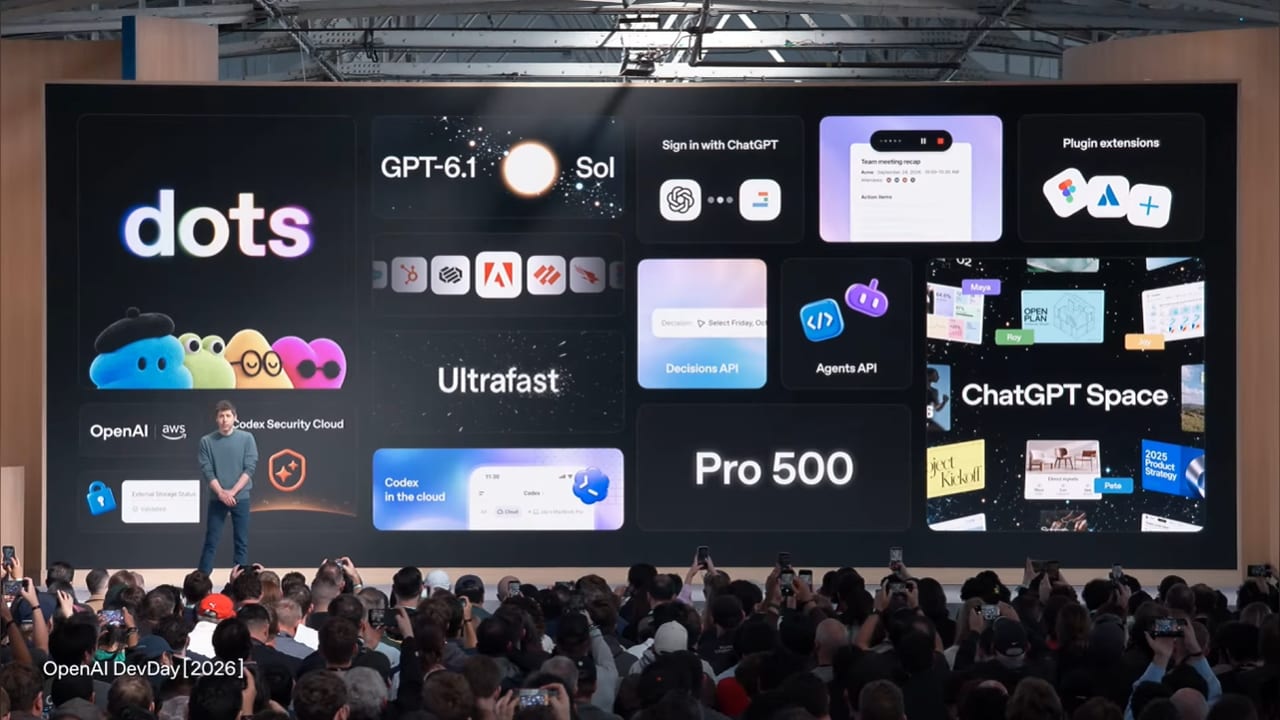
On September 29, 2026, at OpenAI DevDay in San Francisco, more than 20 new features were announced, the main one of which changes the very logic of ChatGPT: instead of a chat — always-on Dots agents on the GPT-6 Astra model, each with its own cloud computer, accessible via ChatGPT, Slack, and Teams, including voice calls. The second move is pricing: the low-cost GPT-6.1 Sol model has appeared in the API, maintaining the level of Astra for about a fifth of the price, while the Ultrafast speed mode on Cerebras hardware has been launched with a six-fold markup. Developers were given the same agent harness through the public beta of the Agents API and the Bedrock Managed Agents integration with AWS, and the pricing lineup was restructured, including the return of Pro 200.
What happened
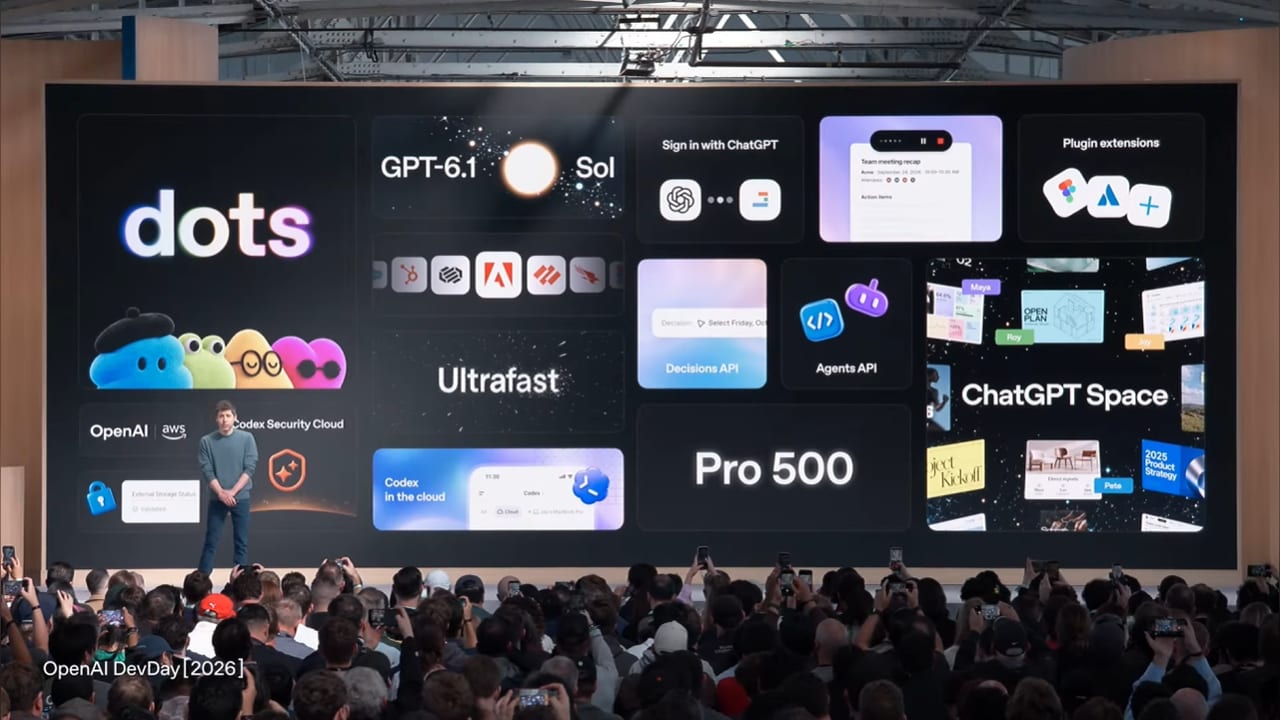
The core of the conference consisted of four blocks of announcements. The first — Dots agents: an always-on agent running on GPT-6 Astra with its own cloud computer; in ChatGPT, Slack, and Teams, you can communicate with it even via voice calls, a catalog of more than 4,000 applications is available through plugins, and if desired, the user's own computer with its local files can be connected to the agent. Dots are included in the Pro and Business Premium plans, the first Dot is free, and in Enterprise, Edu, and Healthcare plans, activation is done by an administrator in beta and is disabled by default. The second block — the GPT-6.1 Sol model: according to OpenAI's wording, it maintains the level of Astra for about a fifth of the price, specifically $2 per million input tokens and $10 per million output tokens; cached input has become twice as cheap, from $0.20 to $0.10. The third block — the Ultrafast mode, inference of GPT-6 Astra on Cerebras hardware with a claimed speed of up to 750 tokens per second: in the API it is open to everyone with low limits, in ChatGPT Work and Codex — on the Pro 500 and Enterprise plans, and the pricing is equal to six times the standard price of Astra, that is, $60 for input, $6 for cache, and $300 for output per million tokens. The fourth block — pricing restructuring: Pro 200 at $200 per month has returned, but new subscribers have their limits cut in half, x10 instead of the previous x20, while existing subscribers retain the previous volume until October 29; Pro 500 at $500 per month provides only twenty-five times the limits of Plus. Separately, the public beta of the Agents API and Bedrock Managed Agents in partnership with AWS were announced.
Context
The main thing in this package is the shift in the harness, not the model: the scientific novelty is modest, but the product and distribution novelty is significant. OpenAI is moving ChatGPT from a chat to a platform of always-on agents, where work is done on the principle of delegated duties: the user assigns a task to an agent with a permanent workplace, rather than having a dialogue with a bot. The second line is economics: the announcement consciously divides the API market into two tiers, where mass background agent labor is assumed to be run on the cheap Sol, and interactive scenarios with a need for speed — on Ultrafast with a markup for specialized inference on Cerebras hardware, while caching significantly reduces the cost of an agent's executed step. The third line is competition: Grok Bot and Muse are directly mentioned in the retelling, to which the cheap model poses a price challenge, so a wave of counter-moves is likely. Finally, DevDay shows the distribution strategy: the agent gets a workplace where the person already has a harness and data, whether it is a chat, a work messenger, or their own machine.
Why this matters for the industry
For developers and companies, the main point of DevDay is not the Dots themselves, but the opening of the agent harness: the public beta of the Agents API and Bedrock Managed Agents allow you to build your own always-on agent in your own AWS environment, instead of building a wrapper around someone else's subscription product. In combination with the cheap Sol for mass agent load, the prototype of such an agent is a matter of days, not a quarter. The API market is divided into two tiers, mass background labor on cheap models and interactive speed with a markup for specialized inference, so architectures will have to separate flows into background and interactive paths with different model choices. Due to caching, competition shifts from the price per token to the price per executed agent step, and this pressure is first felt by thin wrappers over the API that do not have their own data, distribution, and vertical scenarios. Competitors like Grok Bot and Muse will have to respond to the price of Sol with price cuts, and the strict restructuring of limits for top subscriptions shows that the unit economics of agent services are now calculated for each step.
Why this matters for users
You can try Dots immediately on Pro or Business Premium subscriptions: the first agent is included for free, and in Enterprise, Edu, and Healthcare plans, an administrator activates it in beta, while the feature is disabled by default. Conversations with a Dot do not consume subscription limits, but tasks in ChatGPT Work and Codex are deducted as usual, so it is more profitable to delegate routine to an agent. Sol will not appear in regular chat: the model is available via the API under the identifier gpt-6.1-sol, as well as inside ChatGPT Work and Codex. The Ultrafast mode in the API is open to everyone, and the low limits are enough to compare the generation speed with the standard Astra on your own tasks. Existing Pro 200 subscribers should check the billing terms in advance: the tariff has been revised for new connections, while the previous volume is retained for existing subscribers until October 29.
What is still unknown / limitations
The wording "Astra level" for GPT-6.1 Sol is not supported by any of the sources with benchmarks or evaluation methodology: this is positioning, not a scientific result, and it will have to be verified by independent comparisons. The claimed Ultrafast speed is a vendor figure on throughput on its hardware: the measurement conditions, latency, and stability under load are not disclosed. The Agents API is open only in beta, Bedrock Managed Agents is also in its early stages, and there is no data on the real reliability of always-on agents outside of demonstrations yet. The appearance of independent comparisons of Sol with Astra and the first information on the live reliability of agents are expected but not yet accomplished events; the forecast of a two-tier API market remains an interpretation of prices, not an established fact.
Sources
- DevDay 2026 Recap — OpenAI
- Everything OpenAI announced at the DevDay 2026 keynote — RuntimeWire
- OpenAI DevDay 2026 Announcements: Dots, GPT-6.1 Sol, Ultrafast, and Codex Cloud — BenchLM.ai
Author
Look at AI, editorial team