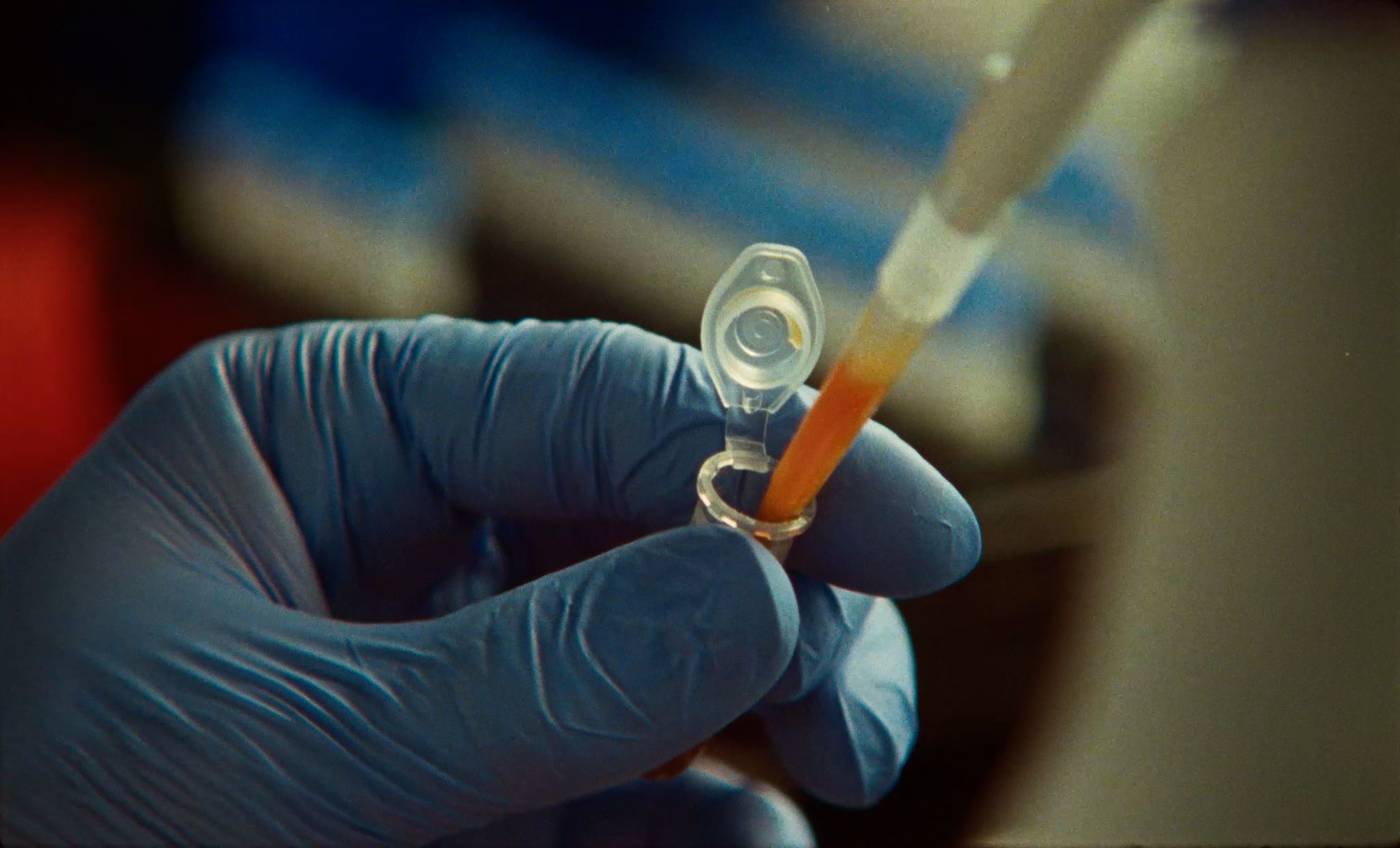
Anthropic published the first result from its new life sciences group, which has its own lab in the San Francisco Bay Area: about 950 Claude Code agents scanned over 200,000 reverse transcriptases from metagenomic databases in 21 hours and 210 million tokens, selecting 20 systems for lab validation. One agent noticed an array of evenly spaced DNA repeats and a partner gene near the enzyme gene — this is how the new ART (array-associated reverse transcriptases) family in giant bacteriophages was described. The structure of the finding resembles CRISPR arrays, but whether it functions as a programmable DNA manipulation mechanism is still unknown.
What happened
The result is presented as a 40-page preprint titled “Autonomous AI agents discover reverse transcriptases with tandem repeat arrays”; the authors include Peter H. Yoon, Januka S. Athukoralage, Emmanuel Ameisen, Eric Kauderer-Abrams, Nicholas T. Perry, and Matthew G. Durrant. The Claude Code agents worked with metagenomic databases built on 1.9 billion protein clusters: from over 200,000 reverse transcriptases — enzymes that copy RNA into DNA — they identified 3,500 candidates and narrowed the list to 20 systems sent for lab validation. The key finding was made by an agent that noticed an array of evenly spaced DNA repeats of blocks roughly 200 nucleotides long and an additional partner gene near the enzyme gene; this combination was described as the new ART (array-associated reverse transcriptases) family in giant bacteriophages, including Staphylococcus phages, where the array is actively expressed as individual short RNAs. Initial experiments showed only that different short RNAs are formed from the array. The search and analysis were performed by agents; the lab work was done by humans.
Context
Reverse transcriptases as a class of enzymes have been known for a long time, so the scientific novelty of the work is not in the enzyme itself, but in describing the combination of “enzyme, repeat array, and partner gene” as a separate ART family. The analogy with CRISPR arose from the array structure: CRISPR arrays function as a “card catalog” of short RNAs, making the CRISPR-Cas system programmable. Fundamentally, classic genomic mining pipelines only find what is predefined by a set of features, whereas here the agent noticed atypical repeats outside these features and prepared a report for a human. Feng Zhang of MIT and the Broad Institute, one of the CRISPR pioneers, after reviewing the preprint called the work an “exciting example” of AI agents’ contribution to biological discoveries. For Anthropic, this is simultaneously a claim to its own place in biotech: the new life sciences group received its own lab, working only with BSL-1/BSL-2 and without human pathogens.
Why this matters for the industry
The main point for the industry is not the enzyme, but the economics of the loop: analysis that would take an expert weeks or months of manual curation was performed by agents in 21 hours, and lab validation was done by humans. The loop itself is built from tools available to any scientist — public Claude Code and Claude Science, so a team with API access can already today replicate an analogous agent scan with report generation for humans on their own data. The same template transfers to adjacent domains: materials science, target discovery, patent prior art, literature screening. The expected market reaction is a wave of replications on metagenomic and other scientific corpora, work on standardizing evals for “discoveries,” and orchestrator services that take a public dataset and return a validated list of candidates with a report; Anthropic’s creation of a separate life sciences group with its own lab indicates that a lab partner is becoming part of such products.
Why this matters for users
For the reader, it is important that the methodology is open: the Anthropic post and preprint are available, including the selection funnel and agent prompts, so conclusions can be verified from primary sources without access to closed data. If ART repeats function like CRISPR arrays, this is potentially a new programmable mechanism for DNA manipulation, but for now this is only a hypothesis, and no ready-made product exists on the market. Teams with API access can already today build a similar agent funnel for their own tasks, and for the average reader this news is primarily about a new working way to make scientific discoveries, not about an available gene-editing technology.
What is still unknown / limitations
The enzyme itself — reverse transcriptase — was known previously, so the framing of “Claude discovered an enzyme system” as a fully autonomous discovery requires a caveat: what is new here is the description of the combination of “enzyme, repeat array of roughly 200 nucleotides, and partner gene” as the ART family. The selection criteria from 3,500 candidates to 20 systems remain a key methodological question, without which the selection effect and overestimation of the agent search’s success cannot be ruled out. The cost of launching, the frequency of false candidates, and the agents’ behavior during failures are not disclosed. The function of ART is unknown, and conclusions about possible genome editing in the sources are explicitly marked as a subject of future research. Feng Zhang’s assessment is a comment, not a review.
Sources
- Claude discovers a novel enzyme system — Anthropic
- Autonomous AI agents discover reverse transcriptases with tandem repeat arrays (Anthropic preprint, PDF)
Author
Look at AI, editorial team